
Span of Control Economics: Why Your Middle Management Layer Is Too Thick
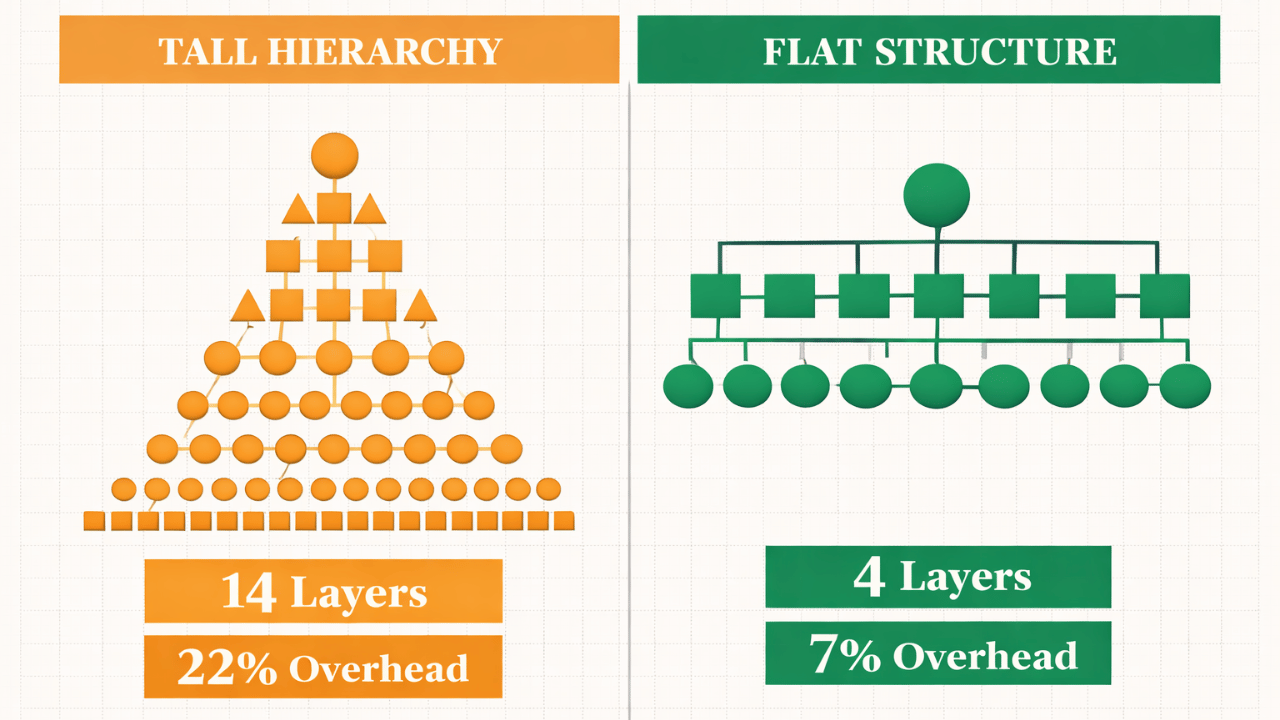
Your organization chart has fourteen management layers between frontline employees and the CEO. Each manager oversees six people. Decisions require four approval levels. Strategy set at the top takes six months to reach execution at the bottom. And everyone complains about moving too slowly.
This didn't happen by accident. It happened by arithmetic.
Organizations add management layers reactively, following a simple rule: when a team reaches ten people, promote someone to manage them. When you have six managers, create a director role to manage the managers. When you have five directors, add a VP. The logic seems sound; managers need manageable spans of control. But the cumulative effect is a tall, slow, expensive hierarchy where decisions die in endless approval chains and overhead costs consume twenty-five percent of payroll.
The assumption driving this expansion, that narrow spans of control improve management quality, is only sometimes true. Optimal span depends on task complexity, employee experience, coordination requirements, and manager capability. Sometimes the right answer is twenty direct reports. Sometimes it's five. The problem is that organizations default to narrow spans without considering context, creating middle management layers that add cost without adding value.
Let's examine the economics of span of control, when wide spans work better than narrow ones, and how to delayer organizations that have accumulated too many managers managing too few people.
The Trade-Offs of Narrow Versus Wide Spans
Span of control, the number of direct reports per manager, determines organizational height, managerial overhead, and decision speed. Narrow spans (five to seven reports) create tall hierarchies with many management layers. Wide spans (fifteen to twenty reports) create flat organizations with few layers. Each choice involves trade-offs.
Narrow spans allow managers to invest more time per direct report. With six people to manage, a manager can spend hours weekly coaching each person, reviewing work closely, and maintaining detailed awareness of individual progress. This intensive management benefits junior employees who need frequent feedback, employees working on complex problems requiring close collaboration, and situations where tight coordination across team members is critical.
The costs of narrow spans accumulate quickly. Every management layer adds fifteen to twenty-five percent overhead, the manager's salary plus benefits. A team of thirty-six engineers with narrow span of six requires six first-level managers, one second-level manager, and possibly one director. That's eight management positions supporting thirty-six ICs, overhead of twenty-two percent before accounting for coordination costs.
Each layer also adds communication lag. Information flowing from CEO to frontline employees passes through multiple filters, losing fidelity and speed at each step. Strategic direction set at the executive level gets translated, reinterpreted, and diluted through successive management layers before reaching execution. Feedback from frontline employees travels the reverse path, similarly degraded. Tall hierarchies create organizational telephone games where messages distort in transmission.
Decision latency compounds this. With multiple approval layers, decisions require sequential sign-offs from increasingly senior managers. A frontline employee requesting budget approval might need their manager's approval, then their manager's manager's approval, then possibly director or VP approval. Each step adds days or weeks. Decisions that should take hours instead take months.
Wide spans reduce these costs dramatically. Fewer managers mean lower overhead, faster decisions, and flatter communication paths. A team of forty engineers with spans of twenty requires two managers and one director. That's three management positions supporting forty ICs, overhead of seven percent. Information flows directly from executives to frontline managers with one intermediary layer. Decisions require fewer approvals and move faster.
The costs of wide spans appear in manager overload and reduced coaching. A manager with twenty direct reports cannot invest substantial time in each person's development. One-on-ones become infrequent. Performance feedback becomes cursory. Career development gets deprioritized. For experienced employees working independently, this is fine; they don't need intensive management. For junior employees or those facing complex challenges, insufficient management attention creates performance problems.
What Determines Optimal Span
The right span of control depends on five variables: task complexity, employee experience level, work interdependence, geographic distribution, and manager quality. Organizations that ignore these variables and default to uniform spans, every team has seven reports, waste money on unnecessary management or starve teams of needed leadership.
Task Complexity
Task complexity is the primary driver. Simple, repetitive work with clear processes can support wide spans. A customer service team handling standardized inquiries can operate effectively with fifteen to twenty reports per manager. Complex, ambiguous work requiring judgment and creativity needs narrower spans. A team of consultants working on custom strategy projects might need spans of five to eight to ensure adequate coaching and project oversight.
Employee Experience
Employee experience level matters enormously. Experienced professionals require less management intervention than junior employees. Senior software engineers working independently can operate well in spans of fifteen to twenty. New graduates learning their craft need closer management, suggesting spans of six to ten. Organizations should vary span by team experience, not enforce uniform spans across experience levels.
Work Interdependence
Work interdependence determines coordination requirements. If team members work independently on separate projects, coordination needs are low and wide spans work well. If team members must collaborate intensively, sharing context and coordinating decisions, narrower spans allow managers to facilitate coordination more effectively. Sales teams with independent territories can support wide spans. Product development teams with high interdependence need narrower spans.
Geographic Distribution
Geographic distribution affects span through limitations on management visibility. Remote work reduces opportunities for informal observation and spontaneous coaching. Managers can't see who's struggling, who's overworked, or who's disengaged. This suggests wider spans for remote teams, micromanagement becomes impossible anyway, but also requires employees who need less intensive management. Organizations attempting narrow spans with remote teams often fail because managers can't effectively support many geographically distributed reports.
Manager Quality
Manager quality is the variable organizations neglect most. Excellent managers can handle wider spans through better delegation, clearer communication, and more efficient use of time. Weak managers struggle with narrow spans because they lack capability to develop people, prioritize effectively, or make decisions efficiently. Widening spans for great managers and narrowing them for weak managers would optimize organizational performance. Instead, organizations enforce uniform spans, preventing great managers from increasing their impact and protecting weak managers from exposure.
The Cost of Too Many Layers
Organizations accumulate management layers gradually, adding positions as teams grow without ever removing them as needs change. The result is middle management proliferation, layers of managers whose primary function is managing other managers, with minimal value-add between each level.
Consider a technology company with four hundred employees. A rational organization structure might be: forty IC teams of ten people, four managers per team (spans of ten), four directors managing ten managers each (spans of ten), one VP managing the four directors (span of four), and one CEO. That's fifty management positions supporting four hundred ICs, twelve percent overhead.
The actual structure often looks different: forty IC teams of six people (narrower spans), sixty-seven managers, thirteen directors managing five managers each, four VPs managing three directors each, two SVPs managing two VPs each, and one CEO. That's eighty-seven management positions supporting four hundred ICs, twenty-two percent overhead. The organization added thirty-seven managers and five management layers without adding value, just cost and decision latency.
Each unnecessary layer costs money directly through salaries and indirectly through slower decisions and reduced accountability. A director managing directors who manage managers who manage IC teams sits three layers from actual work. Information reaching her is filtered three times. Her decisions take weeks to reach execution. Her ability to assess team performance is limited to reports from subordinates who are themselves distant from the work. She's expensive overhead without clear value creation.
The political economy of organizations makes delayering difficult. Managers resist losing status and compensation that come with managing managers. Directors don't volunteer to become senior managers. VPs don't suggest eliminating their own layer. Organizations preserve layers through inertia, even when those layers no longer serve purpose.
When Companies Default to the Wrong Span
Organizations make systematic errors in setting span of control, usually erring toward spans that are too narrow. The default assumption, that managers can only effectively oversee seven reports, persists regardless of context. This creates several predictable pathologies.
Reactive layer addition is the most common. A team grows from eight to twelve people. HR policy says managers can't effectively manage more than ten reports. Therefore, the solution is promoting someone to manage half the team, creating two teams of six with two managers. The organization just added management overhead without asking whether twelve reports was actually unmanageable or whether the team even needed separate management.
This pattern repeats at every level. Six managers report to a director. The team adds three more managers. Rather than the director managing nine people, entirely reasonable for managers who themselves are experienced, the organization promotes a second director, creates a VP role to manage the two directors, and adds two layers where one wide span would have sufficed.
Organizations also add managers to work around bad managers. A weak manager struggles with eight direct reports, so the organization reduces her span to six, moving two people to another team. This addresses the symptom while preserving the problem. The right solution is improving manager quality or replacing the manager, not protecting weak management through narrow spans.
Promotion opportunities drive layer creation as well. High performers want advancement. If advancement requires management roles, organizations create management positions to retain talent, even when those positions add no value. A senior IC becomes a manager of two people not because management is needed but because she deserves promotion. The organization accumulates managers managing tiny teams because it lacks credible IC advancement paths.
Delayering Strategies That Work
Removing unnecessary management layers requires brutal honesty about value creation. Some managers add clear value through coaching, direction-setting, and decision-making. Others are administrative intermediaries forwarding emails and scheduling meetings. Organizations must identify which is which and remove the latter.
The framework for evaluation is simple: What would break if this management layer disappeared? If the answer is "nothing, the team would report to the next level up," the layer is overhead. If the answer is "team performance would decline because they need the coaching, coordination, and decision support this manager provides," the layer is valuable.
Delayering starts by widening spans for experienced, independent teams. If a manager oversees seven senior consultants who work autonomously on client projects, widening the span to twelve or fifteen changes little. The senior consultants need minimal day-to-day management. Weekly check-ins and quarterly development conversations suffice. The manager can handle additional reports without degrading quality. This eliminates the need for a second management position when the team grows.
Organizations should remove management layers by consolidating reporting relationships upward. Instead of managers managing managers managing teams, skip the intermediate layer. Five team managers report directly to a director instead of to two senior managers who report to the director. This removes two positions and one layer without changing team-level management. The director now has a wider span, ten instead of two, but if those ten managers are competent and experienced, the wider span is manageable.
The politics of delayering require care. Removing someone's management role feels like demotion even if it's framed as organizational restructuring. Organizations should offer affected managers credible alternatives: senior IC roles, different management positions, project leadership opportunities. Some managers will leave rather than accept perceived demotion. That's acceptable cost if the alternative is maintaining expensive, low-value layers.
Training managers to handle wider spans supports delayering. Great managers can oversee fifteen to twenty reports through effective delegation, clear communication, and disciplined prioritization. Weak managers struggle with eight reports because they micromanage, communicate poorly, and fail to develop people. Management training that actually improves capability, not generic leadership programs but specific skill-building in delegation, feedback, and strategic thinking, enables wider spans without quality loss.
The Manager-of-Managers Question
The inflection point for organizational design is when you have forty to fifty people in a function. Below that threshold, flat structures work well: one manager overseeing the entire team, or two managers with the function head managing both. Above that threshold, you need to decide whether to create a layer of managers managing managers or to accept very wide spans at the top.
The case for adding a management layer is specialization and bandwidth. A VP managing forty people directly cannot provide adequate attention to each manager. Strategic planning, performance management, hiring decisions, and organizational development all suffer when spans exceed twenty. Creating two directors, each managing twenty people, with the VP managing the two directors reduces span at each level.
The case against adding a layer is cost and latency. Two additional director positions cost $400,000 annually. Decisions take longer with an extra approval layer. Information quality degrades through additional filtering. For many organizations, the VP managing twenty experienced managers directly delivers better results than adding directorial intermediaries.
The decision depends on manager quality and team maturity. If the twenty managers are excellent and experienced, the VP can handle the wide span through efficient management practices and minimal hand-holding. If the managers are developing or struggling, narrower spans and an intermediate layer provide needed support. Organizations should experiment: try the wide span first, add layers only when clear evidence shows the VP is overwhelmed and management quality suffers.
Accepting Some Manager Overload for Speed
The final consideration is that optimal span might deliberately overload managers in exchange for organizational speed and flat structure. A manager with fifteen reports has less time for coaching and development than a manager with seven reports. This is acceptable if the team consists of experienced people who don't need intensive management and if organizational speed matters more than individual development.
Technology startups often operate this way intentionally. Managers have very wide spans, sometimes twenty-five or more reports. Management quality is lower than it would be with narrow spans. Individual development suffers. But the organization moves fast, makes decisions quickly, and avoids bureaucratic layering. For companies where speed is existential, this trade-off makes sense.
Established companies rarely make this choice explicitly. They inherit narrow spans from periods when growth allowed adding management freely, then preserve those spans through organizational inertia. The result is slow, expensive hierarchy optimized for intensive management that most employees don't need.
The optimal organization structure varies by context - industry, growth stage, competitive dynamics, talent quality. The mistake is assuming one structure works everywhere or that current structure is optimal because it's current. Span of control is a choice with profound economic implications. Organizations that make that choice deliberately, based on actual needs rather than default assumptions, can reduce overhead by ten to fifteen percent while improving decision speed and organizational agility. That's worth the discomfort of delayering.
Part of the Leadership Frameworks series examining strategic decisions about leadership selection, development, and organizational design.