
The Decision Rights Tax
Careful decisions are not slow decisions. Fast decisions are nearly twice as likely to be good ones — and the escalation reflex most companies treat as prudent governance is the most reliable source of decision-quality decay in the modern corporation.
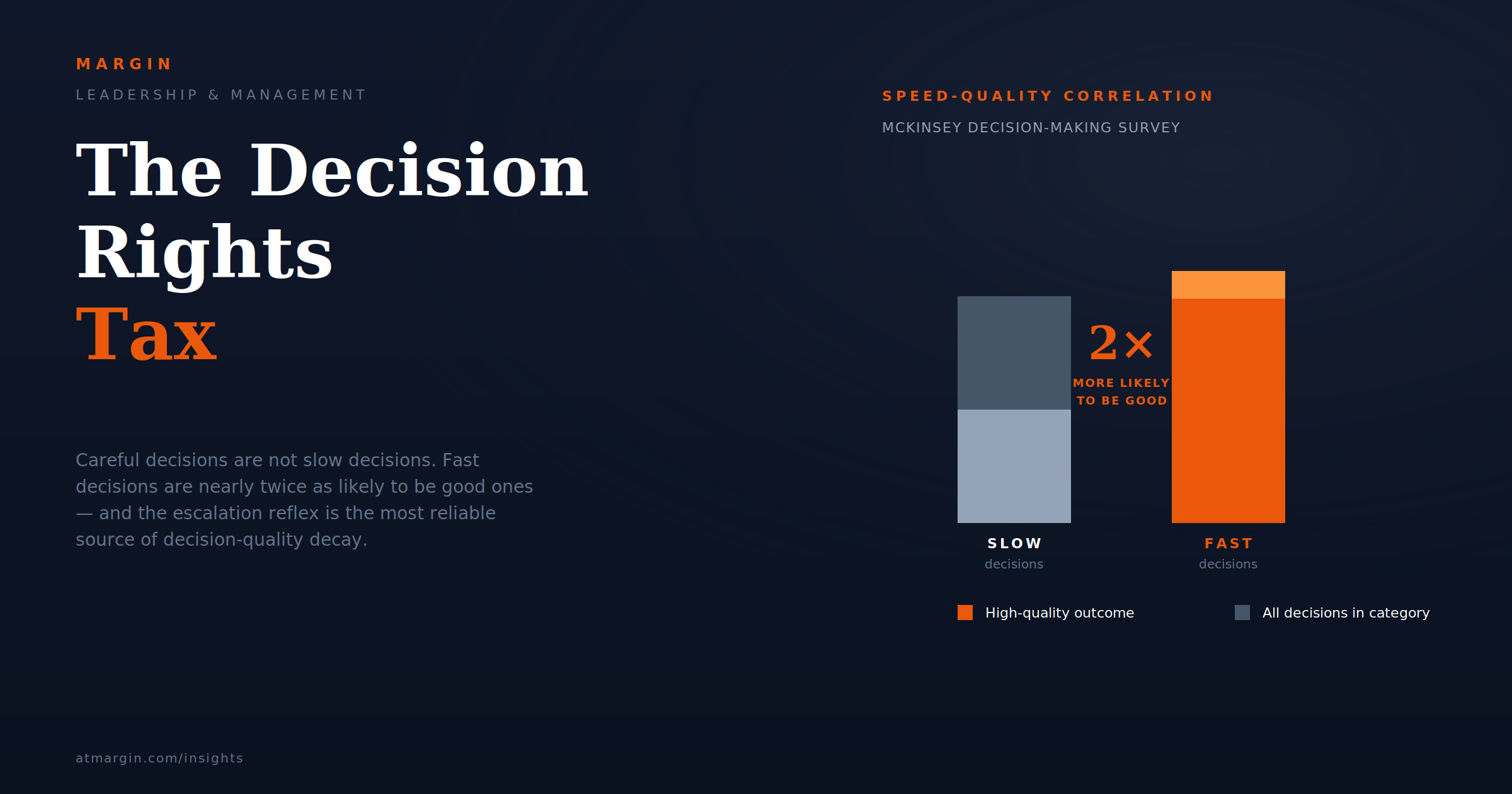
In a McKinsey survey of senior executives across industries, eighty percent of organizations reported struggling with decision-making. Seventy-two percent of senior leaders said bad strategic decisions in their organizations were either about as common as good ones or the prevailing norm.
A separate finding from the same body of work: fast decisions correlate with good decisions. Respondents who reported decision-making was fast were nearly twice as likely to also report that the decisions were of high quality.
The conventional executive intuition — that careful decisions are good decisions, and careful means slow — is, by the data, approximately wrong. Slow decisions are usually slow because they are escalating through too many layers, not because they are receiving more thought; and the additional layers degrade quality rather than improving it.
The cost of the congestion has a name worth using: the decision rights tax. It is paid in delayed decisions, escalation cycles, and senior executive hours absorbed by calls that should be made two or three layers below.
It compounds across the year as a series of separate friction points — a hiring decision that took six weeks to close, a compensation adjustment that required four levels of approval, a structural change to a team that sat on a CEO's desk for two months because the senior vice president was uncertain whether they had authority to make it.
Almost no organization tracks the tax. Almost every organization pays it.
The conventional view treats decision rights as either obvious or unimportant. Obvious because the organizational chart implies authority — a vice president can decide what a vice president decides. Unimportant because, when ambiguity arises, escalation is treated as good governance rather than as a friction cost.
Both views are wrong in ways that shape operational performance more than most CFOs recognize. Decision rights are rarely obvious; the chart implies more than it specifies.
Escalation is rarely good governance; the McKinsey data on speed-quality correlation directly contradicts the assumption that more layers produce better outcomes. The structural problem is that decision rights are a system, not a list, and the system at most companies has been allowed to drift into ambiguity that the chart obscures.
Where the Tax Accumulates
The tax accumulates most heavily in four decision categories that recur across every operating unit: hiring, firing, compensation, and structure. Each category has the same pattern. The manager has nominal authority. The actual exercise of that authority is gated by approvals, reviews, and escalation triggers that consume more time and senior attention than the underlying decision warrants.
Hiring
Hiring authority is the most-discussed and least-clarified of the four. A manager is typically authorized to "make a hire" — meaning they conduct interviews and select a finalist. They are typically not authorized to set compensation, finalize the title, structure the offer, or close. Each of those steps requires HR, comp committee, or higher-level approval.
The result is that every hire passes through three to five separate decision points, with the manager nominally in charge but materially dependent on a series of approvals that can each delay the offer by days. McKinsey researchers describe a chemicals company CEO who found himself making hiring decisions four organizational levels below his own, not because he wanted to but because no one in the chain between him and the hiring manager felt authorized to close.
Time-to-fill bloats; the manager's relationship with candidates degrades because of the latency; senior executive hours disappear into hiring approvals that the senior executive almost never has more context for than the hiring manager does.
Firing
Firing authority is the least-discussed and most-consequential. A manager who has identified a sustained underperformer typically does not have clear unilateral authority to terminate. The path runs through HR, legal, and at least one level of management above the manager — sometimes two.
The path is necessary; protections against arbitrary termination are reasonable. The path is also slow. The interval between the manager's recognition that a termination is warranted and the actual termination commonly runs three to nine months.
During that interval, the underperformer continues to work, the manager continues to manage them, and the team that depends on them continues to absorb the underperformance. The tax here is not the executive time required to approve the termination. It is the months of degraded team output and the morale cost on the high performers who watch the underperformer continue without consequence.
Compensation
Compensation authority is the most-frequently litigated. Off-cycle adjustments, retention conversations, equity remediations — every one of these requires multiple approvals at most companies. The manager who recognizes a pay equity gap on her team has to escalate the correction. The manager who wants to retain a flight risk has to escalate the conversation. The manager who needs to recalibrate a band against a market shift has to escalate the analysis.
Each escalation costs days or weeks. Each escalation also pulls the decision out of the manager's hands and into the hands of someone with less context — typically an HR business partner and a finance approver who are reviewing comp decisions across dozens of similar requests, by definition without time to evaluate any one of them deeply.
Org Structure
Structural authority is the most-invisible. A manager who recognizes that two roles need to be combined, that a reporting line is misaligned, or that the team's structure is impeding output typically does not have unilateral authority to redesign. The redesign requires approval from above and often coordination with HR, finance, and adjacent functions. The path takes weeks if it goes well, months if it goes poorly, and never resolves at all in some meaningful share of cases.
Structural changes that are clearly correct sit in escalation queues for quarters; the team operates on the broken structure the entire time, and the manager who proposed the change loses credibility with their own report-outs each week the structure remains.
The four categories together describe most of what a manager actually does — hire, fire, pay, structure. A manager who lacks clear authority across all four is not, in any operational sense, managing. They are running an escalation pipeline that produces decisions only after passing through the senior layer that nominally delegated the work to them.
Why Escalation Is Not Good Governance
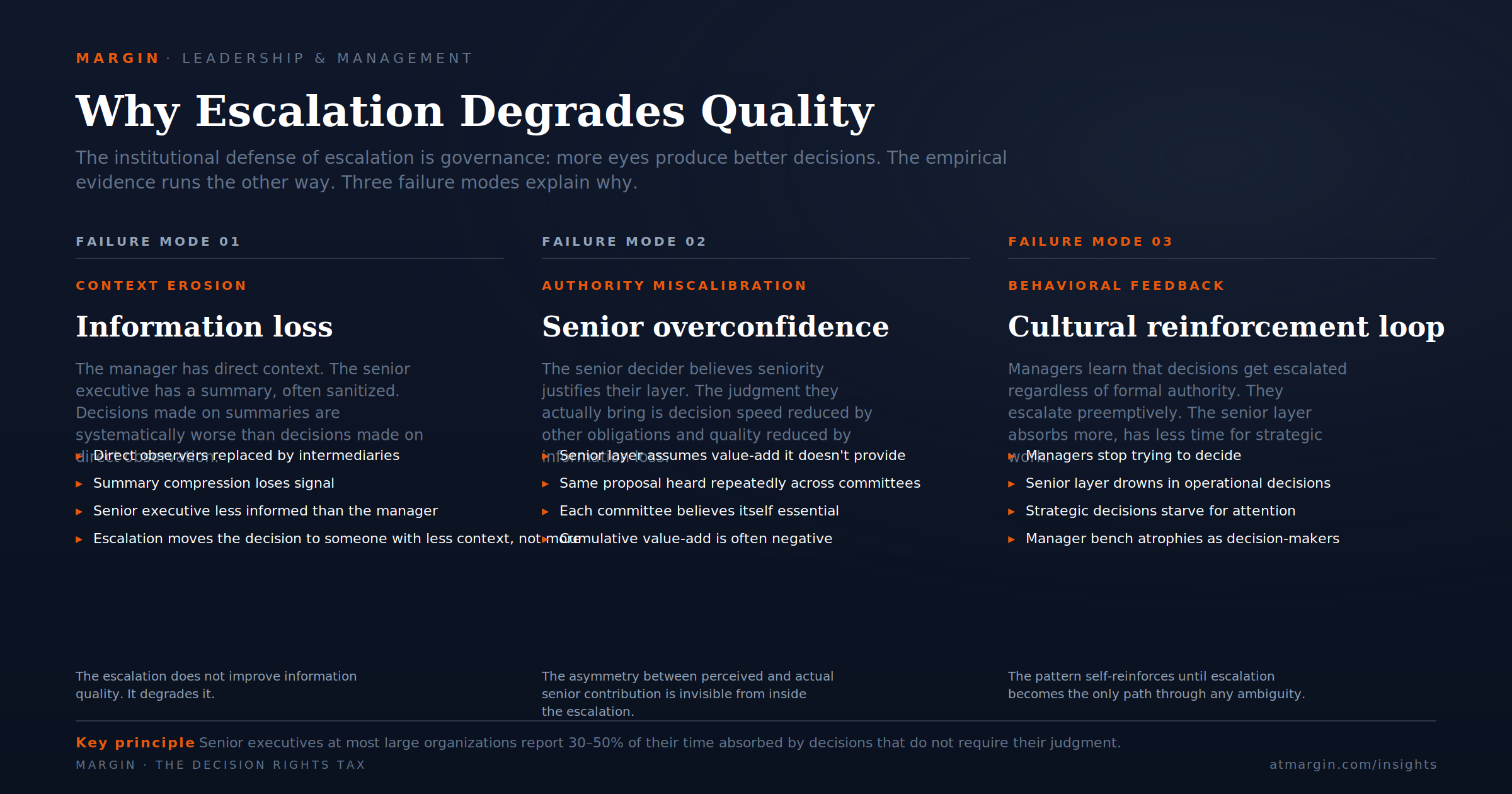
The institutional defense of escalation is governance: more eyes produce better decisions. The McKinsey data suggests this defense is empirically wrong on average. Across the survey base, the speed-quality correlation runs in the opposite direction from the intuition. Fast decisions are nearly twice as likely to be good decisions as slow ones. The mechanism is not that speed produces quality; it is that the conditions that produce slow decisions — multiple approval layers, ambiguous authority, escalation reflexes — are the same conditions that degrade decision quality.
“Slow decisions are usually slow because they are escalating through too many layers, not because they are receiving more thought — and the additional layers degrade quality rather than improving it.”
Several specific failure modes drive the negative correlation.
Information Loss
The first is information loss in the escalation. The manager has direct context on the team, the candidate, the underperformer, the market shift.
The senior executive escalated to has, at best, a summary of that context, often a sanitized one. Decisions made on summaries are systematically worse than decisions made on direct observation. Escalation does not move the decision to someone better-informed. It moves the decision to someone less-informed.
Overconfidence
The second is the overconfidence of the senior decider. An executive presented with an escalation often believes that their seniority itself justifies the additional layer — that they are bringing judgment the manager could not. The judgment they are actually bringing is decision speed reduced by their other obligations and decision quality reduced by the information loss.
The McKinsey researchers describe a healthcare executive who reported sitting through the same ninety-minute proposal three times across three separate committees because no one was authorized to approve. Each committee believed it was adding value. None of them was; the value was negative, accumulating in lost time across every member of every committee.
Cultural Reinforcement Loop
The third is the cultural reinforcement loop. When managers learn that decisions get escalated regardless of their formal authority, they stop trying to make decisions. They escalate preemptively.
The senior layer absorbs more decisions, has less time for the strategic decisions that genuinely require their attention, and produces decisions of degraded quality across the board. The managers atrophy as decision-makers; the executives drown in operational decisions; the strategic decisions that should be the executives' actual work get less attention than they need.
McKinsey researchers describe this pattern as "everybody gets a vote and the polls are always open" — the syndrome where the only path through organizational ambiguity is escalation, regardless of where the formal decision rights are supposed to sit.
A CEO at a healthcare network described the recognition:
"I did an audit of my own calendar for two weeks. Roughly forty percent of my meeting time was spent on operational decisions that should have been made by directors or vice presidents two and three levels below me. They were on my calendar because nobody in the chain felt authorized to close, or because I had a history of revisiting decisions made below me, which trained the chain to escalate. I was the bottleneck I had been complaining about. The hardest part was admitting it. The second-hardest part was actually delegating the decisions back, because the people I was delegating to had spent years learning that the safe move was to push the decision up to me."
The cumulative cost is structural, not anecdotal. Senior executives at most large organizations report spending thirty to fifty percent of their working hours on decisions that, on honest review, do not require their judgment. The decisions that do require their judgment — strategic positioning, capital allocation, organizational design, executive talent decisions — receive whatever time is left over.
The strategic deficit at most companies is not a deficit of executive intelligence. It is a deficit of executive time, produced by the operational decisions that have absorbed the time that should have been available for strategy.
Mapping the Decision Architecture
The corrective is to make the implicit explicit. Most companies have a formal organizational chart that implies authority allocation and an informal escalation pattern that overrides the implication. The corrective is a documented decision architecture that closes the gap.
The architecture identifies, for each significant decision category, four roles. Who decides — the single individual with final authority. Who recommends — the individual or group that brings the analysis to the deciders. Who must be consulted — the parties whose input is required because of expertise or implementation responsibility. Who must be informed — the parties who need to know the decision once it is made but do not have a vote.
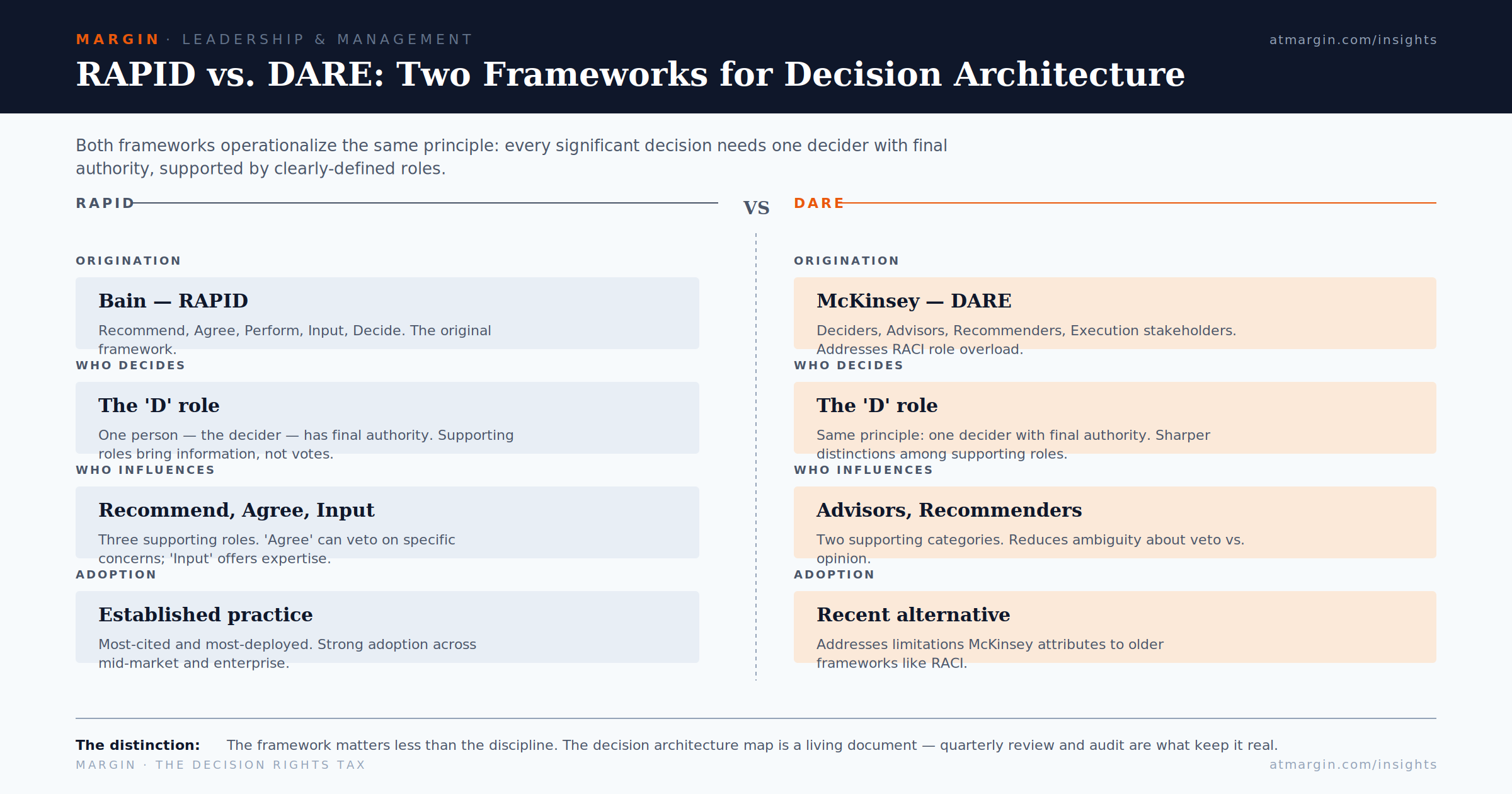
Several frameworks operationalize this. Bain's RAPID framework — Recommend, Agree, Perform, Input, Decide — is the most-cited. McKinsey's DARE framework — Deciders, Advisors, Recommenders, Execution stakeholders — addresses the limitations of the older RACI framework, which the McKinsey researchers argue tends to produce ambiguity rather than resolve it. The frameworks differ in detail. The principle they share is that every significant decision must have one decider — a single person with final authority — and that the supporting roles are voice, not vote.
The mapping process is itself revelatory. When organizations sit down to map their decisions against the framework, they consistently discover three things.
The first is that the formal authority documented in policy does not match the operating reality. People who have nominal authority don't exercise it; people who lack nominal authority effectively decide.
The second is that everyone in the chain has been carrying a different mental model of who decides. The CEO believes the COO decides; the COO believes the SVP decides; the SVP believes the VP decides; the VP believes the COO decides.
The third is that escalation has been accumulating not because the rights are unclear, but because the consequences of being wrong have been distributed unequally — managers below absorb the cost of being wrong; executives above absorb the political cost of being seen to delegate. The asymmetry produces the escalation pattern, regardless of what the policy documents say.
This is the decision architecture map: a documented, role-clear, threshold-explicit allocation of decision authority across the recurring decision categories that drive operational performance. The map is not a one-time deliverable; it is a living document that gets reviewed quarterly, updated as the organization changes, and used as the reference point when ambiguity arises about who decides.
The companies that have built such maps report measurable reductions in escalation volume, in time-to-decision on operational matters, and in senior executive hours absorbed by decisions below their level. They also report a one-time period of organizational discomfort while the new pattern beds in — the discomfort of executives no longer being asked to weigh in on decisions they had grown accustomed to weighing in on, and managers being asked to actually decide things they had grown accustomed to passing up.
What Honest Decision Rights Require
Adopting the decision architecture map requires four organizational changes most companies have not made.
The first is CEO commitment to actual delegation, not nominal delegation. Most CEOs say they delegate. The behavioral test is whether the CEO sends decisions back when they get escalated inappropriately, with explicit reminders that the decision belongs at a lower level, and whether the CEO refrains from second-guessing decisions made below them when those decisions fall within delegated authority.
Most CEOs fail the second test. They say they delegate, then revisit the decisions, which trains the chain to escalate preemptively. Genuine delegation requires CEO discipline against revisiting — accepting that some delegated decisions will be made differently than the CEO would have made them, and that the cost of accepting those differences is lower than the cost of training the organization to escalate.
The second is manager training in actual decision-making, not just in delegation. Many managers have spent years escalating because they were rewarded for escalating; they have under-developed judgment muscle. Building it requires deliberate practice — managers being given decisions to make, supported through the process, and not punished when their decisions are different than the senior executive's would have been. This is uncomfortable for organizations whose managers have been selected and promoted on the basis of their willingness to escalate.
The third is a cultural tolerance for the imperfect decisions that come with delegation. McKinsey researchers note that companies that punish mistakes train their organizations to escalate every decision; the asymmetry between the cost of being wrong (visible, punished) and the cost of escalating (distributed, unpunished) makes escalation the rational individual choice even when it is collectively destructive. Reversing the pattern requires explicit cultural work — leaders who publicly acknowledge that some delegated decisions will be wrong, who treat the wrong ones as learning rather than failure, and who hold the line against the escalation reflex even when a delegated decision goes badly.
The fourth is regular review of escalation patterns. The decision architecture map is not self-enforcing. It requires audit — a quarterly look at what decisions actually got escalated, why, and whether the pattern reveals authority gaps the map needs to address. If everything is escalating, the rights structure is broken regardless of what the map says. The audit is the feedback mechanism that keeps the map alive. Without it, the map calcifies into another document that doesn't describe what is actually happening.
These four changes do not eliminate escalation. Some decisions genuinely require senior judgment, and those decisions should escalate. What the changes eliminate is the share of escalation that exists because authority is ambiguous, the cost of being wrong is asymmetric, and the cultural pattern rewards passing decisions up. That share, in most companies, is the larger share — and removing it returns senior time, accelerates decisions, raises decision quality, and develops the manager bench whose absence is the single most consistent complaint executives make about their own organizations.
The Tax and the Choice
The companies that map their decision rights, enforce them, and audit the escalation patterns will have managers who manage and executives who lead. The companies that don't will keep paying the decision rights tax in senior hours, slow decisions of degraded quality, and the steady departure of the managers who recognize they have been hired to run a function they aren't actually allowed to run.