
Hiring for Potential vs. Experience: The Trade-off CFOs Aren't Modeling
Defaulting to experience as a proxy for future performance feels rigorous. The data suggests it often isn't — and the cost of that assumption compounds quietly across every senior hire.
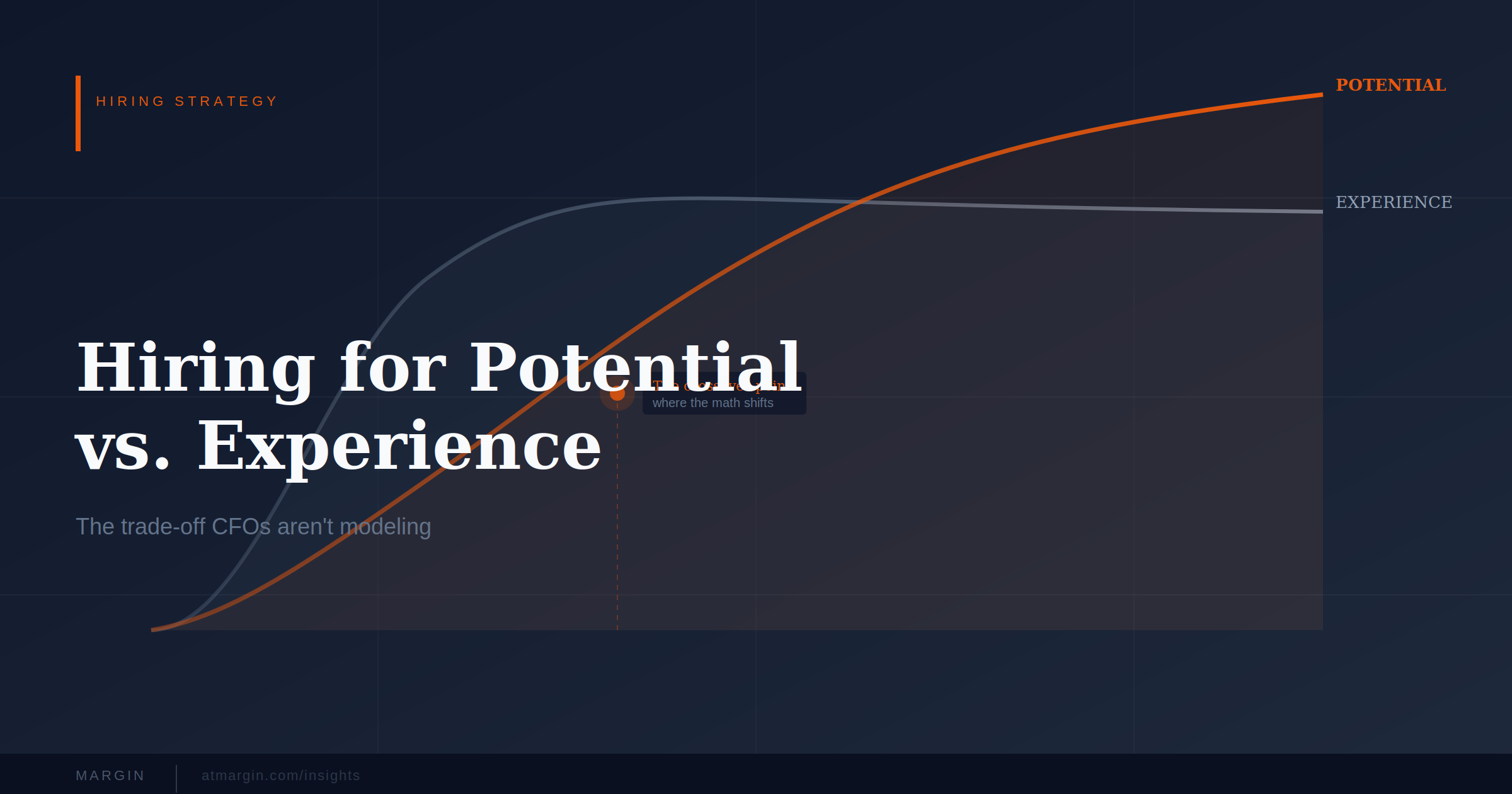
There is a number that finance leaders almost never calculate before making a hiring decision: the expected value of the candidate in front of them. Not their salary history, not their years of experience, not their last title — the probabilistic return on the capital about to be deployed to bring them into the organization and keep them there.
This is not an abstraction. Hiring is capital allocation. A senior hire represents a three-to-five year commitment of direct compensation, management bandwidth, organizational authority, and institutional knowledge investment. The decision to extend an offer at the executive level carries roughly the same financial weight as a mid-sized equipment purchase or a software contract that would require VP sign-off and a formal business case. And yet most organizations make that decision using a framework that would embarrass the finance team if applied to any other asset class: credential counting.
The conventional logic runs like this — experience is verifiable, track record is observable, and a candidate who has done the job before is less risky than one who hasn't. All of that is true, as far as it goes. The problem is that it stops short of the question that actually matters: risky compared to what? The relevant comparison is not experience versus no experience. It is the expected value of a proven hire at a premium versus a high-ceiling hire at a discount, modeled across a realistic tenure and accounting for the full cost of each scenario.
Most organizations skip that model entirely. The result is a systematic bias toward credentialism that is dressed up as quality control and rationalized as prudent risk management — when in many cases it is neither.
Why Experience Became the Default
The dominance of experience as a hiring criterion is not arbitrary. It has a coherent institutional logic, and understanding that logic is necessary to understand where it breaks down.
Experience is auditable. A candidate's prior titles, tenure, and employers can be verified. Their claimed accomplishments can be partially corroborated. This gives hiring managers something to point to when a decision is questioned — by a board, by a CEO, by HR — that feels defensible in a way that a bet on potential does not. Hiring for experience is, in organizational terms, a form of career insurance for the hiring manager. If the hire fails, the manager can demonstrate that they followed the conventional protocol. If they had hired for potential and the hire failed, the deviation from the norm becomes the story.
This is not cynicism — it is an accurate description of how incentive structures shape hiring decisions. Organizations rarely punish managers for making conventional hires that underperform. They do sometimes punish managers for making unconventional hires that underperform. The asymmetry pushes decision-makers toward credentialism regardless of whether it produces better outcomes.
Experience also travels well in committee environments. When five or six stakeholders are evaluating a candidate, the credential serves as a common currency — it is legible to everyone in the room, requires no interpretive framework, and reduces the friction of reaching consensus. Potential, by contrast, requires a shared model of what the role actually demands, what capabilities predict success in that context, and how to evaluate those capabilities in an interview process. Most hiring committees have no such model. Experience fills the vacuum.
The final piece is cognitive: experience provides a narrative. A candidate who has led a supply chain transformation at a comparable organization tells a story that hiring managers can follow. A candidate who has demonstrated all the capabilities required for that role but hasn't held the exact title yet tells a more complex story that requires the hiring manager to do interpretive work. Most people under time pressure and with competing priorities default to the simpler story.
Where the Logic Breaks Down
The experience premium has genuine value in roles where the work is highly technical, highly contextual, or where the learning curve carries real operational risk. A CFO at a pre-IPO company who has never navigated a public offering is a different risk profile than one who has done it twice. That specificity of prior experience is load-bearing in a way that can be quantified.
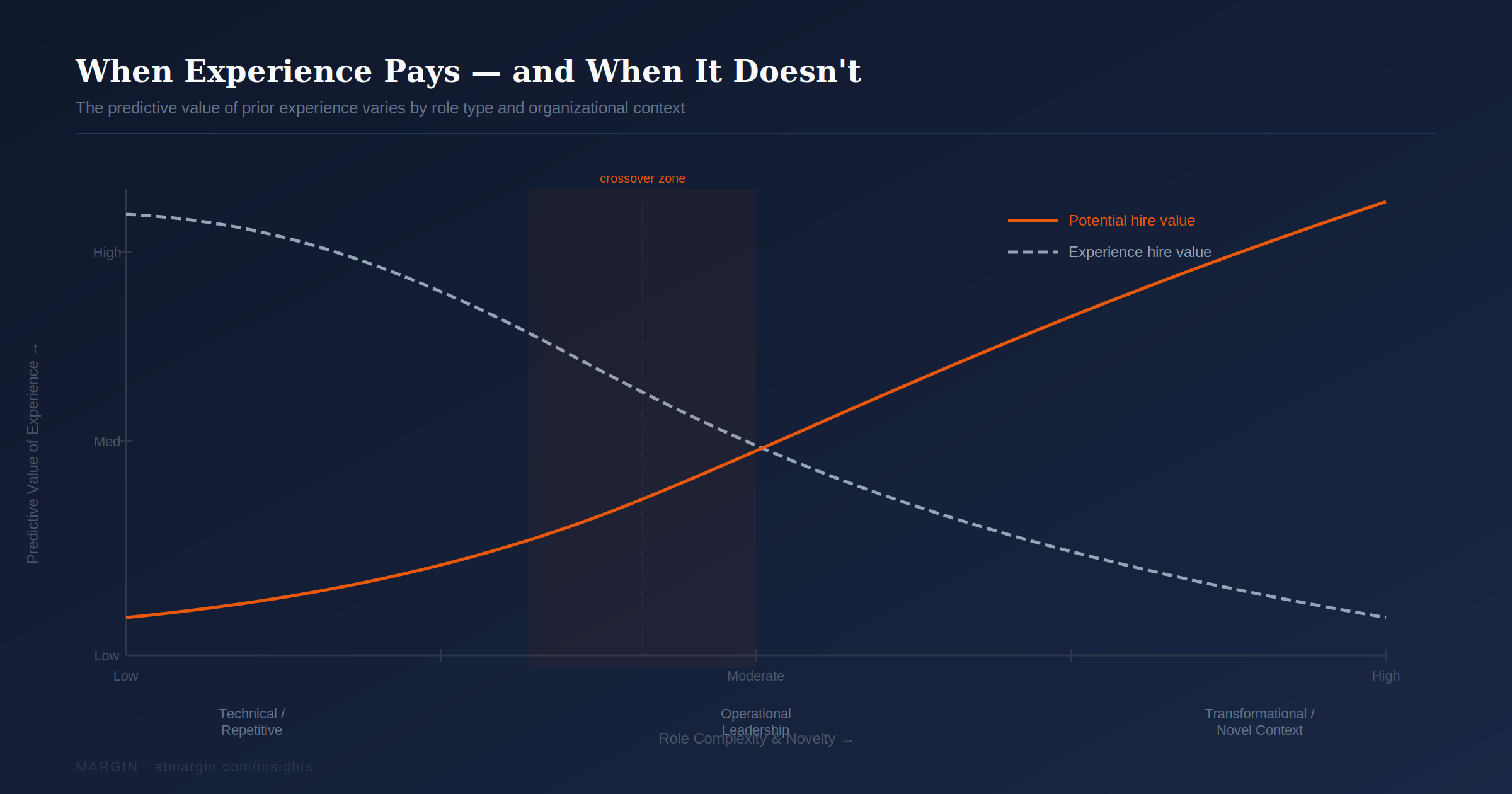
But for a significant class of senior roles, the predictive value of experience is weaker than hiring managers assume, and the research on this is relatively consistent. Meta-analyses of hiring validity consistently show that structured assessment of cognitive ability, learning agility, and behavioral competencies outperforms experience-based screening as a predictor of job performance — particularly in roles that involve novel problem-solving, ambiguous mandates, or significant organizational change. The higher the complexity and novelty of the role, the less prior experience in a comparable role predicts success in this one.
This is not counterintuitive once you reason through it. Experience predicts performance when the new environment closely resembles the prior one. When an organization is hiring for a role because something needs to change — because the prior approach wasn't working, because the business context has shifted, because the function needs to be rebuilt — the candidate who excels in that familiar environment may be precisely wrong for the new one. Their experience is in optimizing a system that the organization is trying to replace.
There is also a ceiling problem. Experienced candidates, by definition, have already developed their operating model. Their management style, their strategic instincts, their tolerance for ambiguity and risk — these are largely formed. Organizations that hire for experience are acquiring a finished product. They are paying for what was built, with limited ability to influence what comes next. High-potential candidates with a shorter track record represent a different value proposition: a higher ceiling at a lower acquisition cost, with more organizational influence over how that ceiling is reached.
The math on this is worth making explicit. If an experienced candidate commands a $50,000 salary premium over a high-potential candidate, and the organization's realistic timeline for determining fit is 18 months, the experience premium costs roughly $75,000 over that period before accounting for benefits and total compensation loading. If the experienced candidate performs at 90% of expectation and the high-potential candidate performs at 85% of expectation, the experienced hire looks slightly better. But if the high-potential candidate performs at 95% — which a well-selected, well-onboarded candidate often does, precisely because they are not carrying the operating assumptions of their prior environment — the calculus flips. The organization paid a $75,000 premium for worse outcomes.
Building the Model
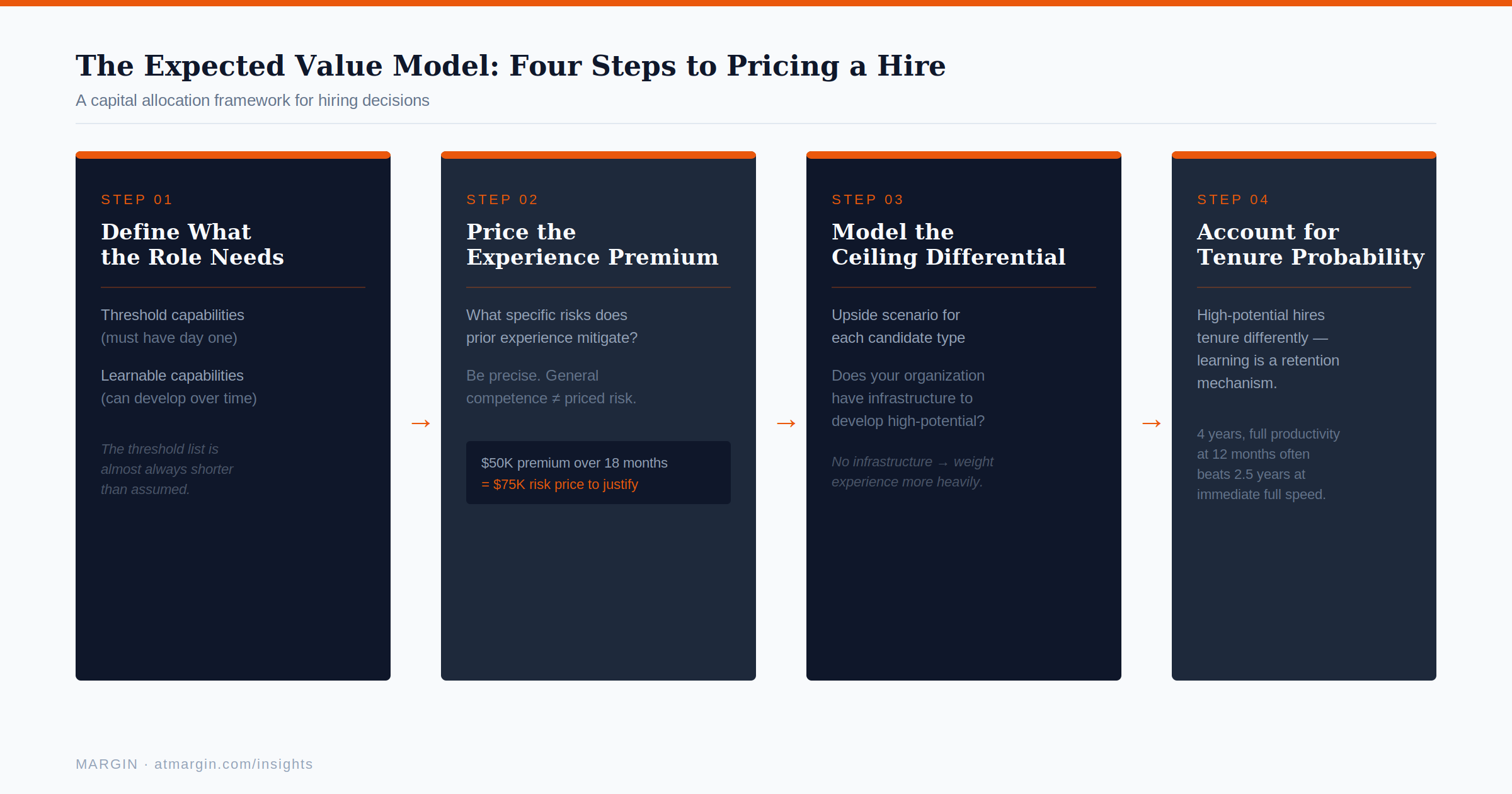
The practical problem is that most organizations have no framework for evaluating this trade-off systematically. Here is one that works.
Step one: Define what the role actually requires.
“The credential they are paying a premium for may not be the variable that predicts the outcome they need.”
Not the requirements list from the job description — that, as examined elsewhere in these pages, is typically an aggregation of preferences rather than a performance specification.
The relevant question is: what capabilities predict success in this specific role, in this specific organizational context, over the next three years? Break those capabilities into two categories: threshold capabilities (things the hire must have on day one to avoid operational failure) and learnable capabilities (things a high-ceiling candidate can develop within a defined timeline with appropriate support). The threshold list is almost always shorter than organizations assume.
Step two: Assign a risk-adjusted value to the experience premium.
What specific risks does prior experience in this role actually mitigate? Be precise. "Knows how to run a finance function" is not a risk — any competent Director of Finance candidate knows how to run a finance function. "Has navigated a debt covenant renegotiation under liquidity pressure" is a risk, if that scenario is realistic in your organization's next 24 months. Price the experience premium against the actual risk it mitigates, not the general category of competence it represents.
Step three: Model the ceiling differential.
What is the upside scenario for the high-potential candidate versus the experienced candidate, and what is the probability weight on each scenario? This requires honest assessment of your organization's ability to develop talent — specifically, whether you have the onboarding infrastructure, the managerial bandwidth, and the institutional patience to develop a high-ceiling hire.
Organizations that lack that infrastructure should weight toward experience, not because experience is inherently better but because their environment will underperform a high-potential candidate. Organizations with strong development infrastructure should weight potential more heavily.
Step four: Account for tenure probability.
Experienced hires from comparable organizations are often closer to the end of their growth trajectory than the beginning. They have learned what they came to learn, and their departure timeline is governed by external opportunity more than internal engagement.
High-potential candidates who are growing into a role have a different tenure profile — the learning itself is a retention mechanism. When calculating the expected value of either hire, tenure assumptions are not cosmetic. A high-potential hire who stays four years and reaches full productivity within 12 months often represents more accumulated organizational value than an experienced hire who performs well for 24 months and then begins looking for the next step.
What Good Selection Infrastructure Looks Like
None of this analysis is useful without an interview process capable of distinguishing potential from credential. Most organizations lack one.
Structured Behavioral Interviews
Structured behavioral interviewing anchored to capability definitions — not credential verification — is the foundation. The questions are not "have you done this before" but "walk me through how you approached this type of problem, what you decided, and what you'd do differently." The latter question is particularly revealing: candidates with genuine learning agility have a ready answer. Candidates who are relying on credential rather than capability often struggle to identify what they'd change about prior decisions.
Learning Agility Evaluations
Cognitive assessment and learning agility evaluation, administered professionally and benchmarked against the role's complexity level, add signal that interviews alone cannot provide. This is not about IQ — it is about how quickly a candidate absorbs new information, how they update their mental models under novel conditions, and how they perform when prior experience is not load-bearing. These are measurable, and organizations that measure them make better hiring decisions.
References
Reference architecture matters too. The backchannel reference — discussed in depth elsewhere in this issue — is where the potential question is most clearly answered. What people who managed or were managed by a candidate say about how they developed, how they handled environments they hadn't seen before, how they responded to failure, tells the organization more about ceiling and trajectory than any credential on a resume.
Honesty
The final element is organizational honesty about what the role is actually asking. If the honest answer is that you need someone who has done this exact thing before because you have no margin for a learning curve and no infrastructure to support development, hire for experience. That is a legitimate conclusion from a rigorous analysis.
What is not legitimate — and what most organizations are actually doing — is defaulting to experience without running the analysis, without modeling the trade-off, and without acknowledging that the credential they are paying a premium for may not be the variable that predicts the outcome they need.