
The Reference Check You're Not Doing
The references a candidate submits tell you what they want you to know. The ones they don't submit tell you what you need to know.
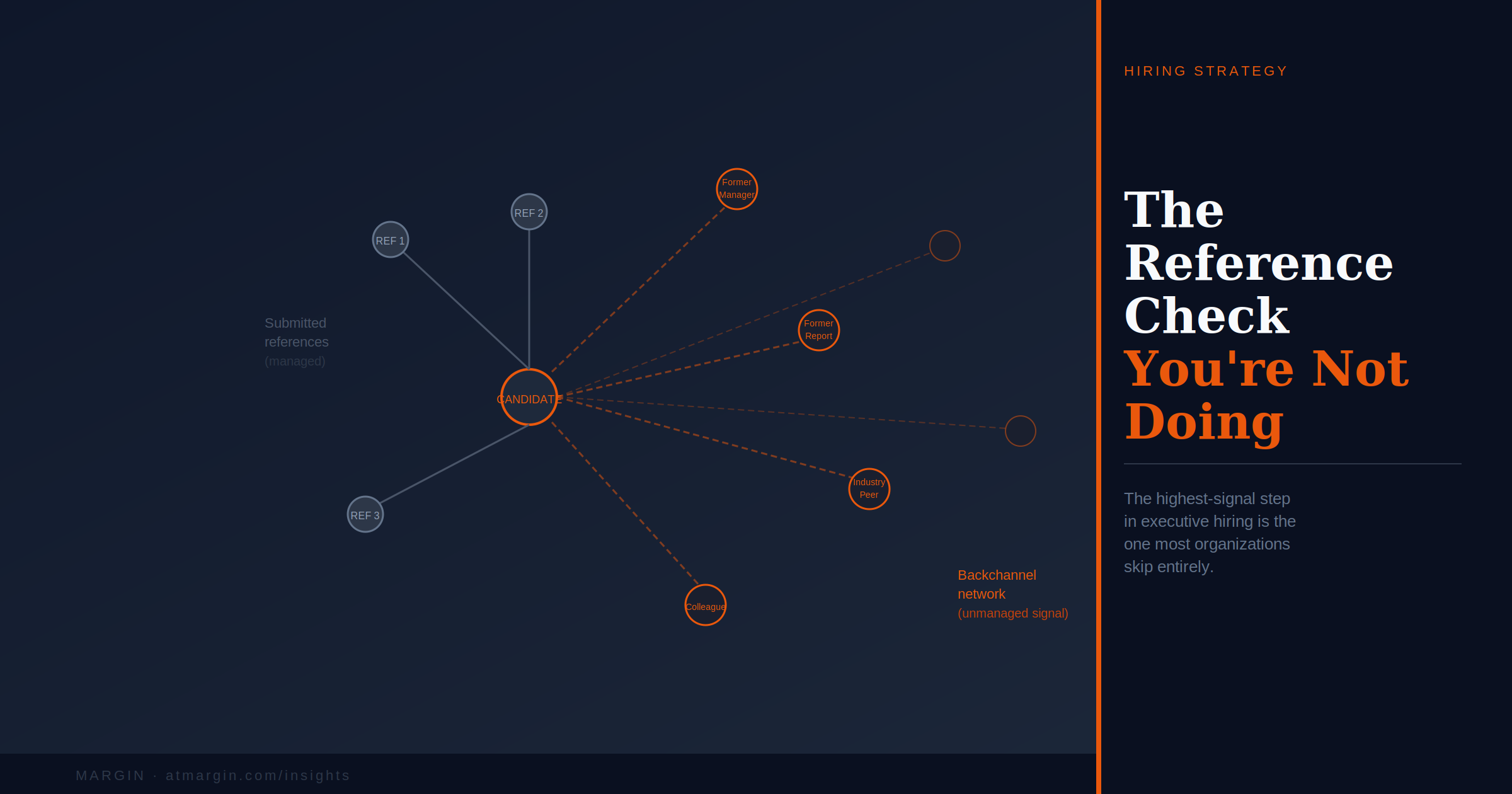
At some point in the last two decades, the formal reference check became a formality. Candidates submit three names. HR contacts them, works through a standard list of questions, documents the responses, and files them in the applicant tracking system. The hiring manager almost never reads them. The exercise consumes perhaps two hours of organizational time and produces almost no decision-relevant information. Everyone involved understands this, and everyone continues doing it anyway.
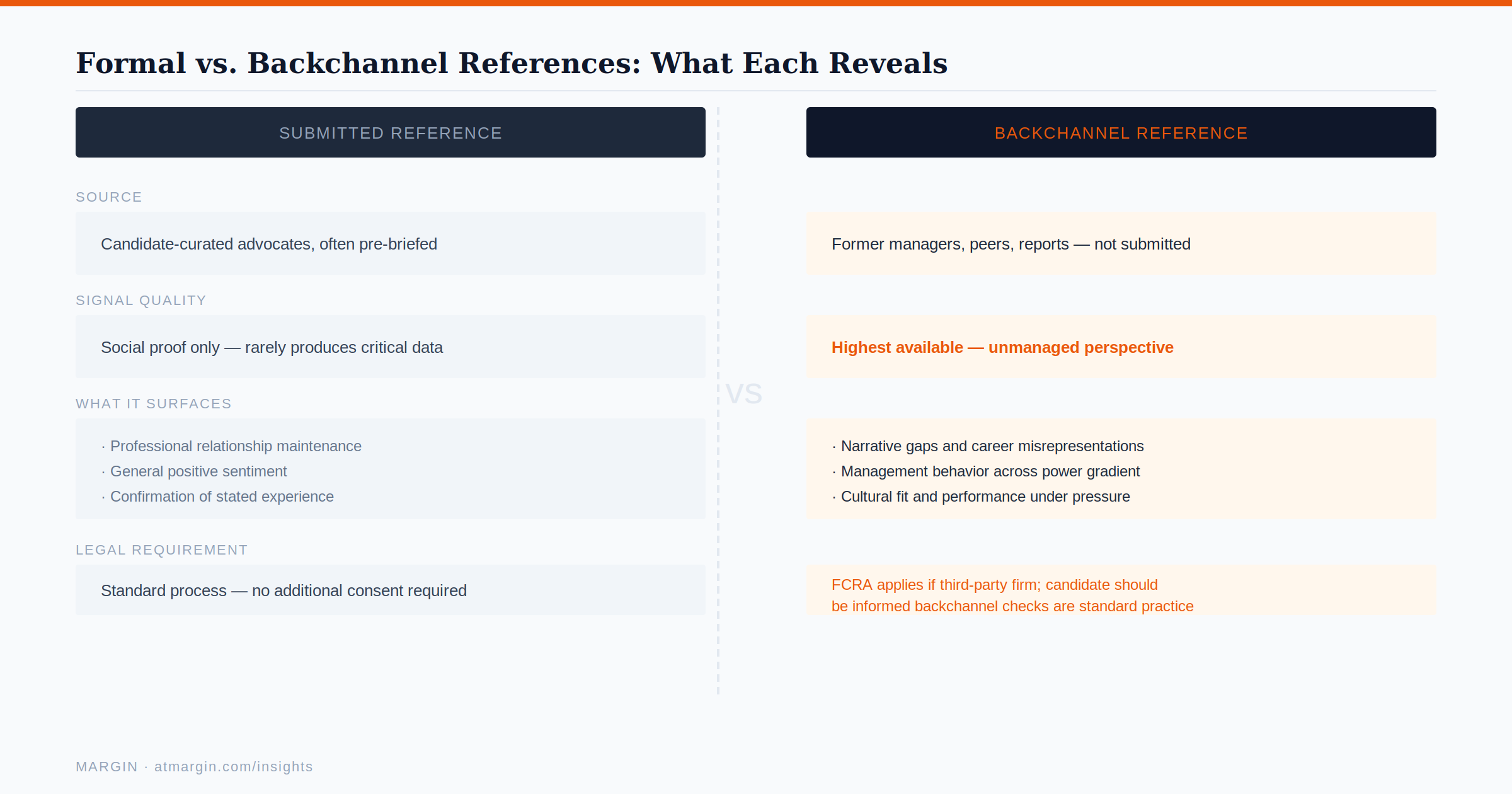
The reason it produces nothing is structural: candidates select for references they have prepared. A professional who has been in the workforce for fifteen years knows exactly which former colleagues will speak well of them and which conversations they'd prefer a prospective employer never have. The submitted reference list is not a panel of neutral observers — it is a curated set of advocates who have, in many cases, been briefed on what to say. Treating this as due diligence is not just inefficient. It creates false confidence — the sensation of having validated a hire that has not actually been validated.
The alternative is the backchannel reference: the deliberate effort to identify and speak with people who know the candidate's work, whom the candidate did not submit, and whose perspective has not been managed. Done rigorously and ethically, the backchannel reference is among the single highest-signal steps available in the executive hiring process. It is also the step that most organizations skip entirely — because it requires effort, because it can feel uncomfortable, and because most hiring managers have never been taught to do it.
What Formal References Actually Reveal
Before dismissing formal references entirely, it is worth being precise about what they do and don't tell you. They are not completely without value. A formal reference who is clearly unenthusiastic — who gives short, careful answers, qualifies praise, or declines to speak to specific capabilities — is telling you something important through the texture of their response rather than its content.
Absence of strong advocacy is data. The reference who says "she was very professional and met her deadlines" when asked to describe a candidate's greatest leadership strength is not giving you a positive reference. Most hiring managers miss this because they are listening for what is said rather than what isn't.
But the ceiling on formal references is low. A prepared reference will almost never volunteer critical information, will deflect or reframe negative questions, and will rarely provide the specific behavioral detail that would allow a hiring team to accurately predict future performance. What you are getting, at best, is a social proof signal that the candidate has maintained professional relationships — useful, but nowhere near sufficient for a hire that will cost the organization several hundred thousand dollars and occupy a seat with real organizational authority.
The categories of information that formal references structurally cannot provide are the ones that matter most at the executive level: how the candidate behaves under pressure, what happens when their judgment is challenged, how they manage people who push back, what they left undone or mishandled in prior roles, and whether the narrative they've constructed about their career reflects what actually happened. These are not things a prepared advocate will tell you. They require sources who weren't prepared.
The Legal and Ethical Framework
This is not a minor consideration, and any organization building a backchannel reference practice should understand both the legal landscape and the ethical constraints before treating it as procedural detail.
The Legal Picture
“The submitted reference list is not a panel of neutral observers — it is a curated set of advocates who have, in many cases, been briefed on what to say.”
There is no federal law that explicitly requires candidate consent before contacting references — but several legal frameworks create real exposure if the process is poorly designed. The most significant is the Fair Credit Reporting Act. When a third-party firm — a search firm, a background screening company, or a retained recruiter — conducts reference gathering on behalf of the hiring organization, that activity may constitute a consumer report under the FCRA, which does impose specific consent and disclosure requirements. Organizations using external search partners to conduct backchannel checks should confirm FCRA compliance with counsel before proceeding; the consent obligations are different from what applies when the hiring organization makes calls directly.
State privacy law introduces additional complexity. Several states impose privacy protections that go beyond federal requirements, and an invasion of privacy claim under state law can proceed even when the information disclosed is entirely true — truth is not a defense to a privacy tort the way it is to defamation. The practical implication is that backchannel reference practices that are legally unproblematic in one state may carry meaningful exposure in another.
California, in particular, has state-level privacy statutes that apply more broadly than the federal FCRA. Organizations operating across multiple states, or conducting searches for candidates located in high-privacy-protection jurisdictions, should not assume that a single national backchannel policy covers them adequately without legal review.
The current employer line is the clearest and most absolute. Contacting anyone at a candidate's current organization — directly or through network connections who could plausibly relay the inquiry — without the candidate's explicit consent is both legally exposed and ethically indefensible.
The harm is not theoretical: candidates have lost current positions because a backchannel inquiry reached the wrong person. No information gained from a current-employer contact is worth the liability and the reputational damage of being known as an organization that burned a candidate's current role. This line should be treated as a hard stop, not a risk to be managed.
The Ethical Constraints
The ethical case for backchannel references is straightforward: professional reputations at the executive level are semi-public, mutual professional networks are a normal feature of industry life, and a candidate presenting themselves for a senior role is implicitly accepting that prospective employers will seek information about their professional conduct. This is especially true at the CFO, COO, and VP level, where candidates have typically operated in a professional community for 15 or 20 years and where the stakes of a poor hire are significant for the organization.
The ethical constraints parallel the legal ones. Backchannel references should be conducted exclusively on finalists, and exclusively through contacts who can be reasonably expected to maintain confidentiality.
The earlier in the process backchannel conversations begin, the higher the ethical risk and the lower the practical justification. Best practice is to conduct them after a candidate has reached finalist status and after they've been informed, as a matter of standard process, that the organization typically seeks perspectives beyond submitted references.
This is not asking permission for each individual call. It is giving the candidate accurate information about how the process works — which is both the ethical and the practical high ground, and which also provides a degree of legal protection by establishing that the candidate was aware reference outreach would occur.
A final consideration that applies to both legal and ethical dimensions: backchannel networks reflect the social and professional geography of the hiring organization. Who you can call about a candidate is shaped by who you know, and those networks are not demographically neutral.
Organizations that rely heavily on backchannel references as a filtering mechanism — especially at early stages — risk encoding the same bias that structured interviewing is designed to reduce. The backchannel is a validation tool for finalists, not a screening tool for a candidate pool.
Building a Backchannel Reference Architecture
The practical question is how to identify and approach backchannel contacts in a way that generates useful information rather than awkward conversations and vague reassurances.
Source Identification
Source identification begins with the candidate's own materials. LinkedIn profiles, published bios, conference appearances, and board memberships all indicate professional relationships the candidate has maintained and made semi-public. Former employers are visible. Company tenure overlaps with known industry figures can often be inferred.
The question is not who the candidate submitted — it is who was in the room with them during the professional moments that matter most. Who did they report to at the company where they claimed to have led a transformation? Who were their peers during the period they describe as their most formative? Who succeeded them in roles they left?
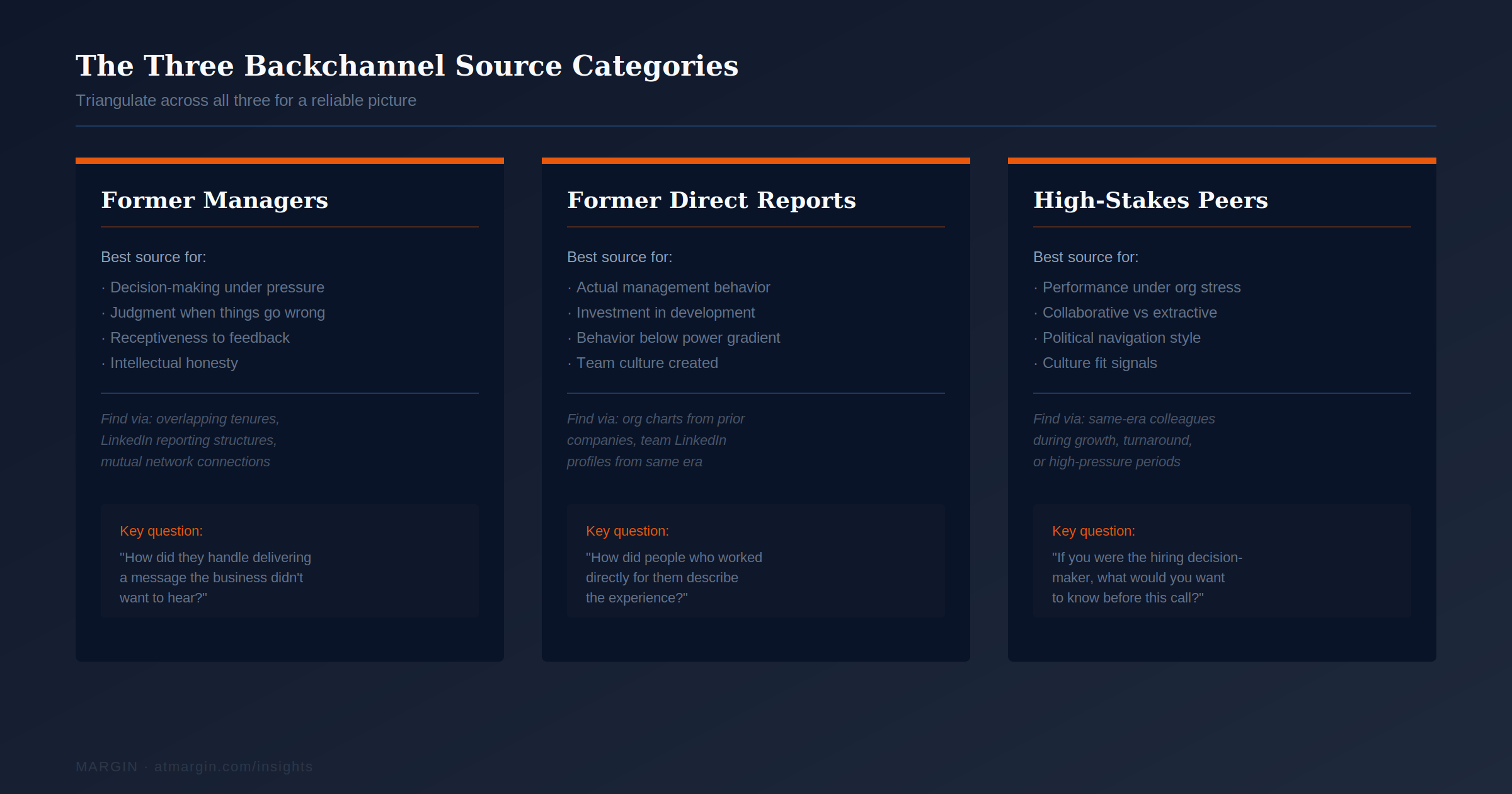
The most useful backchannel contacts fall into three categories. Former managers who were in a position to observe the candidate's decision-making under real conditions — not in a managed meeting, but in the moments where things were going wrong and judgment was actually tested. Former direct reports, who have a perspective on leadership behavior that no manager or peer can replicate. Peers from high-stakes environments — colleagues who worked alongside the candidate during periods of organizational stress, rapid growth, or significant failure — who can speak to how they performed when performance was most consequential.
Approach
The approach conversation matters as much as the questions. Cold outreach to a backchannel contact should be direct about its purpose: you are considering a candidate for a senior role, you understand they worked together, and you'd value a brief conversation about the professional context. Most professionals at the senior level will agree to this conversation. Those who decline are telling you something — either about their relationship with the candidate or about their own discomfort with the exercise, both of which are useful data points.
Questions
The questions should be structured around the specific capabilities the role requires, not generic character assessments. The least useful backchannel question is "what are their greatest strengths and weaknesses" — it invites prepared talking points even from unprepared sources.
The most useful questions are behavioral and specific: In the environment you shared, how did they handle situations where they had to deliver a message the business didn't want to hear? What types of problems did they solve well, and what types did they hand off or avoid? How did people who worked directly for them describe the experience? If you were the hiring decision-maker, what would you want to know before making this call? That last question, delivered after some rapport has been established, often produces the most candid information of the conversation.
Triangulation
Triangulation is required. A single backchannel conversation is an anecdote. Three to five conversations with sources from different relationship contexts — a former manager, a former direct report, a peer — begin to constitute a pattern. When those conversations converge on a consistent description of how a candidate operates, that description is likely accurate. When they diverge sharply, the divergence itself is worth understanding: it may indicate that the candidate shows up very differently depending on the power dynamic, which is among the most predictive signals in executive assessment.
What Backchannel References Reliably Surface
Organizations that conduct structured backchannel references consistently — and there are search firms that have built their entire value proposition around this — report a predictable set of findings that formal references never produce.
The most common: a gap between the candidate's narrative about their prior role and what actually happened. The transformation they led was narrower in scope than described. The team they built was inherited and then partially lost. The growth they claim credit for coincided with a market tailwind that lifted every competitor simultaneously. These are not necessarily disqualifying — but they are material to how the organization should interpret the candidate's judgment and capabilities, and they are never volunteered in a formal reference process.
The second most common: performance in the wrong direction of the power gradient. Candidates who managed up brilliantly and managed down poorly. Executives who were exceptional in a boardroom and difficult in a staff meeting. Leaders who advocated effectively for their function with peers and underinvested systematically in the development of their direct reports. These patterns are invisible in formal references, which are typically drawn from people the candidate impressed. They are reliably surfaced in conversations with people who reported to them.
The third: cultural fit data that the interview process cannot generate. How someone operates in an ambiguous environment, how they respond to political friction, whether they build organizational trust or extract it — these emerge from backchannel conversations with people who experienced them in action. They are the variables that most often determine whether a technically capable executive succeeds or fails in a specific organizational context, and they are the variables that formal hiring processes are least equipped to evaluate.
None of this replaces structured interviewing or formal assessment. But for executive hires — where the cost of error is high, the interview process is inherently managed, and the formal reference process produces near-zero signal — the backchannel reference is the one step that consistently yields information the organization couldn't get anywhere else. The question is not whether to do it. It is whether to build a process rigorous enough to do it well — and defensible enough to do it safely.