
The Regrettable vs. Non-Regrettable Distinction Is Costing You
Sorting departures into regrettable and non-regrettable feels like analysis. It isn't. It's a retrospective judgment that arrives too late to be useful and too imprecise to be actionable.
In most HR departments, the moment an employee resignation is received, someone makes a quiet determination: regrettable or non-regrettable. The language varies by organization — some call it critical versus non-critical, some use a tiered system, some don't use formal labels but make the same judgment informally — but the logic is consistent. Certain departures are losses the organization mourns. Others are losses the organization accepts, or quietly welcomes. The classification shapes how the departure is processed, whether a counteroffer is considered, and how the role is backfilled.
This framework has genuine utility. Not every departure deserves the same response, and organizations that treat all turnover as equally problematic misallocate their retention resources. The ability to distinguish between a high performer whose departure represents a real organizational cost and a marginal performer whose departure opens an opportunity for upgrade is a legitimate capability.
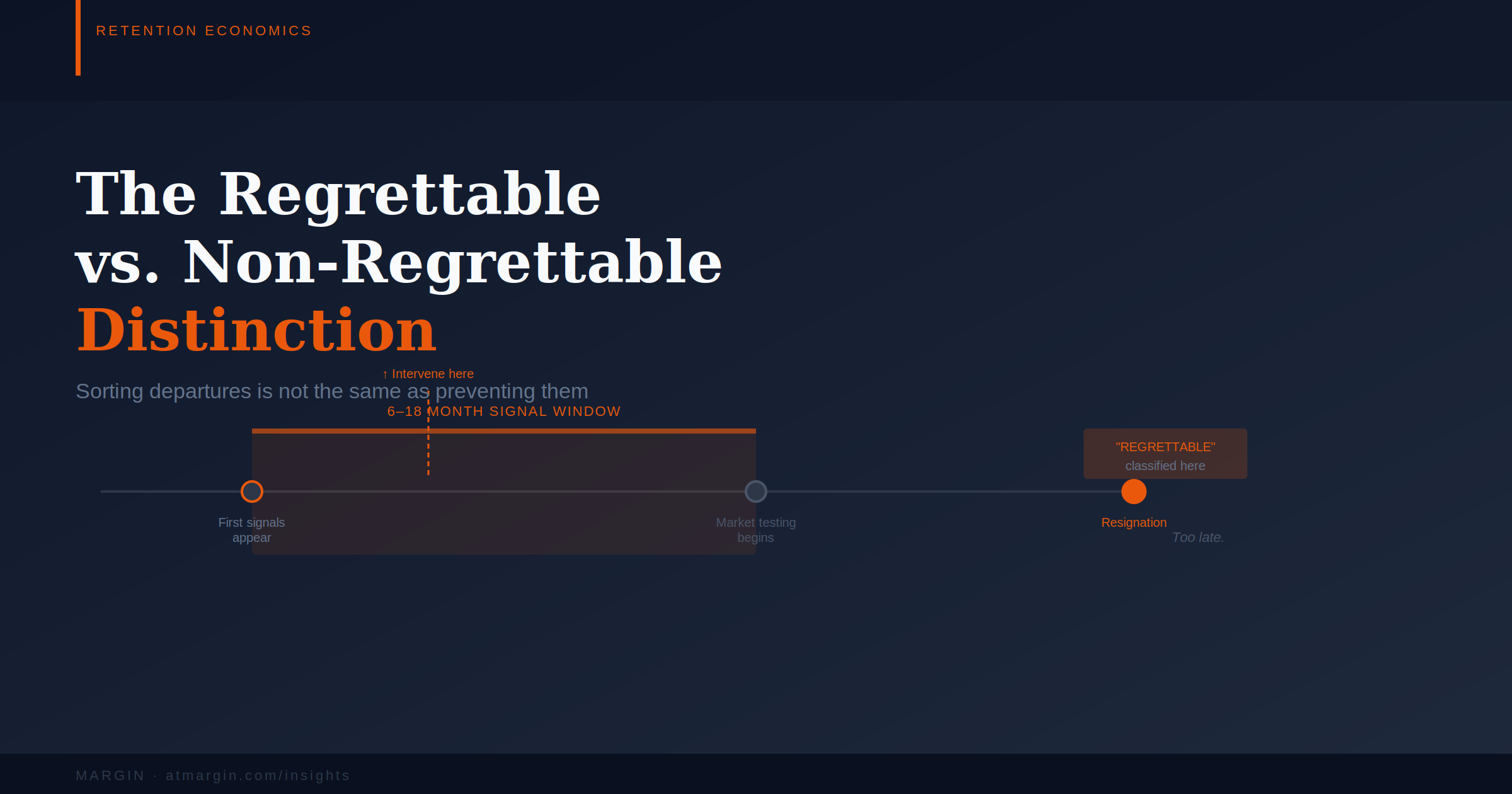
The problem is not the distinction itself. The problem is where it sits in time. The regrettable versus non-regrettable classification is made at resignation — after the employee has made a final decision, typically accepted another offer, and for all practical purposes already left. The retention window, if one ever existed, has closed. What organizations call retention analysis is more accurately described as departure taxonomy: a categorization exercise that produces useful data about the past and almost no leverage over the future.
The most important question in retention strategy is not whether you regret a departure. It is whether you could have predicted it — and if so, when, and what you would have done.
Why the Retrospective Frame Persists
The appeal of the regrettable/non-regrettable framework is partly analytical and partly organizational. It provides a metric — regrettable turnover rate — that can be tracked, reported, and benchmarked. It gives HR a language for communicating retention risk to leadership that is legible without being threatening. And it allocates accountability for departures in a way that is politically manageable: a non-regrettable departure requires no explanation and no action. A regrettable departure requires some reflection, but since the person is already gone, that reflection carries no urgency.
The framework also has the advantage of certainty. At the moment of resignation, the regrettable/non-regrettable judgment is easy to make because all the relevant information is available: the employee's performance history, their organizational relationships, their replacement cost. The hard work of predicting departure before it happens requires operating under uncertainty, building models, making probabilistic judgments about people who haven't made a final decision and may not for months. Organizations with limited analytical infrastructure and high operational bandwidth naturally default to the easier exercise.
The cost of this default is difficult to see precisely because the framework measures what happened, not what didn't happen. The regrettable departure that was prevented, the high performer who considered leaving and decided to stay because the organization identified and addressed the risk early — these don't appear in any turnover metric. They are invisible successes. The visible failures are the regrettable departures that weren't prevented, and those are attributed to market conditions, competitive compensation, or individual circumstances rather than to the failure of the retention model itself.
The Predictability Question
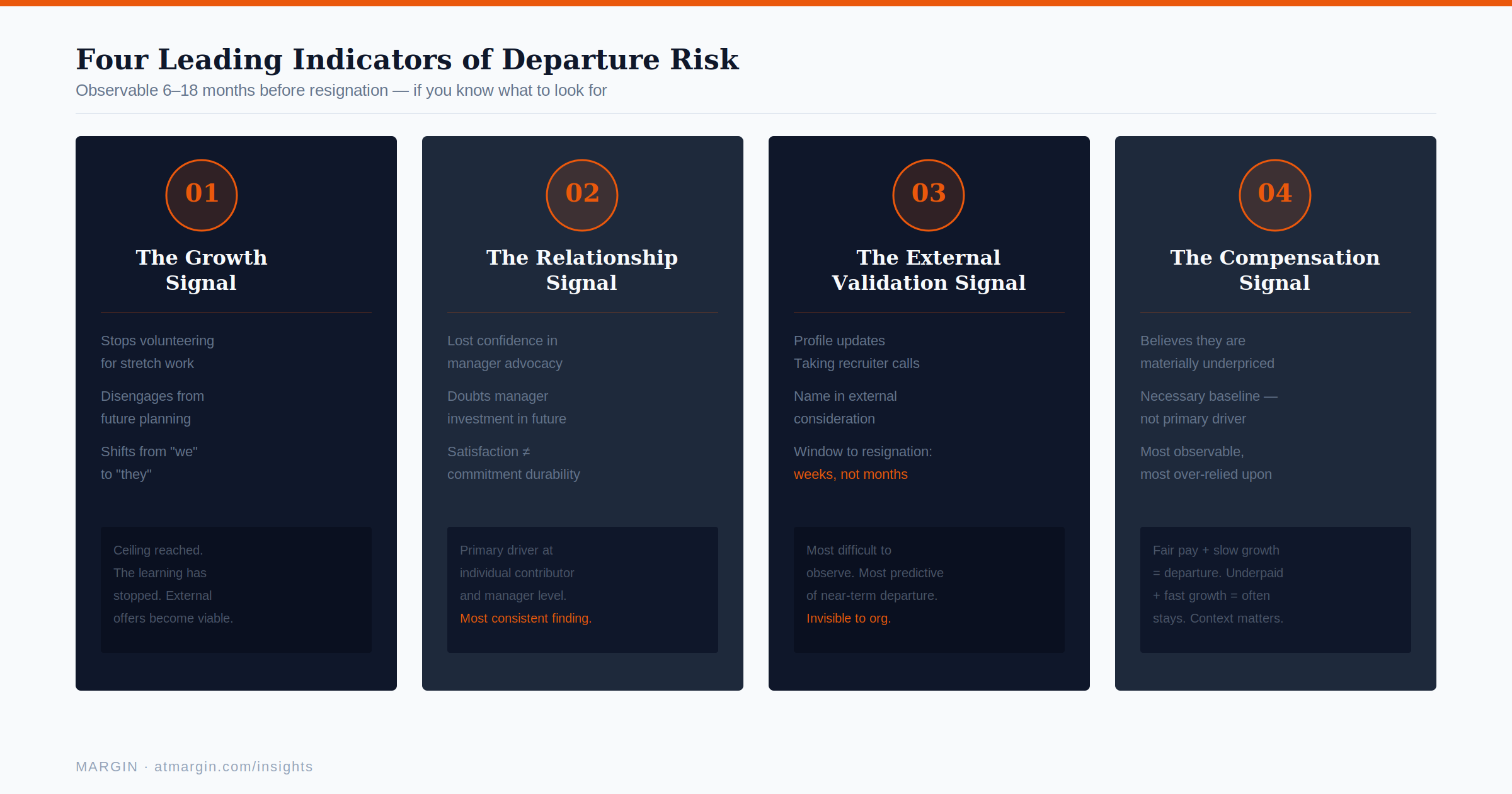
Research on voluntary turnover consistently identifies a set of conditions that precede departure, often by six to eighteen months, and that are observable to an attentive organization. The conditions vary by role level and function, but the most reliable leading indicators cluster around four variables.
Growth Signal
The first is the growth signal. Employees who have reached the ceiling of what their current role can teach them begin, often unconsciously, to disengage from the future of the organization. They stop volunteering for stretch assignments. They become less engaged in planning conversations that extend beyond their current scope. They begin referring to the organization in slightly more external terms — "they" instead of "we" — in a shift of linguistic framing that precedes departure more reliably than almost any survey response. Managers who are paying attention can observe this. Most are not paying attention.
Relationship Signal
The second is the relationship signal. The primary driver of voluntary departure at the individual contributor and manager level is the direct manager relationship — a finding so consistent across studies that it barely qualifies as a finding at this point. But the relationship signal goes beyond simple satisfaction. Employees who have lost confidence in their manager's advocacy for their development, compensation, or advancement are flight risks regardless of how satisfied they report being in engagement surveys. The question is not whether they like their manager. It is whether they believe their manager is invested in their future at the organization.
External Validation Signal
The third is the external validation signal. This is the most difficult to observe and the most predictive of near-term departure. When an employee begins testing the market — updating their profile, taking recruiter calls more seriously, allowing their name to enter consideration for external roles — they are engaged in a comparison that the organization has no visibility into and cannot influence after the fact. The window between active market testing and resignation is typically measured in weeks. By the time a competing offer arrives, the retention decision has effectively been made.
Compensation Signal
The fourth is the compensation signal. This is the most observable and the one most organizations over-rely on. Employees who believe they are meaningfully underpriced relative to the external market are at elevated departure risk, but compensation alone is neither necessary nor sufficient for departure. An employee who is fairly compensated but growing too slowly will leave for a role at the same pay. An employee who is underpaid but growing rapidly in an environment they value will often stay. Compensation is a necessary baseline condition, not the primary driver — and retention strategies that treat it as the primary driver consistently underperform.
Building a Retention Risk Model
The practical alternative to the regrettable/non-regrettable framework is a forward-looking retention risk model: a structured, regularly updated assessment of departure probability for the talent population that matters most to organizational performance. This is not a novel concept in theory, but its implementation is rarer than its discussion, and the gap between organizations that have built it and those that haven't is measurable in retention outcomes.
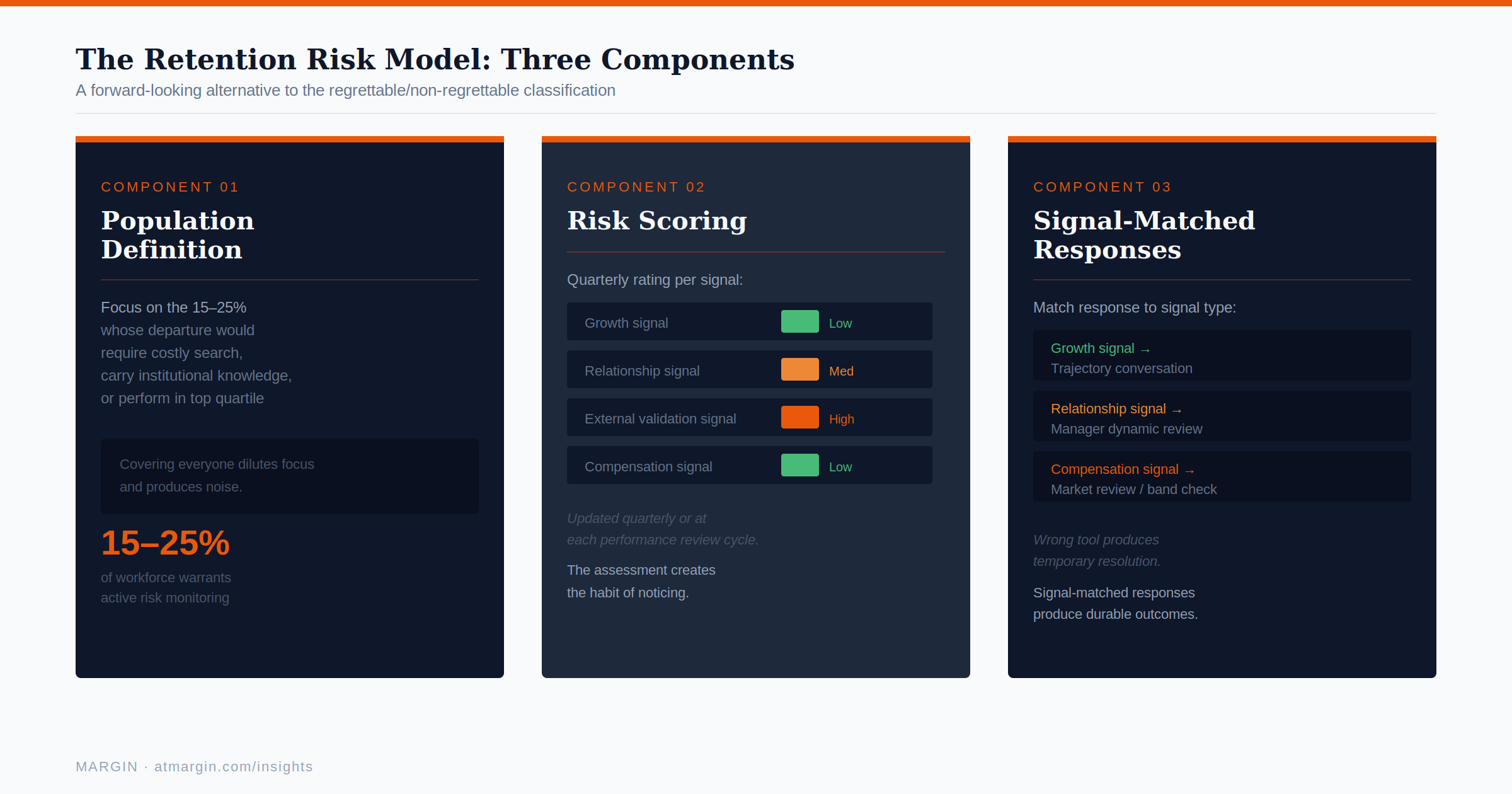
The model has three components.
Population definition.
“The retention window, if one ever existed, has closed. What organizations call retention analysis is more accurately described as departure taxonomy.”
Not all employees are equally expensive to lose, and a retention risk model that tries to cover the entire workforce dilutes focus and produces noise. The relevant population for proactive retention investment is the subset of employees whose departure would require a costly, time-consuming external search, whose institutional knowledge represents a meaningful competitive or operational asset, or whose performance output is in the top quartile of their function. For most organizations, this is 15 to 25 percent of total headcount — a manageable number to assess with real attention rather than survey averages.
Risk scoring.
For each person in the defined population, managers and HR partners should maintain a regularly updated assessment across the four signal categories described above. This does not require sophisticated technology. A simple rubric — low, medium, or elevated risk on each dimension, updated quarterly or at each performance review cycle — provides more actionable information than any engagement survey because it is specific to individuals rather than averaged across teams, and because it is owned by the people in the best position to observe the signals.
The scoring conversation itself has value independent of the output. Requiring managers to actively assess retention risk for their key people forces a level of deliberate attention to individual circumstances that most managers do not naturally maintain. The assessment creates the habit of noticing, which is the foundation of early intervention.
Response protocols.
The model is only as valuable as the actions it enables. For each risk level, the organization should have a defined set of responses available — not mandatory interventions, but options calibrated to the risk profile. An employee at elevated risk in the growth signal dimension needs a conversation about trajectory, not a retention bonus. An employee at elevated risk in the compensation dimension may need a market review, an accelerated review cycle, or a conversation about the organization's compensation philosophy and timeline. An employee showing multiple concurrent risk signals requires a different and more urgent response than one showing a single indicator.
The critical design principle is that responses are matched to signal categories. Organizations that respond to all retention risk with the same tool — typically a compensation adjustment or a promotion — achieve temporary resolution at best. The employee who is leaving because they can't see year three stays for six months and leaves anyway. The employee who was leaving because of manager conflict receives a raise that changes nothing about the underlying dynamic. Signal-matched responses require more managerial sophistication and more organizational infrastructure, but they produce durable retention outcomes rather than delayed departures.
What to Do With the Framework You Already Have
Abandoning the regrettable/non-regrettable classification entirely is probably not the right prescription — it does have value as a retrospective quality measure, and the metric has enough organizational currency that eliminating it creates more friction than insight. The more practical recommendation is to treat it as what it actually is: a lagging indicator that confirms the effectiveness or ineffectiveness of the forward-looking model.
If the organization is regularly experiencing regrettable departures in the same function, at the same tenure band, or under the same managers, those patterns are the signal worth analyzing. Not "this departure was regrettable" but "we have now had three regrettable departures from high-performers between years two and four of tenure, all from the same business unit, in the past 18 months." That is a retention system failure with a specific organizational address, and it is the kind of finding that a forward-looking risk model, consistently applied, would have surfaced before the third departure rather than after it.
The question that should follow every regrettable departure is not "could we have kept them." It is "when did we first have sufficient information to know this was possible, and what would we have needed to do differently at that point." That question, asked honestly and consistently, tells the organization more about the quality of its retention infrastructure than any turnover metric — and it points directly toward the changes that would produce different outcomes.