What Stay Interviews Actually Measure (And What They Don't)
Stay interviews have become a popular retention tool. The problem is that they measure something different from what most organizations think — and acting on the wrong signal produces decisions that don't retain the people they're designed to keep.
The stay interview has had a good decade. As organizations grew more attuned to the cost of turnover and more skeptical of the exit interview as a retention tool — which, as examined elsewhere in these pages, arrives too late to be useful — the stay interview emerged as the proactive alternative. Ask employees why they stay before they decide to leave. Identify the factors that matter to them. Act on what you learn. The logic is appealing, the implementation is simple, and the practice has spread accordingly. It now appears in nearly every retention playbook, recommended with confidence by HR consultants, and deployed by organizations that have never examined whether it actually works.
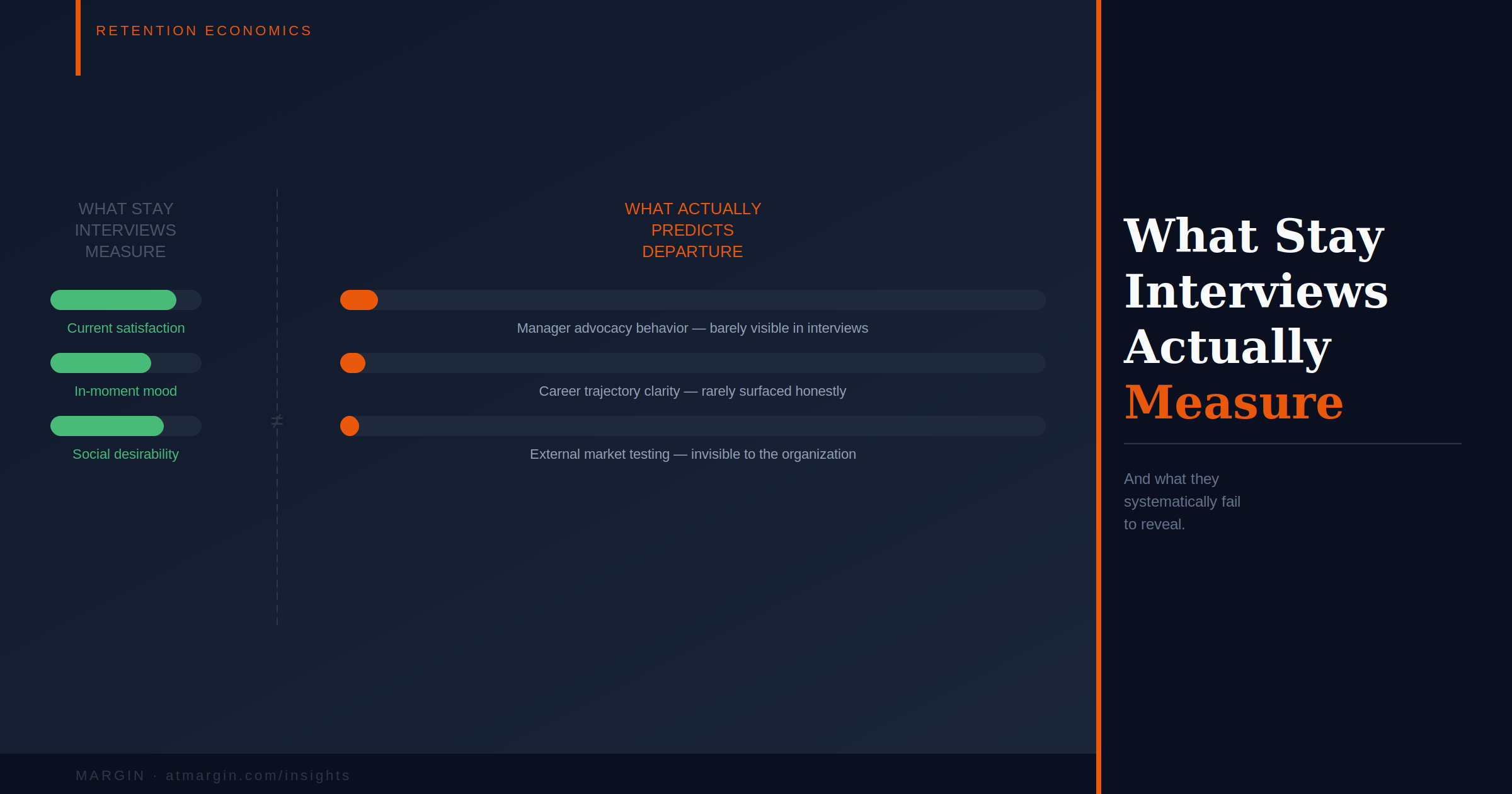
The inconvenient finding from the research that has accumulated on stay interviews is that they measure what employees think they value, not what actually drives their retention decisions. This is not a minor methodological nuance. It is the difference between building a retention strategy on solid behavioral data and building it on a well-intentioned survey that reflects cognitive biases and social desirability more than it reflects the actual drivers of departure.
Understanding what stay interviews actually measure — and what they systematically fail to measure — is the necessary precondition for using them well, which is not the same thing as using them often.
The Measurement Problem
Stay interviews ask a version of the same question: what keeps you here, what might cause you to leave, and what would make this a better place to work. The responses generate themes. Those themes inform retention initiatives. The initiatives are implemented. Turnover continues. The organization concludes that retention is a complex problem and schedules the next round of stay interviews.
The structural problem is that self-reported intent to stay is one of the weakest predictors of actual departure behavior in the organizational psychology literature. The correlation between what employees say they value and what they subsequently act on is positive but modest — strong enough to be better than nothing, not strong enough to be a reliable basis for individual retention decisions. Several mechanisms explain the gap.
Employees are genuinely uncertain about their own future behavior.
The conditions that will trigger a departure decision often haven't occurred yet at the time of the stay interview. An employee who says they are committed to the organization and satisfied with their role is telling the truth about their current state. They are not, and cannot be, accurately predicting how they will respond to a strong external offer, a difficult performance conversation six months from now, or a manager change that shifts their experience of the role.
Stay interviews are social interactions, and social interactions are subject to social desirability effects.
Most employees understand that a stay interview is partly a managerial relationship check — a signal that the organization values them. Responding with candid criticism of their manager, their compensation, or their sense of organizational trajectory requires a level of psychological safety that many employees do not have, particularly with a manager who has the authority to affect their performance review. The responses organizations get in stay interviews are systematically skewed toward what employees believe is safe to say, not what is actually driving their engagement or departure risk.
The questions stay interviews ask are future hypotheticals that people answer by referencing their current state.
Third, the questions stay interviews typically ask — what do you love about your work, what would make you consider leaving — are forward-looking hypotheticals that most people answer with reference to their current state. Research on affective forecasting consistently shows that people are poor predictors of how they will feel in future states that differ significantly from their current one. An employee who is currently engaged and growing confidently predicts they will stay for the foreseeable future. That prediction is not a retention commitment — it is an accurate description of how they feel today, with all the fragility that implies.
What Behavioral Data Actually Predicts
The variables that most reliably predict voluntary departure at the individual level are largely behavioral — observable through action rather than self-report — and they cluster around factors that stay interviews are structurally poorly equipped to surface.
Manager Relationship Quality
“An employee who says they are committed to the organization is telling the truth about their current state. They are not, and cannot be, accurately predicting how they will respond to a strong external offer six months from now.”
Manager relationship quality, measured not by employee satisfaction with their manager but by specific observable behaviors: whether the manager advocates for their direct reports in compensation reviews, whether they create development opportunities or defer them, whether they provide feedback that employees experience as genuinely useful rather than evaluative. These are not survey questions — they are behavioral patterns that HR business partners and senior leaders can observe if they are paying attention and know what to look for.
Career Trajectory Clarity
The departure risk associated with unclear advancement is not primarily about employees' stated satisfaction with their career path — most employees will describe their career path as acceptable when asked directly. It is about whether they can construct a specific, plausible narrative for what year three or year five looks like at this organization. Employees who cannot construct that narrative are at elevated departure risk regardless of what they say in a stay interview, because the departure decision, when it comes, will be driven by an external opportunity that offers a clearer answer to that question than the current organization does.
Compensation Market Awareness
As pay transparency increases — both legally mandated and socially normalized through salary-sharing platforms — employees have better real-time information about their market value than at any prior point in the modern employment relationship. An employee who discovers they are meaningfully underpriced relative to the external market is not going to report that discovery in a stay interview before they have decided what to do about it. By the time compensation comes up as a stay interview theme, the employee has often already done the math.
Network Activation
When an employee begins engaging seriously with external opportunities — updating professional profiles, responding to recruiter outreach, allowing their name to enter consideration for external roles — they are in an active decision process that will likely conclude in weeks or months. This is invisible to the organization and completely unreachable by a stay interview that hasn't been scheduled yet.
Redesigning the Stay Interview for Actual Signal
None of this means stay interviews have no value. They are a direct conversation with employees about their experience of the organization, and direct conversations, conducted well, produce useful information. The question is how to structure them to generate signal on the variables that actually predict departure, rather than the variables that employees are comfortable reporting.
Shift from satisfaction to specificity.
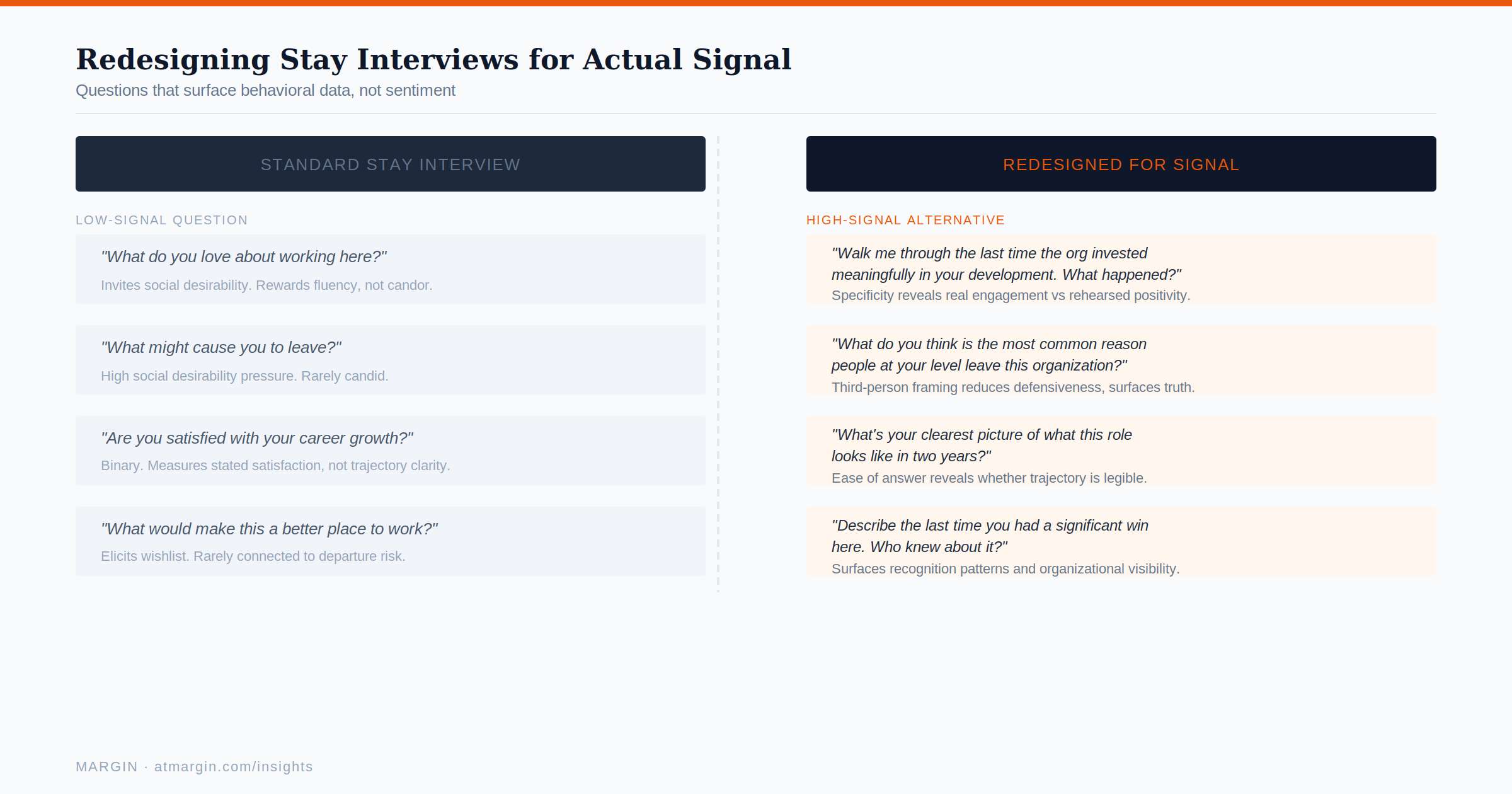
The least useful stay interview question is some variant of "what do you love about working here." The most useful questions are specific and behavioral: "Walk me through the last time you felt like the organization invested meaningfully in your development. What happened?" "Describe the last time you had a significant professional win here. Who knew about it?" "What's your clearest picture of what this role looks like in two years?" The specificity of the answer — the ease with which the employee constructs a concrete narrative — tells you more about their engagement than any satisfaction rating. Employees who struggle to identify specific examples are often experiencing a disengagement that they haven't consciously labeled.
Ask about the organization, not the employee.
Reframing stay interview questions from first-person experience to third-person observation reduces social desirability effects. "What do you think is the most common reason people at your level leave this organization?" produces more candid information than "what would cause you to leave?" Employees find it easier to be honest about organizational dynamics when they're not being asked to disclose their own departure risk.
Create structured manager behavior assessments.
Separate from the traditional stay interview format, direct reports should have regular, structured opportunities to evaluate specific manager behaviors — not manager likability — that are known to drive retention: clarity of feedback, advocacy for development, equity in recognition and opportunity. These assessments are most useful when they are aggregated across a manager's team and compared over time, rather than used as individual data points that invite retaliation concerns.
Build in trajectory mapping.
Every stay conversation should include an explicit, specific discussion of what the employee's next 18 to 24 months looks like from the organization's perspective. This is not a promise — it is a conversation that establishes whether the organization has a credible narrative for the employee's future and whether the employee finds it compelling. Employees who leave organizations are often not leaving for a better present situation — they are leaving for a more legible future. The organization that can articulate that future convincingly, specifically, and with some demonstrated commitment retains at a higher rate than the one that offers general reassurance.
The Broader Retention Measurement Architecture
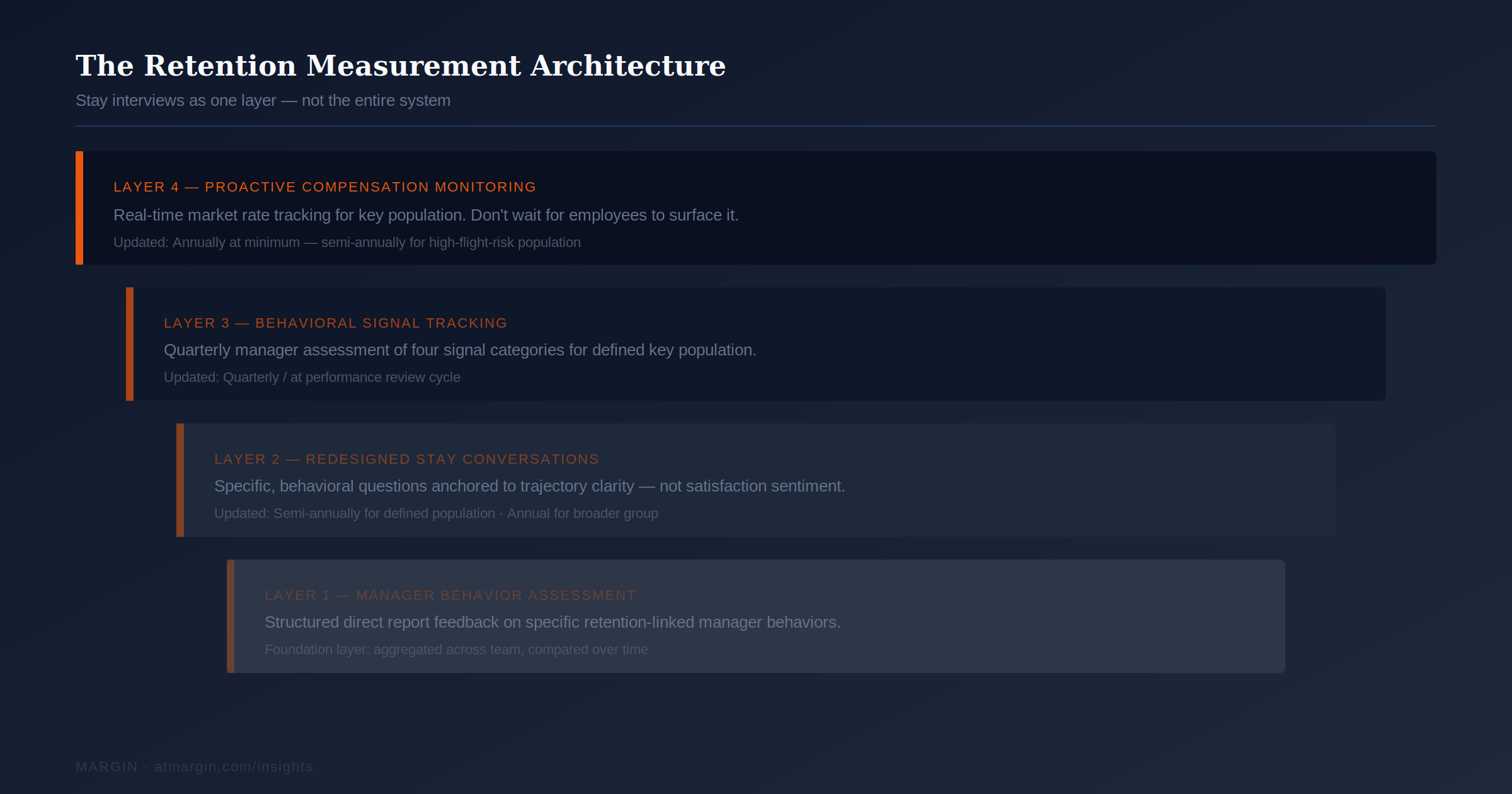
Stay interviews, redesigned to surface behavioral signal rather than satisfaction sentiment, are one element of a retention measurement system, not the system itself. The organizations that perform best on regrettable turnover tend to operate a layered architecture: manager-level retention risk assessments updated quarterly, behavioral signal tracking for the high-value talent population, stay conversations structured around trajectory specificity rather than satisfaction, and compensation market monitoring that doesn't wait for employees to surface the issue themselves.
The stay interview's appropriate role in this architecture is as a relationship-building exercise that generates qualitative texture on individual circumstances — not as the primary data source for retention strategy. An organization that relies on stay interviews as its main retention intelligence is building its retention model on self-reported intent, which is the weakest available signal. An organization that uses them as one input among several — alongside manager behavior data, performance trajectory analysis, and proactive compensation monitoring — is using them correctly.
What employees say when asked why they stay is genuinely useful, as long as the organization understands what it's actually measuring. It is a description of the current state, filtered through social desirability and limited self-knowledge, about factors that may or may not be the actual drivers of their future behavior. Treating it as a retention commitment is a category error. Treating it as one honest data point in a larger picture is exactly right.