
Pay Transparency: The Trade-offs Companies Don't Discuss
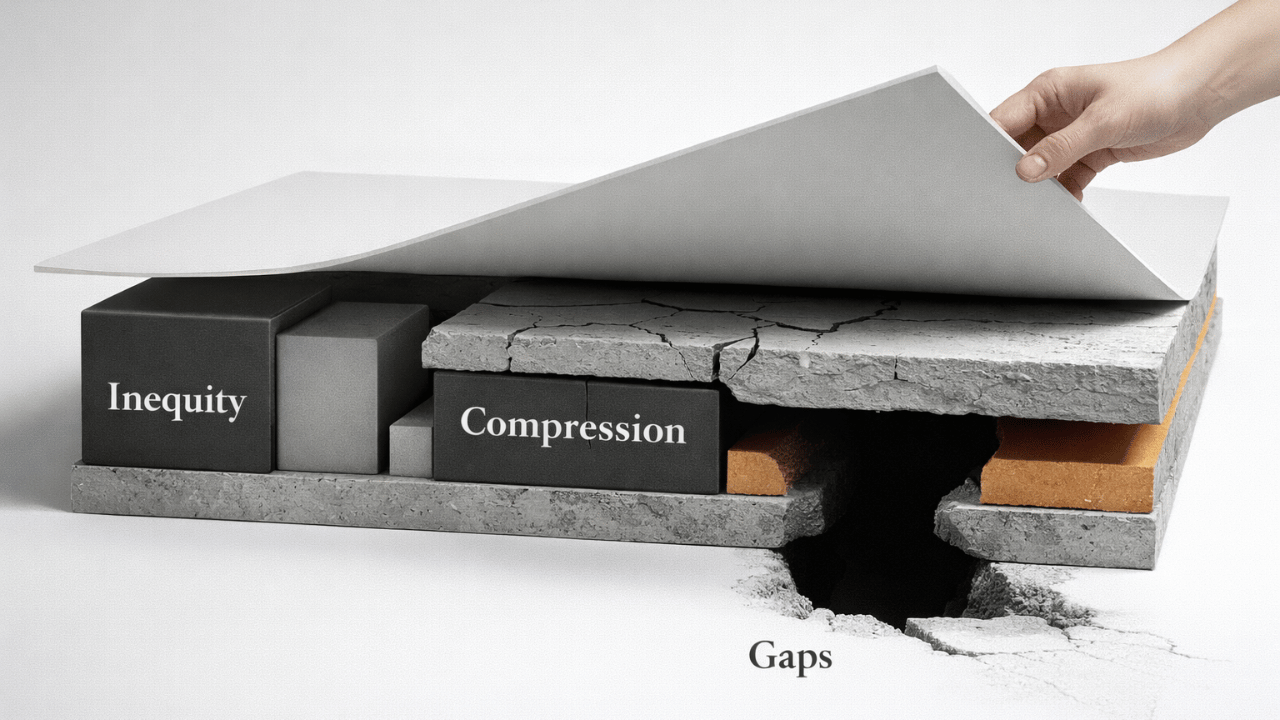
Pay transparency is being mandated by law in a growing number of states and adopted voluntarily by progressive companies. The narrative around transparency is almost entirely positive: it reduces pay inequity, builds trust, demonstrates fairness, and attracts values-aligned candidates. All of this is true. What's rarely discussed is that transparency also exposes existing pay problems, reduces compensation flexibility, creates difficult conversations, and requires substantially more disciplined compensation strategy than most companies currently have.
You can't simply flip a switch and become transparent. Transparency without preparation is expensive and potentially destructive. The companies succeeding with transparency are those who fixed their compensation house first, then opened it for inspection.
The Transparency Spectrum
Transparency isn't binary; it exists on a spectrum with distinct trade-offs at each level:
Level 0: Complete opacity.
No one knows what anyone else earns. Pay bands aren't published. Compensation decisions happen behind closed doors. Employees are often explicitly told not to discuss compensation with each other (which is illegal under NLRA, though widely practiced). This maximizes management flexibility and minimizes difficult conversations, but it also maximizes employee suspicion and enables systematic pay inequity.
Level 1: Published pay bands.
You publish the salary range for each role and level ("Accounting Manager: $140,000-$180,000") but individual salaries remain private. This provides structure and sets expectations while preserving some flexibility and privacy. The challenge is that employees anchor to the top of published bands and feel underpaid if they're anywhere below maximum, even if maximum represents 3+ years of high performance.
Level 2: Published compensation formula.
You publish the exact methodology used to calculate compensation, including how you factor in experience, location, performance, and other variables. Buffer pioneered this approach with their public salary calculator. This provides complete transparency about how compensation is determined while requiring extremely disciplined compensation strategy; any exceptions or inconsistencies are immediately visible.
Level 3: Full individual transparency.
Everyone's actual salary is visible internally (or in Buffer's case, publicly). This maximizes equity pressure and trust but also maximizes comparison and potential dissatisfaction. If Employee A discovers they earn less than Employee B in a similar role, they need a clear explanation of why, and "performance" is often insufficient without detailed evidence.
Most companies currently operate at Level 0, are being pushed toward Level 1 by regulation, and are trying to understand whether moving further up the spectrum makes strategic sense.
The Legal Landscape
The regulatory environment increasingly mandates transparency:
Salary range disclosure laws: Colorado (2021), California (2023), New York State and New York City (2023), Washington (2023), Rhode Island (2023), Connecticut (2021) and others now require employers to include salary ranges in job postings. More states are considering similar legislation.
Equal pay laws: Federal law and state laws require equal pay for equal work, with limited exceptions for seniority, merit, and factors other than sex/protected characteristics. These laws don't mandate transparency, but transparency makes equal pay violations more difficult to hide and easier to prove.
NLRA protections: Under the National Labor Relations Act, employees have the right to discuss compensation with each other. Policies prohibiting salary discussion are illegal, though many companies had them until recently and some still do unknowingly.
The trend is clear: transparency is increasing whether companies want it or not. The strategic question is whether to get ahead of regulations or wait until forced.
Benefits of Transparency: The Optimistic Case
The case for transparency is compelling:
Reduces pay inequity, especially demographic gaps.
When compensation is opaque, pay gaps based on negotiation skill, hiring timing, manager discretion, or demographic factors can persist indefinitely. Transparency exposes these gaps and creates pressure to fix them. Companies that go transparent typically discover and correct pay inequities in the process of preparing for transparency.
Builds trust and perceived fairness.
Employees are suspicious about whether they're being paid fairly. Transparency addresses that suspicion directly. "Here's what everyone in your role earns and here's why you're positioned where you are" is far more trust-building than "your compensation is competitive and you shouldn't discuss it with others."
Reduces negotiation leverage problems.
If everyone knows the salary bands and positioning criteria, there's less room for aggressive negotiation to create pay inequity. The employee who asks for 20% more than the band allows can be told clearly, "that's not how our compensation structure works."
Attracts values-aligned candidates.
Transparency signals that you value fairness and are confident in your compensation decisions. This appeals to candidates who prioritize equitable workplaces, which increasingly includes top talent, particularly in younger demographics.
Easier legal defensibility.
When you're transparent about compensation and can show that differences are based on objective, job-related factors, defending against equal pay claims becomes simpler.
These benefits are real and substantial. They're also contingent on having your compensation structure in order before going transparent.
Costs of Transparency: The Skeptical Case
What transparency advocates often minimize:
Exposes existing pay problems that are expensive to fix.
Most companies have significant unexplained pay variance within roles. You might have two Senior Engineers earning $140,000 and $175,000 because one was hired during a competitive market and negotiated aggressively while the other was hired during a slow market and didn't negotiate. When this gap becomes visible, you have to fix it; which means either bringing the lower-paid employee up to the higher level (expensive) or explaining why the $35,000 gap is justified (difficult if it isn't).
If you have 200 employees and discover that 30% are underpaid by an average of $15,000 when you audit for transparency, that's $900,000 in corrective adjustments. Many companies can't afford that in a single year, which means transparency gets deferred indefinitely.
Reduces compensation flexibility.
When you publish bands or formulas, you constrain your ability to make exceptions for critical hires, competitive situations, or retention cases. The critical engineering hire who would add enormous value but requires $220,000 in a role where your published band maximum is $180,000 creates problems. You either lose the hire, violate your published structure (undermining its credibility), or adjust the entire band (expensive for all current employees in that band).
Creates difficult conversations about performance differences.
In an opaque system, you can tell Employee A they're performing well even if they're actually average. In a transparent system where Employee A can see they're at the 40th percentile of the band while peers are at 60th-75th percentile, "you're doing great" is no longer credible. You need honest performance feedback that explains compensation positioning, which many managers aren't equipped to deliver.
Triggers anchoring to top of band.
When you publish "Senior Engineer: $140,000-$180,000," every senior engineer anchors to $180,000 as the reference point. If they're earning $155,000, they feel underpaid even if $155,000 is at market rate and $180,000 represents exceptional performance after 4-5 years in role. The psychology of loss aversion means the gap from their current salary to band maximum feels more salient than the gap from band minimum to their current salary.
Provides competitive intelligence.
When you publish compensation bands, your competitors know what you're paying. This can affect their own compensation decisions and your ability to compete. In highly competitive talent markets, you might prefer to keep your compensation strategy proprietary.
The Preparation Tax
The real cost of transparency is the preparation required before you can afford to be transparent:
Audit existing compensation for inequity.
Pull all employee compensation data and analyze it by role, level, tenure, performance, demographics, and hiring date. Identify unexplained variance. This is often the first time companies look at compensation holistically rather than employee by employee, and what they discover is often ugly.
Fix identified inequities before going transparent.
If the audit reveals demographic pay gaps, compression problems, or random variance from inconsistent practices, you need to fix these before publishing anything. This is the expensive part; bringing underpaid employees up to fair compensation might require 3-7% of total comp budget.
Establish clear compensation philosophy and structure.
You can't be transparent without having clear answers to: How do we position relative to market? What drives pay differences within roles? How do we balance internal vs. external equity? These questions from Article 2 aren't optional when you're transparent; employees will ask, and you need defensible answers.
Create and document positioning criteria.
If you're publishing bands, you need clear criteria for where someone falls within the band. "Performance" isn't specific enough; you need measurable factors that explain why one senior engineer is at $145,000 and another is at $170,000. Years of experience, specific skills, impact metrics, and scope of responsibility are all defensible. "They negotiated better" is not.
Train managers on compensation conversations.
Transparency means managers need to explain compensation positioning to their reports. Most managers aren't equipped for this. They need training on how to discuss the compensation structure, how to explain performance-based differences, and how to handle difficult questions about why someone else earns more.
This preparation typically takes 6-12 months and substantial expense. Companies that skip preparation and jump to transparency discover the problems the hard way - through employee complaints, legal challenges, or mass dissatisfaction when inequities are exposed.
Managing Transparency Downsides
If you decide to increase transparency, several practices mitigate the downsides:
Clear career levels and progression criteria.
Employees can accept that a Senior Engineer earns more than a Mid-Level Engineer if the distinction is clear and the path to advancement is transparent. But if levels are arbitrary or progression criteria are vague, pay differences feel unfair.
Performance-based differences well-defined.
"You're at $145,000 and your peer is at $165,000 because they're consistently delivering above-level impact while you're delivering solid mid-level performance" is acceptable if you have objective evidence of impact. "They're just better" is not.
Regular compensation reviews that adjust for market.
Transparency reveals when your compensation lags market. If your bands haven't adjusted in 18 months and employees can see that new hires are getting top-of-band offers while they're at midpoint after three years, you have a compression problem. Quarterly or semi-annual band reviews prevent this.
Communicate the philosophy, not just the numbers.
Publish your compensation philosophy alongside your bands. Explain that you target 50th percentile base salary but lead market on equity and total rewards. Explain that you prioritize internal equity over individual negotiation. Context makes numbers more acceptable.
Prepare for comparisons and dissatisfaction.
Accept that transparency will surface compensation complaints that were previously hidden. Some employees will be dissatisfied when they discover they're below peers. This is better than those same employees being dissatisfied in private and quietly job searching. At least you have the opportunity to address it.
When Transparency Works
Transparency is most successful when:
You have a strong, defensible compensation philosophy.
You've done the work from Article 2, you know where you position relative to market, how you handle internal vs. external equity, and how performance affects pay. You can explain and defend your decisions.
Pay variance within roles is modest and justified.
If Senior Engineers in your company earn $140,000-$165,000 with clear reasons for the variation (experience, performance, scope), transparency works. If they earn $120,000-$190,000 with no clear pattern, transparency exposes chaos.
You have high trust culture.
Transparency requires trust that the company is acting in good faith and that explanations for pay differences are honest. In low-trust environments, transparency can backfire; employees assume the worst about any pay difference they discover.
You're values-driven and equity is a priority.
Companies that genuinely prioritize fairness and equity over compensation flexibility benefit most from transparency. If your primary goal is to minimize comp expense by paying different people as little as you can get away with, transparency will expose that and create problems.
When to Avoid Transparency (or Delay It)
Transparency is risky when:
You have wide, unexplained pay variance.
If your compensation is chaotic (large random differences based on negotiation, hiring manager discretion, or market timing) going transparent exposes all of that chaos simultaneously. Fix the chaos first, then go transparent.
Your compensation strategy is weak or nonexistent.
If you don't have clear answers to basic compensation philosophy questions, you're not ready for transparency. Employees will ask "why does X earn more than me?" and you won't have good answers.
You're in highly competitive markets where flexibility matters.
If you're competing for scarce talent in markets where you frequently need to pay above standard bands to close critical hires, rigid transparency constrains you. You might choose opacity to preserve flexibility.
You can't afford the equity corrections.
If auditing compensation reveals that fixing existing inequities would require $2-3 million in adjustments and you don't have that budget, you need to either find the budget or defer transparency until you can fix problems gradually.
The Gradual Approach
Rather than jumping from complete opacity to full transparency, most companies benefit from gradual increases:
Year 1: Internal audit and philosophy development.
Analyze current compensation, identify inequities, establish clear compensation philosophy and structure. This is internal work, not visible to employees yet.
Year 2: Fix major inequities and establish bands.
Make corrective adjustments to address the worst pay gaps. Create and document pay bands with clear positioning criteria. Still not published externally.
Year 3: Publish bands in job postings (compliance).
Share salary ranges in external job postings as required by law. This is Level 1 transparency—ranges are public but individual salaries remain private.
Year 4: Share bands and philosophy with employees.
Make compensation structure and philosophy available to current employees. Explain how bands work and how positioning within bands is determined. Still not publishing individual salaries.
Year 5+: Consider full transparency if appropriate.
Once you've operated with published bands for several years and demonstrated that the structure is fair and consistently applied, you might consider moving to formula-based or full individual transparency if it aligns with culture and values.
This gradual approach spreads the cost over multiple years and builds confidence in your compensation structure before making it fully transparent.
The Strategic Decision
Transparency is ultimately a values decision wrapped in an economic calculation. The economic question is: does the reduction in pay inequity and increase in trust outweigh the cost of fixing existing problems and the loss of flexibility? The values question is: do we prioritize equity and openness over compensation optimization?
For companies where equity is a genuine priority and culture is built on trust and transparency, the economics favor transparency—the benefits outweigh the costs. For companies where compensation is primarily an expense to minimize and flexibility is critical, transparency is expensive and constraining.
The mistake is pretending these trade-offs don't exist. Transparency advocates often present it as pure upside with no downsides. That's not reality. Transparency is expensive to implement, requires substantial preparation, constrains future flexibility, and creates difficult conversations. It also reduces inequity, builds trust, and demonstrates values.
The companies that succeed with transparency are those who count the cost, prepare thoroughly, fix their problems before going transparent, and commit to maintaining the discipline transparency requires. The companies that fail are those who jump to transparency without preparation, expose problems they can't fix, and undermine employee trust in the process.
If you're considering transparency, start by auditing your current compensation. If what you find is defensible and fair, transparency will reinforce that. If what you find is chaos and inequity, fix that first; then decide whether transparency serves your strategic goals. You can't skip the preparation phase and expect transparency to solve your compensation problems. It doesn't solve problems. It exposes them.