
The Negotiation Paradox: Why Starting Low Costs You More Than Starting Fair
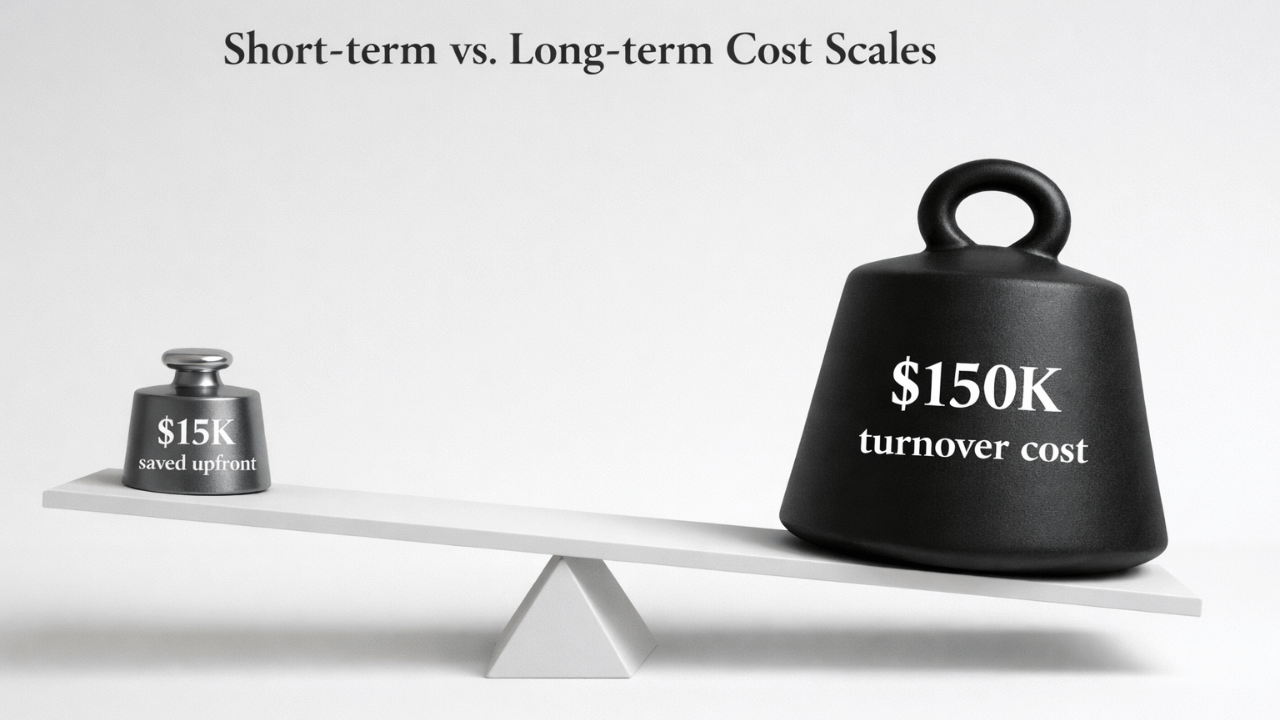
The conventional wisdom in offer negotiations is to start low. Leave room to negotiate. Don't show your best hand first. Be fiscally conservative. This logic seems sound: you'll save money on candidates who accept the lowball offer, and you can always negotiate up for candidates who push back. The problem is that this strategy backfires systematically through adverse selection, creates pay inequity, anchors resentment, and costs more in turnover than you save in compensation.
The economic reality is that lowballing filters out your best candidates, rewards negotiation skill rather than job performance, creates demographic pay gaps, and starts the employment relationship with a value signal that damages retention. Companies that start at fair market rate rather than 10-15% below end up with better talent at lower total cost.
The Adverse Selection Mechanism
When you lowball an offer, you're conducting an unintended screening process. Consider what happens when you offer 10-15% below market rate:
The best candidates reject immediately.
High performers with multiple options know the market rate because they interview frequently. When your offer comes in 10-15% below what they're seeing elsewhere, they don't counter-offer; they just decline and move forward with better opportunities. You've filtered out the exact candidates you most wanted to hire.
Skilled negotiators extract market rate anyway.
Experienced professionals who are good at negotiation will counter your lowball offer and push you up to market rate (or close to it). You haven't saved money on these hires; you've just annoyed them and wasted time in extended negotiations. Worse, you've signaled that you tried to underpay them, which affects their perception of the company and their starting relationship.
Non-negotiators accept the lowball.
Some candidates (disproportionately women, minorities, and people from cultures where salary negotiation is less common) accept your initial offer without negotiating. You've successfully underpaid these employees, but at significant cost. You've created internal pay inequity (negotiators earn more than non-negotiators for identical work), and you've started these employees at below-market compensation, which drives earlier attrition.
The result is a systematic bias: you lose the best candidates (adverse selection), pay market rate to skilled negotiators anyway (no savings), and create pay inequity by underpaying non-negotiators. This is economically irrational.
The Negotiation Premium and Its Consequences
Research on gender wage gaps consistently identifies negotiation as a significant driver of pay differences. Women negotiate starting salaries at lower rates than men, and when they do negotiate, they tend to request smaller increases. The gap has narrowed but persists.
If your compensation strategy depends on negotiation to reach fair pay, you're systematically creating demographic pay gaps. The employee who negotiates aggressively might earn 15-20% more than the employee who accepts your initial offer, despite identical qualifications and job performance. This isn't just unfair; it's legally risky under equal pay laws.
The negotiation premium also compounds over time. If Employee A negotiates their starting salary to $150,000 while Employee B accepts the initial offer of $130,000, and both receive 4% annual merit increases, the gap persists and grows. After five years, Employee A is earning $182,000 while Employee B earns $158,000 - a $24,000 annual gap that originated entirely from negotiation skill, not job performance.
The Resentment Anchor
Starting with a lowball offer creates an anchor point that affects the entire employment relationship. When an employee accepts your offer of $130,000 after negotiating up from $115,000, they know you were willing to underpay them by 13%. This knowledge affects their perception of fairness and trust.
Behavioral economics research shows that initial anchors have persistent effects on perception. The employee who had to fight for fair compensation doesn't forget that fight. When the next compensation discussion happens (promotion, raise, retention), that initial resentment surfaces again. They're primed to be suspicious of your offers and assume they need to negotiate aggressively to get fair treatment.
Compare this to the employee who receives an initial offer at fair market rate with clear explanation of how you arrived at that number. This employee starts with the perception that the company is treating them fairly and transparently. When compensation discussions happen later, there's trust rather than suspicion.
The long-term cost of the resentment anchor is difficult to quantify but manifests in lower engagement, higher attrition, and more difficult compensation discussions throughout the employment relationship.
The Retention Cost
Employees who accept below-market offers leave faster. The economics are straightforward: they're underpaid relative to market, which means they have financial incentive to explore other opportunities. When they interview externally and discover they can earn 10-20% more, they're likely to leave.
The typical pattern is that employees who accept lowball offers stay 18-24 months before leaving, while employees hired at fair market rates stay 36+ months on average. The difference is substantial: if your cost to replace an employee (recruiting, onboarding, productivity loss) is 1-1.5x annual salary, and low-offer employees leave 18 months earlier, you're spending far more on turnover than you saved by offering below market.
Calculate this specifically: You save $15,000 annually by hiring someone at $135,000 instead of $150,000. They leave after 18 months instead of 36 months. Your replacement cost is $150,000 (1x their salary). Net outcome: you saved $22,500 in compensation over 18 months but spent an extra $150,000 in replacement costs 18 months earlier than necessary. Total loss: $127,500.
Even if only 30-40% of lowball-offer employees leave early due to compensation dissatisfaction, the economics are negative. The retention cost overwhelms the compensation savings.
The Counter-Offer Revelation
When an employee accepts your offer, then their current employer counters with exactly what you offered (or slightly more), you've revealed that the employee was previously underpaid. This creates a specific resentment: the employer who had them for years was willing to underpay them, only offering fair market rate when forced to by a competing offer.
Employees who accept counter-offers typically leave within 12 months anyway. The counter-offer doesn't address the underlying problem; they were underpaid and had to threaten to leave to get fair compensation. The trust is broken.
From your perspective as the company making the initial offer, you've now lost a candidate you invested time recruiting, and you've confirmed that your offer was fair (their current employer matched it). You didn't lowball successfully; you just wasted time.
The Fair Offer Strategy
The alternative approach is straightforward: start at fair market rate with minimal negotiation room.
Fair Market Rate
Fair market rate means the 50th-75th percentile for the role, location, and experience level, based on current market data (not 18-month-old survey data). Use the benchmarking approaches from Article 1: real-time market intelligence from recruiting conversations, what you're actually paying to close similar hires, and what competitors are paying.
Small Negotiation Room
Small negotiation room (5-7% for exceptional candidates) allows some flexibility for genuinely exceptional candidates or unusual circumstances, but it's not the default. Most offers should be near your best offer, not 10-15% below it.
Transparent Explanation
Transparent explanation of how you arrived at the number builds trust. "We're offering $155,000, which is at the 65th percentile for senior engineers in this market with your experience level. Here's how we calculated that." This is far more effective than leaving the candidate to wonder if you're lowballing and whether they should negotiate.
Sell Total Package
Sell the total package, not just cash. Articulate the equity value, benefits, development opportunities, and other components that make your total rewards competitive. If you can't overcome a modest cash gap with your total package, you have a compensation strategy problem, not a negotiation problem.
This approach creates several advantages:
You don't filter out top candidates. High performers see a fair offer and accept quickly rather than declining to pursue better options.
You avoid extended negotiations. Most candidates accept fair offers without significant negotiation, saving time and maintaining momentum.
You create pay equity. Compensation is based on role, experience, and market, not on negotiation skill.
You start the relationship positively. Employees begin with the perception that you're treating them fairly, which affects long-term engagement and retention.
When to Negotiate vs. When Not to Negotiate
Not every offer should leave negotiation room:
Don't negotiate for:
Standard roles with clear market rates and structured compensation bands
High-volume hiring where consistency matters (sales teams, customer support, junior engineers)
Roles where internal equity is critical (you're hiring multiple people into similar roles)
For these situations, make your best offer clearly and explain why. "This is our standard offer for this role based on our compensation structure. We don't negotiate individual offers to maintain pay equity across the team." Most candidates accept this if the offer is genuinely fair.
Do negotiate for:
Unique, senior, or specialized roles where market rate is ambiguous and candidate circumstances vary significantly
Critical hires where the cost of not hiring exceeds the cost of premium compensation
Situations where the candidate has specific needs (relocation support, schedule flexibility, equipment) that you can address without cash compensation increase
Even in negotiable situations, start near your best offer rather than far below it. The goal isn't to extract maximum savings through negotiation; it's to close great candidates efficiently.
The Pay Equity Implications
Beyond the economic cost, lowballing creates legal risk. Equal pay laws increasingly require that you can justify compensation differences within protected classes (gender, race, etc.). "We pay what we can negotiate" is not a legally defensible answer when someone discovers they're earning 15% less than a colleague in the same role because they didn't negotiate aggressively.
Several states (California, Massachusetts, New York, others) have implemented salary history bans, prohibiting employers from asking about previous compensation. The intent is to break the cycle of pay inequity following candidates from job to job. If you're using negotiation-based compensation to circumvent this intent (by letting aggressive negotiators extract more regardless of their history), you're exposing yourself to legal challenge.
The trend is clearly toward more pay transparency and stricter equal pay enforcement. Compensation strategies that create large pay variance within roles based on factors other than job performance and experience are increasingly risky.
Implementation: Changing Your Offer Strategy
If you've been lowballing offers and want to shift to fair market offers, the transition requires careful management:
Update your benchmarking. Make sure you're using current market data, not outdated surveys. Track your recent offer acceptance rates and what you're losing candidates to. Get your market intelligence current.
Establish clear offer authority. Define who can make offers and at what level. If hiring managers have been lowballing because that's the culture, changing the strategy requires clear guidance and potentially retraining.
Create offer scripts that explain your reasoning. "Here's our offer and here's how we calculated it based on market data and your experience" is more effective than just stating a number.
Monitor offer acceptance rates and time to accept. If your acceptance rate increases and time-to-accept decreases after shifting to fair offers, you're seeing the efficiency gain. If not, your offers might not actually be at fair market yet.
Track retention by offer level. Do employees hired at your initial offer level stay longer than employees who negotiated significant increases? This data validates (or refutes) the retention cost argument.
Address pay equity issues proactively. If you have existing employees who were hired via lowball offers and are now underpaid, you need a plan to correct that. Waiting until they threaten to leave costs more than proactive adjustment.
The common objection to fair offers is cost: "Won't we just spend more on compensation?" The answer is no, for three reasons:
You're losing less money to turnover from underpaid employees who leave quickly.
You're not wasting time in extended negotiations or losing candidates you already invested recruiting time in.
You're avoiding the cost of corrective raises when pay inequity is discovered, or the cost of losing underpaid employees and replacing them at current market rates.
The total cost of compensation isn't just what you pay; it's what you pay plus turnover costs plus the opportunity cost of roles staying unfilled or being filled with worse candidates. Fair initial offers reduce total cost even if they increase initial compensation expense.
The Cultural Signal
Beyond the economics, your offer strategy signals how you think about employees and fairness. Lowballing signals that you're trying to extract maximum value while paying minimum price - a vendor relationship, not a partnership. Fair offers signal that you value the person and want to start the relationship on terms that work for both parties.
This cultural signal affects more than just the employee receiving the offer. Your hiring managers learn from watching offer negotiations. If the pattern is "start low and see what we can get away with," that becomes the internal culture around compensation. If the pattern is "make fair offers and explain our reasoning," that creates a different culture.
Similarly, employees who go through difficult offer negotiations talk to their peers about that experience. Word spreads about which companies lowball and which companies make fair offers. Your reputation in the talent market is affected by your offer strategy.
The paradox is that companies lowball to save money but end up spending more. They filter out the best candidates, create pay inequity that requires expensive corrections, drive faster attrition from employees who discover they're underpaid, and build a reputation that makes future recruiting harder. All to avoid paying fair market rate upfront, which they often end up paying anyway after negotiation or retention situations.
The economically rational strategy is simpler: pay fair market rate from the start, communicate transparently about how you calculated it, and compete on your total rewards package rather than trying to win compensation negotiations. You'll hire better talent, create more pay equity, retain employees longer, and spend less total money. That's not a paradox. That's just better economics.