
Total Rewards: Why Cash Isn't King (Even Though Everyone Acts Like It Is)
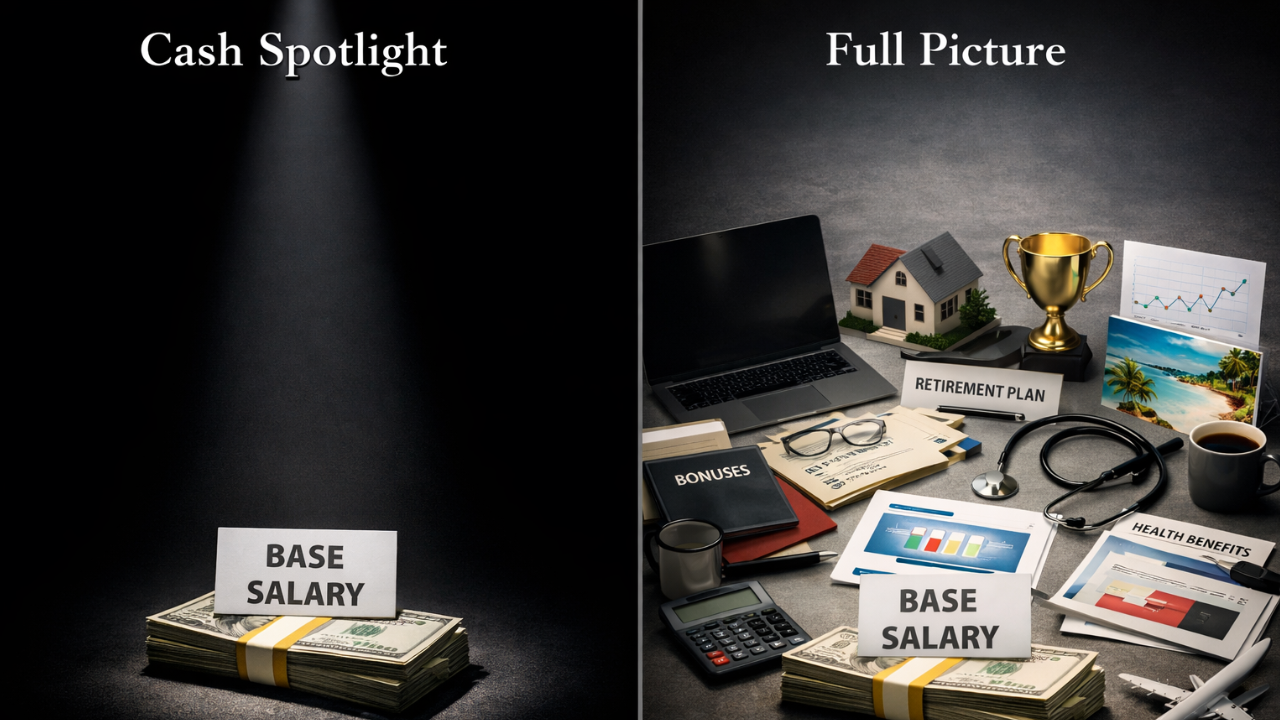
When you lose a candidate to a competitor, the conversation always focuses on base salary. "They offered $20,000 more." "We couldn't match their comp." But base salary is only one component of total rewards, and often not the most important one. Companies that over-index on cash and under-invest in other reward components are optimizing the wrong variable - paying more for talent than necessary while delivering less total value than they could.
Total rewards encompass everything an employee receives in exchange for their work: base salary, variable compensation, equity, benefits, perks, development opportunities, and the intangible value of culture and mission. Different components have different costs to the company and different values to employees. Strategic compensation design means understanding these asymmetries and exploiting them.
The Components and Their Economics
Base salary is the foundation - fixed, predictable, most valued by risk-averse employees. It's also the most expensive component for the company because it's guaranteed cash outflow that increases with every raise and compounds over time. A $10,000 base salary increase costs you $10,000 this year, $10,000 next year, and $10,000 every year after (plus the compounding effect of future percentage raises on the higher base).
Variable compensation (bonuses, commissions, profit sharing) ties pay to performance or results. From the company's perspective, variable comp is more efficient than base salary when it's truly variable (you don't pay it in bad years or when employees underperform). From the employee's perspective, it's less valuable than equivalent base salary because it's uncertain. This creates an opportunity: you can deliver the same perceived total comp while lowering your guaranteed cash outflow.
The challenge is that most "variable" compensation isn't actually variable. If you pay bonuses every year regardless of company performance, employees treat it as guaranteed income. If you've paid 100% of target bonus for five consecutive years, then the year you pay 70% feels like a pay cut, not variable compensation working as designed. True variable comp requires discipline to actually vary the payout.
Equity (stock options, restricted stock units, phantom stock) converts employees into owners. For growth companies with credible paths to liquidity (acquisition or IPO), equity can be enormously valuable while costing the company nothing in cash. You're trading dilution for compensation expense reduction.
The problem with equity is that most employees discount it heavily. A stock grant with a theoretical value of $50,000 might be worth only $20,000-30,000 in the employee's mental accounting because of uncertainty about future value and liquidity timing. If you're offering equity instead of cash, you need to overcome this discount; either by offering much more equity than the cash equivalent, or by building credible equity value (strong growth trajectory, clear path to exit, track record of successful exits in your leadership team).
Benefits (health insurance, retirement contributions, parental leave, disability insurance) vary widely in value based on employee circumstances. A comprehensive family health plan might cost the company $20,000 annually but be worth $30,000+ to an employee with a family and health issues. Generous parental leave might cost $50,000 per employee who uses it but create intense loyalty. Conversely, these same benefits might be worth very little to a young, single, healthy employee who values cash more.
Perks (remote work, flexible schedule, learning budgets, equipment allowances, gym memberships) are often high-value to employees but low-cost to the company. Remote work flexibility might cost you nothing (or save money through reduced office space) while being worth $10,000-$15,000 in the employee's mental accounting. A $2,000 annual learning budget might cost you $2,000 but provide $5,000 in perceived value to development-focused employees.
Development opportunities (training, mentorship, career growth, scope expansion) are even more asymmetric. They cost you primarily time and attention, not cash, but can be the primary reason high-performers stay. The employee who turns down a 20% raise elsewhere because they're learning rapidly and growing their skills in your environment is making a rational economic decision if the skill development has higher long-term value than the short-term cash.
Culture and mission (the intangible quality of work environment, mission alignment, team quality) are difficult to quantify but matter enormously to some employee segments. Employees at nonprofits accept 20-30% lower cash compensation for mission alignment. Employees at high-prestige companies accept lower comp for resume value. These are real economic tradeoffs, not just sentiment.
Why Companies Over-Index on Cash
If total rewards are what actually matter, why do most companies fixate on base salary? Several reasons:
Cash is easy to compare.
Glassdoor shows base salary. Candidates can compare $150,000 vs. $170,000 directly. They can't easily compare "Company A pays $150,000 plus 15% bonus target, generous equity, full remote work, and strong development culture" vs. "Company B pays $170,000 plus 10% bonus target, minimal equity, office-required three days/week, and unclear development." The complexity of total rewards comparison means candidates anchor to the simplest metric: base salary.
Recruiters and candidates negotiate on base.
When a candidate says "I need $160,000 to make this move," they're talking about base salary. When their recruiter tells them they're underpaid, the reference is base salary. The negotiation focuses on the most visible, comparable component, which drives companies to compete on base even when other components might be more cost-effective.
Finance teams focus on cash costs.
Your CFO's budget model shows cash compensation expense, not the theoretical value of your equity grants or the perceived value of your flexible work policy. When you need to cut costs, you cut cash compensation because that's what directly affects cash flow. This creates organizational focus on base salary as the primary compensation lever.
Simplicity in administration.
It's easier to manage 100 employees who each earn a base salary than to manage 100 employees who each have a customized total rewards package balancing base, variable comp, equity, benefits, and perks. Standardization pushes toward cash because it's the simplest common denominator.
The result is that companies pay more cash than necessary while delivering less total value. You could deliver equivalent or greater perceived value to employees at lower cash cost by optimizing the total rewards mix.
Employee Segment Preferences
Not all employees value rewards components equally. Your total rewards strategy should account for these preference differences:
Early career employees (first 5 years of work)
This group typically prioritizes development over cash. They're building skills and credentials that will affect their lifetime earnings. A role where they're learning rapidly, working with strong team members, and building marketable skills is worth 10-20% less cash than a role where they're stagnating. These employees also tend to be more risk-tolerant around equity because they have long time horizons.
Mid-career employees (families, mortgages, school costs)
This group prioritizes cash and benefits. They need reliable income to meet fixed expenses. Health insurance matters enormously. Work-life balance and schedule flexibility become valuable as they manage family responsibilities. Equity is less attractive because they're more risk-averse and have shorter time horizons before they need liquidity.
Senior employees (late career, wealth accumulation)
This group often prioritizes equity, autonomy, and impact over incremental cash. The difference between $250,000 and $280,000 in base salary matters less than the difference between 1% and 2% equity in a company with serious growth potential. These employees have enough cash; they're optimizing for wealth creation and meaningful work.
Risk-tolerant employees (typically younger, unmarried, no dependents)
This group accepts equity-heavy packages with lower cash. The typical startup offer of 70% market-rate cash plus meaningful equity is attractive to this segment because they're optimizing for upside, not stability.
Risk-averse employees (families, financial obligations, previous bad experiences with equity)
This group heavily discounts equity and prioritizes cash and benefits. They've seen too many equity grants go to zero or stay illiquid forever. They want guaranteed income and comprehensive benefits.
The strategic implication: if you're hiring mostly early-career or risk-tolerant talent, you can compete with lower cash and higher equity/development. If you're hiring mid-career talent with families, you need competitive cash and strong benefits. Trying to apply the same total rewards approach to all segments is inefficient.
Strategic Total Rewards Design
The high-leverage approach is to identify which total rewards components are low-cost to you but high-value to employees, then over-index on those components:
Remote Work
Remote work flexibility costs you little or nothing (potentially saves office space costs) but is worth $10,000-$15,000 annually in employee mental accounting. Full remote work plus occasional travel for team gatherings often beats 20-30% higher cash for location-dependent roles.
Learning
Learning and development budgets cost you the actual spend ($2,000-$5,000 per employee annually) but provide outsized value to development-focused employees. The employee who can attend conferences, buy books and courses, and invest in skills development sees this as worth 2-3x the nominal cost.
Workspace Allowances
Equipment and workspace allowances for remote workers cost $2,000-$4,000 upfront but create goodwill and productivity improvements. Letting employees choose their own equipment rather than providing standard corporate laptops often delivers better value at similar cost.
Flexible Schedules
Flexible schedule costs you nothing but matters enormously to employees with family responsibilities or personal scheduling preferences. The ability to work 7am-3pm instead of 9am-5pm, or to flex hours around family needs, is worth thousands in employee mental accounting.
Parental Leave
Generous parental leave is expensive when used (potentially $50,000+ per employee in paid leave plus coverage costs) but is used by a small percentage of employees in any given year, making the amortized cost relatively low. For employees who use it, the loyalty and goodwill created far exceeds the cost.
The insight is that value is not symmetric with cost. A $1,000 investment in remote work setup might create $3,000 in perceived value. A $10,000 increase in base salary creates exactly $10,000 in value (actually less, after taxes). Optimize for the asymmetries.
The Equity Challenge
Equity is the most powerful total rewards component when it works, and nearly worthless when it doesn't. The conditions for equity to work:
Growth trajectory is credible
If you're growing revenue 50%+ annually and have a clear path to acquisition or IPO within 3-5 years, equity grants have real expected value. If you're growing 10-15% annually and haven't articulated an exit strategy, equity grants are theoretical value that most candidates will discount to near zero.
You communicate value transparently
Most employees don't understand equity. They don't know what a 0.1% equity grant means in dollar terms, how vesting works, or what liquidation preferences mean for their payout. If you can't explain "here's what this equity could be worth in these realistic scenarios, and here's the probability distribution," the employee will discount it heavily.
You have a track record
If your founders and leadership team have successfully exited companies before and made employees wealthy, new equity grants are more credible. If this is everyone's first startup, candidates are right to be skeptical about equity value.
The equity is meaningful
A 0.05% equity grant in a company worth $500 million might be worth $250,000 at exit, but most candidates can't or won't do that math. A 0.5% equity grant that you explain as "potentially worth $2-5 million if we achieve our growth plan and exit at realistic valuations" is more compelling, even though the expected value might be similar once you factor in probability.
The mistake companies make with equity is offering token amounts (0.05%-0.1% grants) and expecting them to substitute for meaningful cash compensation. Either offer enough equity to meaningfully change the employee's financial outcome, or don't bother using equity as a major compensation component; just pay market cash instead.
Benefits ROI: What Actually Matters
Benefits are expensive and vary widely in perceived value.
High-ROI benefits:
Health Insurance
Comprehensive health insurance costs $15,000-$25,000 per family annually but is valued at or above cost by employees with families and health issues. This is table stakes in the US market; you can't compete without it.
Retirement Contributions
Retirement contributions (401k match) cost 3-6% of salary but have asymmetric value. Younger employees undervalue retirement benefits (they're optimizing for current cash), while older employees value them highly. The employee who's maxing their 401k and getting a 6% company match sees this as worth more than 6% of salary.
Parental Leave
Parental leave creates intense loyalty among employees who use it but is used by only 5-15% of employees annually. The amortized cost is low, the goodwill is high.
Low-ROI benefits:
Office Perks
Fancy office perks (free lunch, game rooms, dry cleaning) are expensive and create dependency rather than loyalty. Employees come to expect them and resent their absence, but they don't drive retention or performance. These were popular during the 2010s startup era and have largely been recognized as low-value.
Premium Office Space
Premium office space in expensive locations costs enormous amounts in rent but isn't valued by employees who would prefer remote work. The trend toward remote work has made expensive office space a negative-ROI investment for many companies.
Unlimited PTO
Unlimited PTO sounds generous but often results in employees taking less time off than defined PTO policies. It also creates accounting advantages for the company (no accrued PTO liability) while providing no real value increase to employees.
The strategic question for each benefit: does this cost us $X and create more than $X in value to employees? If not, consider reallocating that budget to higher-value components.
Communicating Total Rewards
If you're competing on total rewards rather than just cash, you need to communicate the full package effectively. Most companies fail at this:
Bad communication: "We're offering $140,000 base plus benefits."
Better communication: "We're offering $140,000 base plus 15% target bonus ($21,000), equity valued at $50,000 at current valuation, full remote work flexibility, and $3,000 learning budget - total package of approximately $214,000 plus the value of remote flexibility."
The second version helps the candidate understand they're not comparing $140,000 to a competitor's $155,000 offer; they're comparing total packages where yours might be competitive or even superior despite lower base.
For equity specifically, provide multiple scenarios: "Your equity grant is 0.2% of the company. If we achieve our business plan and exit at a conservative valuation in 4 years, this would be worth approximately $400,000. At our target valuation, it would be worth $800,000. At current trajectory, we believe realistic exit value is in the $600,000-$1,000,000 range for your grant."
This level of specificity requires confidence in your equity value, but it's far more compelling than "you'll get equity that could be valuable someday."
The Strategic Choice
Your total rewards strategy reflects a core strategic choice: are you competing primarily on cash, or on total package?
Cash-heavy strategy:
Lead market on base salary and bonus, meet market on everything else. This is simple, easy to explain, and works in markets where talent is scarce and sophisticated enough to compare total packages. It's also expensive and often unnecessary; you're paying premium for simplicity.
Total rewards strategy:
Meet market on cash, lead market on equity, benefits, development, and flexibility. This is more complex but potentially much more cost-effective. You're optimizing for high-value, low-cost components while keeping cash compensation competitive but not premium.
Most companies claim to compete on total rewards but actually compete on cash because they can't effectively communicate the other components or don't invest meaningfully in them. If your equity grants are too small to matter, your benefits are standard, and you don't actually offer meaningful development or flexibility, you're not competing on total rewards; you're just paying below-market cash and rationalizing it.
The test is simple: when you lose a candidate to a competitor paying $20,000 more in base salary, can you honestly say your total package was competitive? Or did you lose because your total rewards story wasn't compelling enough to overcome the cash difference?
If you can't overcome a $20,000 base salary gap with your total rewards package, you're not competing on total rewards. You're just offering below-market cash and hoping candidates don't notice.