
The Build vs. Buy Decision: Leadership Development ROI
Your company just invested $200,000 in a leadership development program for high-potential managers. The program includes executive coaching, rotational assignments, and strategic projects designed to prepare internal candidates for director-level roles. Three years later, two of the eight participants have been promoted to director, one has left the company, and five remain in their original roles with unclear advancement timelines.
Meanwhile, you've hired three external directors over the same period at recruiter fees totaling $180,000. Two integrated successfully and are performing well. One struggled with cultural fit and left after eighteen months.
Which strategy delivered better ROI? The answer isn't obvious, and that's the problem. Companies invest heavily in leadership development assuming it's always superior to external hiring. The reality is more complex. Sometimes internal development builds loyalty, preserves institutional knowledge, and creates stronger leaders. Sometimes it's expensive, slow, and produces candidates who aren't ready when positions open. Sometimes hiring externally is faster, cheaper, and brings capabilities the organization lacks.
The question isn't whether to build or buy leaders. It's when each strategy delivers better returns given specific circumstances, organizational needs, and candidate quality. Let's examine the economics.
The Build Economics: Costs and Benefits of Internal Development
Developing leaders internally requires time, investment, and acceptance of failure rates. Not everyone in a development program will successfully advance to leadership. Organizations must invest in multiple candidates to produce one successful leader, and that investment timeline extends years.
Costs
The costs start with program expenses. Executive coaching runs $20,000 to $40,000 annually per participant. Formal leadership development programs cost $10,000 to $50,000 per person depending on quality and duration. Rotational assignments create opportunity costs; the high-potential employee produces less in their temporary role than an experienced person would, and their permanent role loses productivity during the rotation. Aggregate these costs across a cohort of eight candidates over three years, and total investment reaches $400,000 to $800,000 for the program.
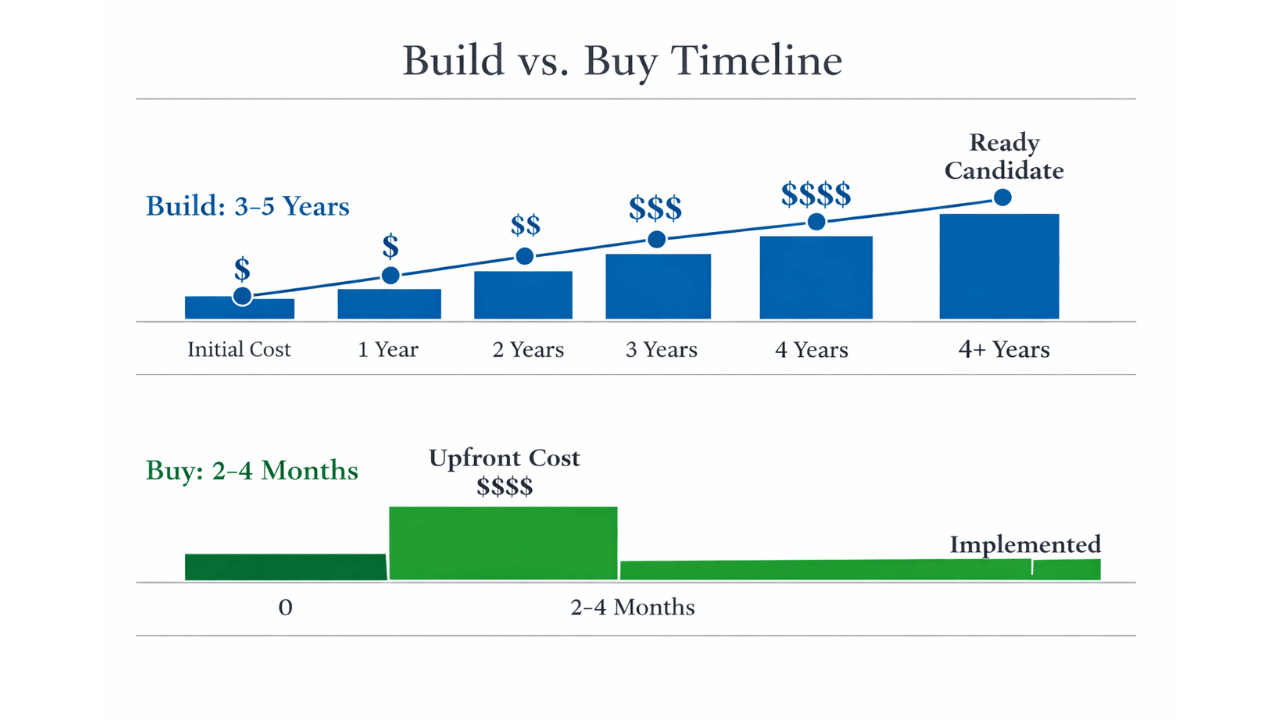
Time cost compounds the financial cost. Leadership development takes three to five years before candidates are ready for advancement. During this period, you're paying for potential future value while receiving current role performance. If three of your eight development program participants leave before reaching target roles, you've invested in developing leadership capability for competitors. The participants who stay might not be ready when positions open, forcing you to hire externally anyway.
Failed development represents pure waste. Some high-potential employees don't develop leadership capability despite investment. They might lack aptitude, lose interest, or discover they prefer individual contributor work. A development program with fifty percent success rate, where half the participants successfully advance to target roles, means half the investment produced no return. This is normal and should be priced into ROI calculations, but organizations often ignore it, treating leadership development as if all participants will succeed.
Benefits
The benefits of successful internal development are substantial but back-loaded. Promoted internal leaders arrive with deep organizational knowledge; they understand culture, relationships, history, and context that external hires take years to acquire. This institutional knowledge enables faster decisions and better navigation of organizational complexity.
Cultural fit is dramatically higher with internal promotions. Someone who has worked in the organization for five years, succeeded in multiple roles, and been deliberately developed understands and embodies cultural norms. External hires face culture fit risk; they might have excellent leadership capability but operate in ways incompatible with how things work here. Internal development eliminates this risk.
Loyalty and retention improve with visible investment in development. Employees who see the organization investing in their growth, providing coaching and stretch opportunities, and creating advancement paths are more likely to stay. This compounds over time; high-potential employees who might otherwise leave for faster advancement elsewhere remain because they see credible internal paths. The development investment itself becomes a retention mechanism.
Morale signals matter for the broader organization. Promoting from within demonstrates that advancement is possible, creating motivation for strong performers and validating the message that the company invests in people. External hiring for senior roles sends the opposite signal: outsiders get the best opportunities, insiders hit ceilings. This can trigger attrition among high performers who see their advancement blocked.
The Buy Economics: Costs and Benefits of External Hiring
Hiring external leaders delivers immediate capability at the cost of integration risk, cultural fit uncertainty, and internal morale concerns. The economic trade-off is speed versus stability.
Costs
The costs start with recruiting fees of twenty to thirty percent of first-year salary. For a director hired at $180,000, that's $36,000 to $54,000 in recruiter fees. Add premium compensation (external candidates often require above-market offers to leave current roles, especially if they're not actively looking) and the cash outlay can reach sixty to seventy percent of annual salary before the person starts.
Onboarding time represents delayed productivity. External hires take three to six months to reach full effectiveness as they learn organizational context, build relationships, and understand how decisions get made. During this period, they're consuming management attention while producing limited output. The onboarding cost is real even if it doesn't appear on an invoice.
Culture fit risk is the largest cost and hardest to predict. An external hire might have excellent leadership track record and all the right skills but operate in ways incompatible with organizational culture. They might be more hierarchical in a flat organization, more consensus-driven in a fast-moving culture, or more political in a direct-feedback environment. These mismatches often don't surface until several months into tenure, after substantial investment has been made.
Integration challenges extend beyond culture fit. Existing team members may resent being passed over for promotion, creating resistance to the external hire's leadership. Internal relationships and trust that an internal promotion inherits must be built from zero. Competitive intelligence concerns arise; what proprietary knowledge does this person bring from competitors, and what are the legal risks?
Benefits
The benefits of external hiring are speed and capability. When you need a leader now, external hiring delivers in two to four months versus three to five years for internal development. This matters when roles are critical and vacant positions create organizational dysfunction.
External hires bring proven track records. Their leadership capability has been tested and demonstrated, reducing uncertainty about whether they can perform. Internal candidates being developed represent bets on potential. External candidates represent bets on demonstrated capability. The variance is lower, even if the mean outcome isn't necessarily better.
New perspectives and capabilities are external hiring's strategic value. An organization developing leaders internally replicates its current approaches and thinking. External leaders bring different mental models, experiences from other companies, and exposure to alternative ways of operating. This is particularly valuable when the organization needs to change, enter new markets, or adopt new capabilities.
Competitive intelligence flows from external hires in both directions. You learn how competitors operate, what's working for them, and what strategic moves they're making. They learn the same about you. For fast-moving industries, this information exchange can be valuable, though it cuts both ways.
When to Build: The Case for Internal Development
Internal development makes economic sense under specific conditions: you have a long runway before the leadership need arises, strong internal candidates exist with high potential, organizational-specific knowledge is critical for success, retention of high performers is strategically important, and cultural preservation outweighs the value of new perspectives.
Time
Timeline is the primary determinant. If you know you'll need a new VP of Operations in four years due to planned retirement, you have time to develop internal candidates. If the current VP leaves unexpectedly and you need someone in three months, external hiring is the only option. Development requires long runways. Urgent needs require external talent.
Strong Internal Candidates
Strong internal candidates justify development investment. If you have three high-potential managers who could plausibly become directors with appropriate development, investing in all three makes sense. One or two will likely succeed. If you have weak internal candidates who would struggle even with substantial investment, development is wasteful; hire externally and use the development budget elsewhere.
Organization Knowledge Matters
Organizational-specific knowledge matters more in some roles than others. A CFO navigating complex regulatory environments, unique accounting treatments, and board relationships needs deep institutional knowledge. Developing them internally makes sense. A Chief Technology Officer bringing new technical capabilities might benefit from external perspective rather than organizational tenure. Match development strategy to role requirements.
Retention is Critical
Retention of high performers creates economic justification for development programs even when the primary benefit is retention rather than leadership production. If running a development program keeps three senior engineers from leaving for competitor offers, the program pays for itself through avoided turnover costs even if only one participant successfully advances to leadership. The development program becomes a retention mechanism with leadership development as secondary benefit.
Cultural Preservation
Cultural preservation is valuable when culture is a competitive advantage. Organizations with distinctive cultures that drive performance should develop leaders internally to preserve those cultures. Hiring external leaders risks diluting culture through different norms and approaches. For companies where culture is strategic, internal development protects valuable organizational DNA.
When to Buy: The Case for External Hiring
External hiring delivers better ROI when you face immediate needs, lack internal candidates with leadership potential, need capabilities your organization doesn't possess, require strategic pivots that internal candidates can't execute, or need proven change agents for turnaround situations.
Immediate Need
Immediate need drives external hiring decisions. When a critical role is vacant and organizational performance is suffering, waiting three years to develop someone internally isn't viable. The cost of prolonged vacancy exceeds the cost of external hiring, even accounting for integration risk and premium compensation.
Weak Internal Candidates
Weak internal bench strength justifies external hiring even when timeline permits development. If your candidate pool for leadership development lacks potential (your senior individual contributors don't want to manage, lack capability, or aren't interested in the required roles), investing in development is inefficient. Hire externally and build the next generation of internal candidates at more junior levels.
Capability Gaps
Capability gaps require external hiring when internal development can't produce needed skills quickly enough. If you're entering a new market, adopting new technologies, or facing competitive threats requiring capabilities you don't have, developing those capabilities internally takes years. Hiring someone who already possesses them delivers faster impact.
Strategic Pivots
Strategic pivots often require external perspective. An organization making fundamental changes to business model, target market, or operating approach may struggle when led by people deeply embedded in the old model. Internal candidates, regardless of capability, carry mental models shaped by how things have always worked. External leaders bring fresh thinking unencumbered by organizational history.
Turnaround Situations
Turnaround situations demand proven change agents. When organizational performance is poor and substantial restructuring is needed, external hiring reduces risk. Someone with demonstrated turnaround success knows what to do and has credibility to make hard decisions. Internal candidates may have the relationships but lack the experience or objectivity to execute necessary changes.
Hybrid Strategies: Building and Buying Simultaneously
The build versus buy framing implies binary choice. Smart organizations pursue both strategies simultaneously, creating competitive internal development while maintaining external hiring options and combining approaches to maximize talent quality.
Develop internal candidates while maintaining external search relationships. Run leadership development programs for high potentials while building relationships with executive recruiters and maintaining market awareness of external talent. If internal candidates develop successfully, promote them. If they don't reach readiness when positions open, you have external options ready. This reduces risk from either strategy failing.
External hires can accelerate internal development. Bringing in external leaders with specific capabilities creates learning opportunities for internal high-potentials. The external VP of Product teaches product strategy to internal managers through collaboration and observation. The organization gets immediate leadership capability while developing future internal leaders. This works when external hires are willing to mentor and internal candidates are willing to learn.
Build for core roles, buy for specialty positions. Develop internal candidates for roles central to organizational success, positions where deep institutional knowledge and cultural fit drive performance. Hire externally for specialized roles where technical expertise matters more than organizational context. A company might develop all operational leaders internally while hiring technical specialists, legal counsel, and finance experts externally.
Use external hiring to supplement weak cohorts. If a particular development program cohort underperforms (participants leave, don't develop as expected, or aren't ready when needed), supplement with external hiring rather than leaving positions vacant. This maintains organizational capabilities while the next development cohort matures.
Why Leadership Development Often Fails
Leadership development investments frequently produce disappointing returns because programs are poorly designed, participants lack motivation or capability, development activities don't build job-specific skills, outcomes aren't measured rigorously, and political access distorts participation.
No Clear Outcome
No clear role waiting after development is the most common failure mode. Organizations invest in developing leadership capability without corresponding leadership positions. The developed candidates have nowhere to go. They either leave for external opportunities or remain in current roles, frustrated. Development without clear advancement paths is expensive turnover acceleration.
Generic Programs
Generic programs that don't develop job-specific skills waste money. A leadership program teaching generic concepts like "strategic thinking" and "executive presence" without connecting to actual job requirements produces learning that doesn't transfer. Effective development builds specific capabilities needed for target roles through rotations, project leadership, and exposure to real challenges.
Time Conflict With Current Responsibilities
Time commitment conflicts with day job responsibilities. High-potential employees selected for development programs still have current role expectations. Adding twenty hours monthly for coaching, programs, and projects creates overload. Participants either underperform in their current role or shortchange development activities. Both outcomes waste investment.
Lack of Measurement
Lack of measurement enables persistent failure. Organizations don't track leadership development ROI rigorously. They measure activity (number of participants, completion rates, satisfaction scores) rather than outcomes like promotion rates, retention of program alumni, time to readiness, and post-promotion performance. Without measurement, programs persist even when they consistently fail to produce leaders.
Political vs Merit
Political access rather than merit determines participation in many programs. Senior leaders nominate their favorites rather than objectively assessing potential. This produces cohorts including participants who lack capability or interest in leadership, diluting program quality and wasting investment on people who won't advance regardless of development.
High-ROI Development Approaches
Leadership development that actually produces leaders shares common characteristics: participants rotate into stretch roles with real responsibility, coaching addresses specific challenges rather than generic leadership concepts, action learning projects solve real business problems, reverse mentoring exposes senior leaders to junior perspectives, and peer learning cohorts enable shared problem-solving.
Rotations
Rotations into stretch roles provide the most powerful development. Someone being developed for director takes an interim director role for six months, managing a small team with actual decision authority. They learn management by managing, with coaching support but real accountability. This tests capability, builds specific skills, and provides clear evidence of readiness. Someone who succeeds in a six-month interim director role is ready for permanent promotion. Someone who struggles needs more development or isn't suited for the role.
Executive Coaching
Executive coaching tied to specific challenges delivers better ROI than generic coaching. A high-potential manager struggling with delegation gets coaching focused on delegation techniques, mindset shifts, and behavioral changes. The coaching addresses real problems in real time, producing immediate performance improvement alongside skill development. Generic coaching about leadership presence and strategic thinking rarely translates to job performance.
Action Learning Projects
Action learning projects that solve real business problems combine development with business value. A cohort of high-potentials gets assigned a strategic challenge (improving customer retention, reducing operational costs, entering new markets) and must analyze the problem, develop solutions, and present recommendations to executives. They learn strategic thinking by doing strategic work, with the added benefit of actual business impact from their analysis.
Reverse Mentoring
Reverse mentoring exposes senior leaders to junior perspectives while developing high-potentials' communication and influence skills. A junior employee mentors a senior executive on technology trends, customer insights, or market dynamics. The junior employee develops executive presence and learns to communicate with senior leaders. The executive gains perspective from someone closer to frontline reality. Both benefit.
Peer Learning Cohorts
Peer learning cohorts enable high-potentials to share challenges, solutions, and experiences. A group of managers being developed for director roles meets monthly to discuss problems they're facing, approaches they're trying, and lessons learned. Peer learning is often more valuable than formal training because it's specific, relevant, and timely. The cohort also builds relationships that support collaboration after participants are promoted.
Measuring Development ROI
Leadership development ROI should be measured like any other investment: costs incurred, benefits received, and return relative to alternative uses of capital. Most organizations measure activity rather than outcomes, making ROI assessment impossible.
The relevant metrics are promotion rate of program alumni compared to non-participants, retention of high-potentials in development programs versus high-potentials not selected, time from program completion to target role promotion, post-promotion performance of program alumni versus external hires, and cost per leader produced through development versus cost of external hiring.
Rate of Promotion
If sixty percent of development program participants reach target leadership roles within three years of completion, the program works. If twenty percent reach target roles, it doesn't. Compare this to baseline; what percentage of high-potentials not in programs reach leadership roles? If the difference is small, the program isn't adding value.
Retention of High Potentials
Retention of program participants matters because early attrition wastes investment. If half your development cohort leaves within two years, you're developing leaders for other companies. High retention suggests the program creates loyalty and advancement paths that keep people engaged.
Time to Readiness
Time to readiness determines program value for organizational needs. If you need directors in three years and your development program produces ready candidates in four years, timing mismatches create forced external hiring. Programs should align development timelines with anticipated needs.
Post-Promotion Performance
Post-promotion performance is the ultimate test. Leaders developed internally should perform well in their promoted roles, with measurable outcomes like team retention, productivity, and stakeholder satisfaction. If promoted internal candidates consistently struggle while external hires succeed, development isn't producing ready leaders despite successful promotion.
Cost Per Leader
Cost per leader produced is the financial metric: total program cost divided by number of participants who successfully reach target roles. If a three-year program costs $600,000 and produces three new directors, cost per leader is $200,000. Compare this to external hiring cost, $50,000 recruiter fee plus premium compensation plus integration time. If the external hiring all-in cost is $100,000 to $150,000 per leader, development costs more. Factor in retention benefits, cultural fit, and institutional knowledge before concluding development isn't worth the premium.
The Strategic Question: What's Your Leadership Pipeline?
The build versus buy decision should be strategic rather than reactive. Organizations need explicit leadership pipeline strategies: which roles develop internally, which hire externally, what development investments make sense given anticipated needs, and how to balance internal development with external hiring to maximize both quality and readiness.
Companies should segment leadership roles by internal development appropriateness. Core operational roles, positions requiring deep institutional knowledge, and roles central to culture should primarily fill through internal development. Strategic positions, specialized roles, and positions requiring capabilities the organization lacks should primarily fill through external hiring. This creates clarity about where to invest development resources.
Anticipated needs determine development investment levels. If you expect to need six new directors in the next four years due to growth and retirements, developing eight to ten internal candidates makes sense, assuming fifty to sixty percent success rates. If you expect to need two new directors, developing eight candidates is over-investment; develop three or four and supplement with external hiring as needed.
The balance between internal development and external hiring should reflect organizational strategy. Companies where culture is competitive advantage and institutional knowledge drives performance should emphasize internal development. Companies facing strategic transformation, entering new markets, or requiring new capabilities should emphasize external hiring. Most organizations need both, with proportions varying by role and circumstances.
Leadership development isn't always better than external hiring. It's sometimes better, sometimes worse, and frequently similar in cost when rigorously measured. Organizations that treat development as obviously superior waste money developing people who aren't ready, leave positions vacant waiting for internal candidates, and miss opportunities to bring in external talent who could deliver better results. Those that treat external hiring as obviously superior alienate high performers seeking advancement, lose institutional knowledge to turnover, and damage culture through repeated outsider appointments.
The answer is strategic choice based on specific circumstances: timeline to need, quality of internal candidates, role requirements, organizational priorities, and honest assessment of development program effectiveness. Make that choice deliberately rather than defaulting to either extreme, and leadership quality improves while development ROI rises. That's better than assuming one approach always works.
Part of the Leadership Frameworks series examining strategic decisions about leadership selection, development, and organizational design.