
The Decision Bottleneck: When Senior Leaders Become the Constraint
In many organizations, the most expensive operational problem isn't headcount, technology, or market conditions. It's that the people at the top of the hierarchy have become the rate-limiting factor on everything below them.
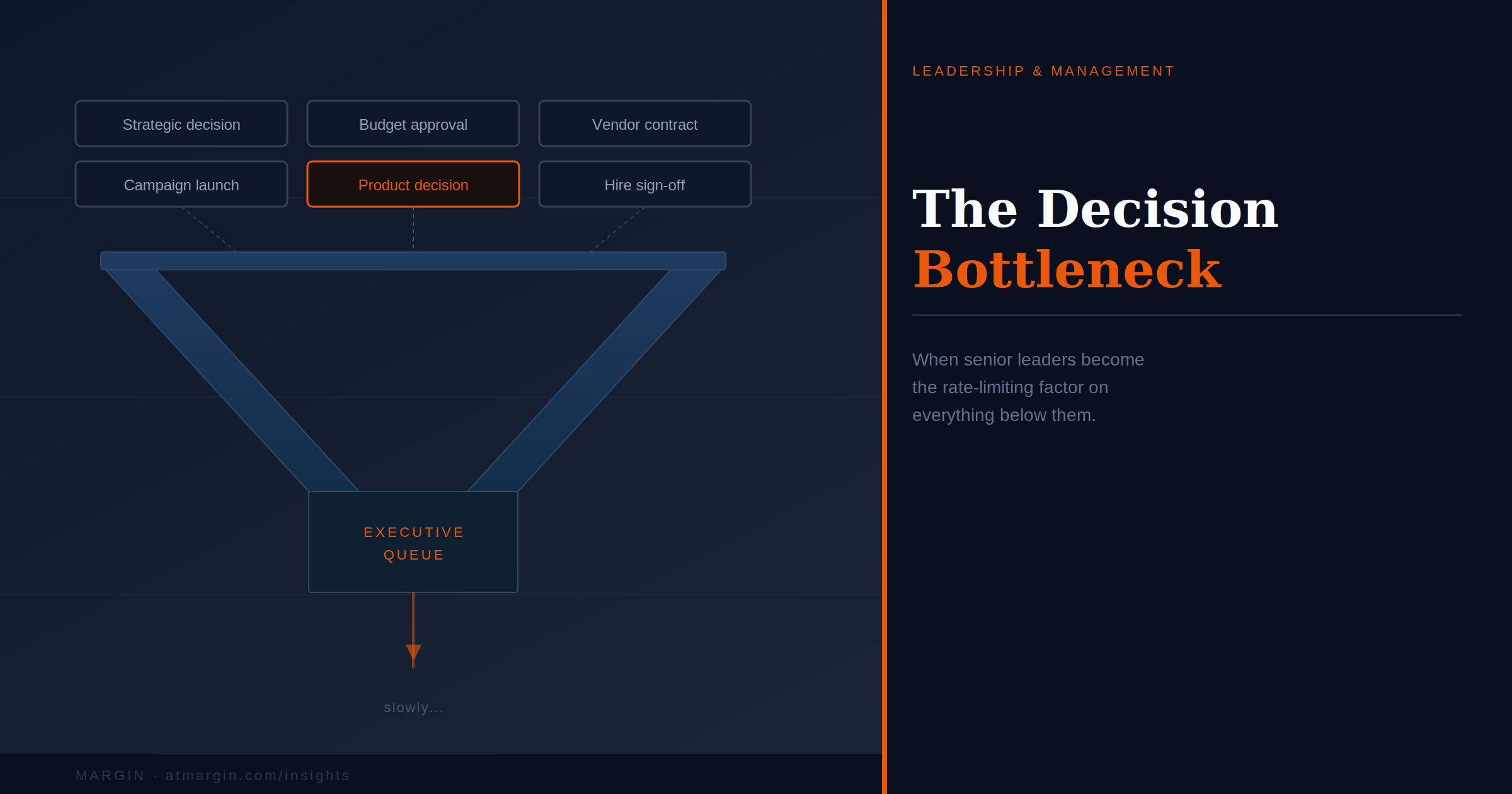
There is a category of organizational problem that does not appear on any financial statement and is rarely identified in any operational review, because the people best positioned to identify it are usually the people causing it. The symptom is familiar: decisions that take too long, initiatives that stall without explanation, teams that perform well in isolation but can't move without approval, executives who are perpetually busy and perpetually behind. The diagnosis, in many of these cases, is not workload. It is decision architecture — specifically, a concentration of decision authority at the top of the organization that made sense at an earlier stage of growth and has since become the primary constraint on organizational velocity.
When an organization is small, centralized decision-making is a feature. The founder or CEO who makes every significant call ensures consistency, maintains quality control, and preserves the strategic coherence that early-stage organizations depend on. This is not a failure of delegation — it is a rational response to an environment where the cost of a bad decision is high and the people positioned to make decisions number in the single digits.
As organizations grow, the same logic inverts. The cost of centralized decision-making scales with organizational complexity in a way that the benefit does not. A CEO making every significant decision in a 30-person organization is the source of organizational coherence. The same CEO making every significant decision in a 300-person organization is the source of organizational paralysis — and typically doesn't know it, because the reporting structure continues to function, the meetings continue to happen, and the outputs continue to be produced, just more slowly than they should be and with more friction than anyone is formally accounting for.
The Invisibility of Bottleneck Costs
Decision bottlenecks are organizationally invisible in a way that makes them particularly persistent. Unlike other operational inefficiencies — excess headcount, redundant processes, underperforming vendors — the cost of a leadership bottleneck does not appear in any budget line and is not captured by any standard management accounting system.
What the cost actually consists of is a set of lost time values that are real but dispersed. The product team that has been waiting three weeks for executive approval to proceed with a development decision has not created a visible budget variance — they have consumed their sprint capacity on lower-priority work while the pending decision sits in an executive queue. The business development team that cannot respond to a client request without two levels of approval has not generated a measurable loss — only a slightly slower response time that cumulatively disadvantages the organization in competitive situations that nobody is tracking. The manager who rewrites a proposal four times because they are uncertain what the executive actually wants — because the executive has not defined the decision parameters clearly enough to act without review — has not produced an error report. They have produced four proposals and a depleted capacity for the rest of the week's work.
The accumulated cost of these micro-frictions across a complex organization is substantial. Research on organizational decision-making velocity consistently finds that companies with faster, more distributed decision processes outperform peers on revenue growth, margin expansion, and employee retention — not because speed is intrinsically valuable, but because decision velocity is a proxy for organizational clarity, trust, and resource allocation efficiency. The bottlenecked organization is not just slow. It is expensive in ways that don't show up on the income statement.
There is also a talent dimension that receives insufficient attention. High performers — the employees who produce disproportionate value and have the most employment options — are acutely sensitive to organizational friction. They are motivated by autonomy, by the ability to exercise judgment, and by the experience of their work having impact. An environment where every meaningful decision requires senior approval is an environment that systematically frustrates the people most capable of making those decisions well. The bottleneck doesn't just slow the organization down; it accelerates the departure of the people best positioned to fix it.
Diagnosing Whether You Have a Bottleneck Problem
“The bottleneck doesn’t just slow the organization down; it accelerates the departure of the people best positioned to fix it.”
The challenge in addressing leadership bottlenecks is that organizations rarely have an objective view of where decisions are actually being made. The formal authority structure describes where decisions are supposed to be made. The actual decision structure — which is often different and is almost never documented — describes where they are actually being made. The gap between the two is where most bottleneck problems live.
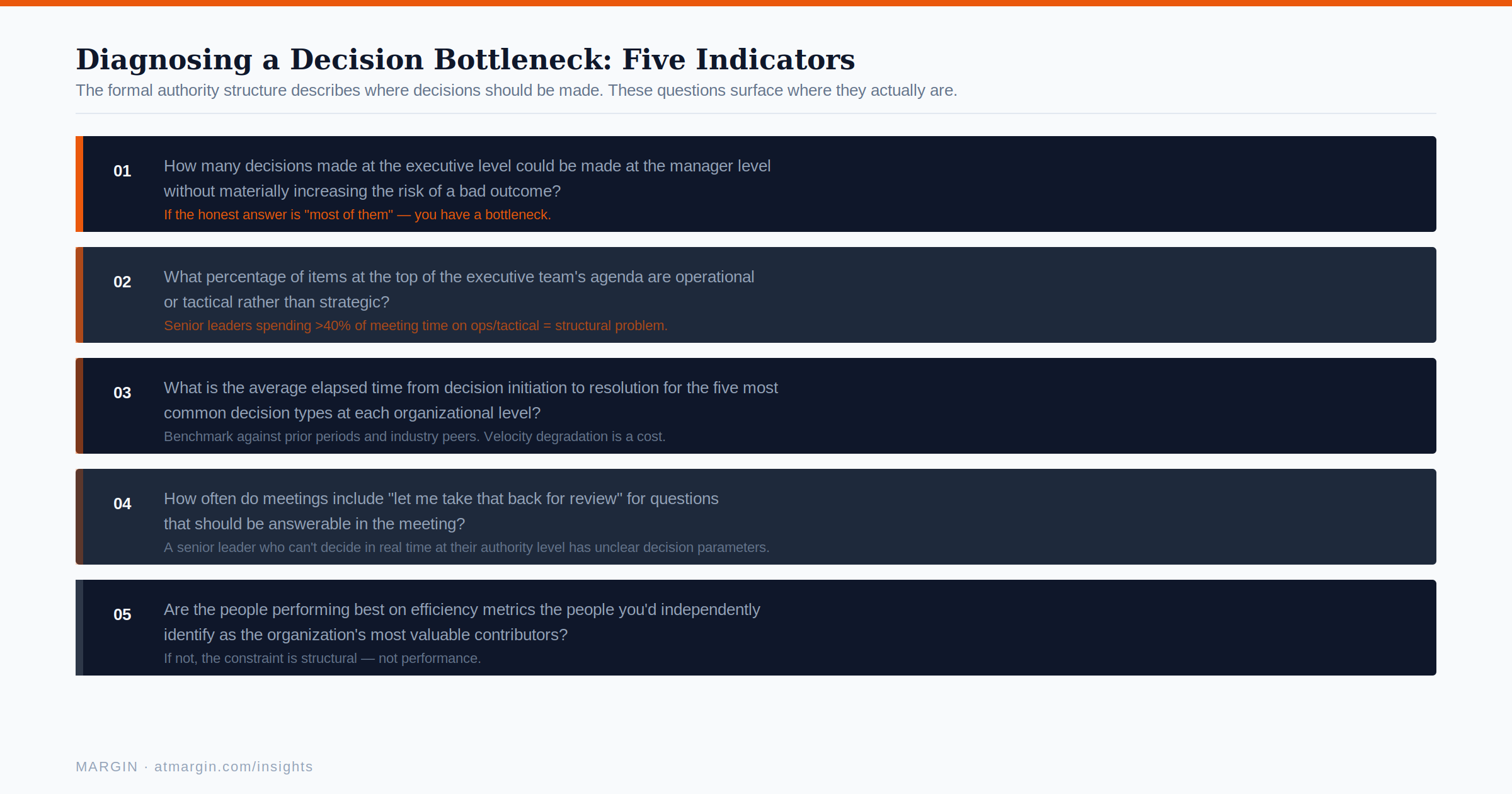
Several diagnostic questions help surface the gap. How many decisions that are made at the executive level could be made at the manager level without materially increasing the risk of a bad outcome? What is the average elapsed time from decision initiation to decision resolution for the five most common types of decisions at each organizational level? What percentage of items at the top of the executive team's agenda are operational or tactical rather than strategic? How often do meetings include the phrase "let me take that back for review" for questions that should be answerable in the meeting?
The last question is particularly revealing. Organizations with functional decision distribution have executives who can make decisions in real time at their level of authority and escalate the genuinely ambiguous ones clearly and quickly. Organizations with bottleneck problems have executives who routinely receive questions they should be able to answer and defer them — not because the questions are genuinely complex but because the executives have never clarified their own decision parameters clearly enough to act without further consultation.
A more formal diagnostic is a decision audit: a structured inventory of significant decisions made over the previous quarter, mapped against who made them, who was consulted, how long the process took, and whether the decision required the level of authority it actually consumed. Decision audits are uncomfortable exercises — they tend to reveal that executives are spending meaningful time on decisions that should be made one or two levels below them — but they provide the factual basis for a distribution conversation that anecdote and impression cannot.
The RACI Trap — and What Actually Works
Most organizations, when they decide to address decision clarity, reach for the RACI matrix. Responsible, Accountable, Consulted, Informed — a framework for mapping roles against decision types that has become standard in organizational design. It is administratively appealing, easily documented, and frequently useless in practice.
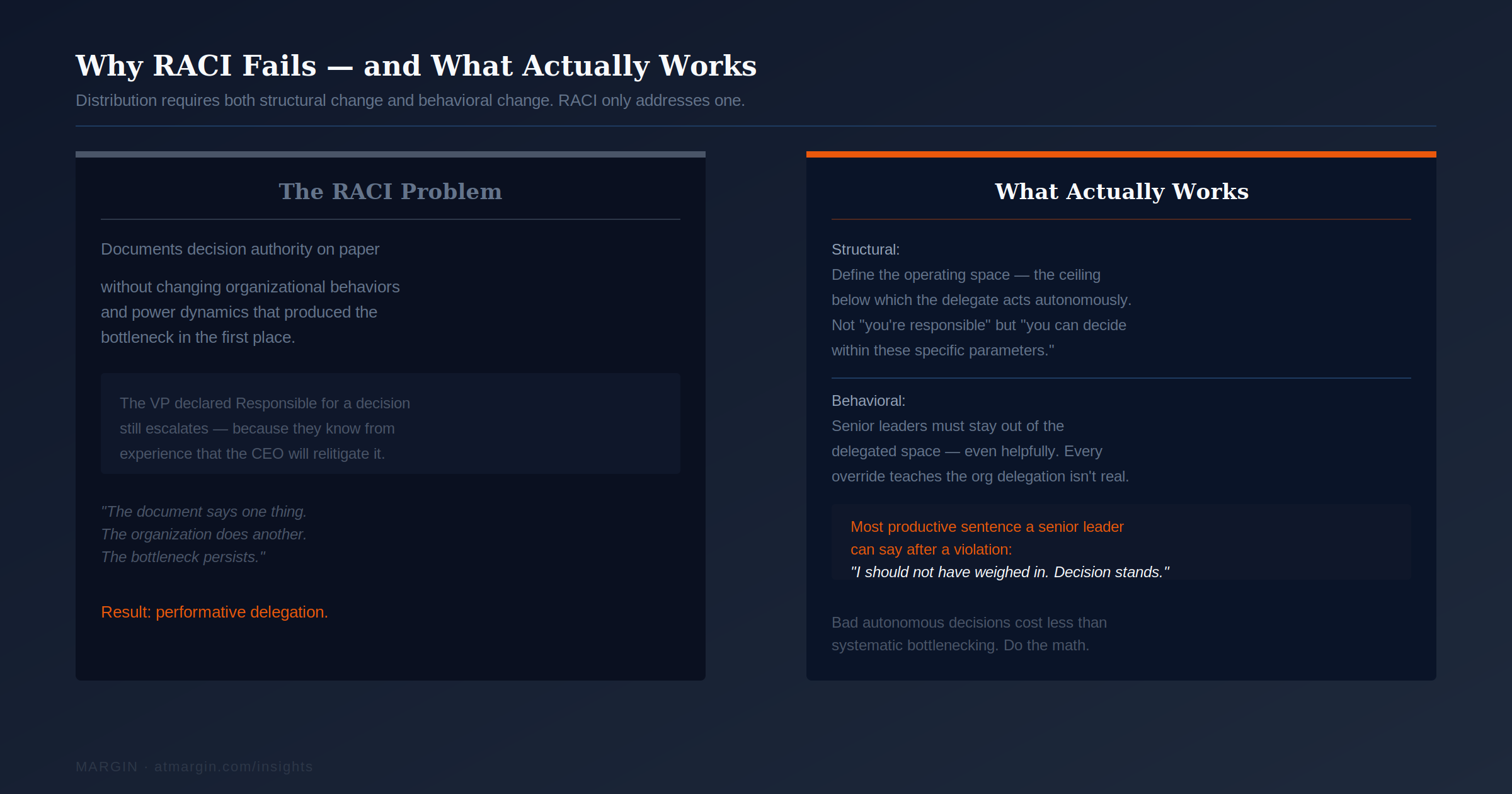
The RACI matrix fails for a consistent reason: it describes decision authority on paper without changing the organizational behaviors and power dynamics that produced the bottleneck in the first place. Declaring that a VP is Responsible for a decision does not change the fact that the VP knows from experience that the decision will be relitigated if the CEO doesn't like the outcome, and therefore behaves as though they need implicit approval before acting. The document says one thing. The organization does another. The bottleneck persists.
What actually works requires addressing both the structural and the behavioral dimensions of decision distribution.
Structural Side
On the structural side: define not just who is responsible for a decision, but what the decision parameters are — the range within which the designated decision-maker can act without escalation. A VP of marketing who is responsible for campaign budget decisions needs to know the ceiling below which they can act autonomously. A product leader who owns roadmap prioritization needs to know which constraints are non-negotiable and which are flexible. Structural decision distribution is not about transferring accountability — it is about defining the operating space within which authority can be exercised without triggering review. Most organizations that attempt delegation without defining these parameters find that their delegates continue to escalate, not because they are incapable but because the implied rules are too ambiguous to act under confidently.
Behavioral Side
On the behavioral side: senior leaders who have operated in centralized-decision environments for years have habits that don't automatically change when the org chart is redesigned. The CEO who inserts themselves into decisions that have been formally delegated — even well-intentionedly, even with the aim of being helpful — is signaling to the organization that the delegation isn't real. This behavior is extremely common and extremely corrosive. Every time a senior leader overrides or revisits a decision that was made at the appropriate level, they teach the organization that delegation is performative and that real authority still sits at the top.
Addressing this requires explicit commitment from senior leaders to stay out of the operating space that has been designated as subordinate decision territory — and to repair trust quickly when they violate that commitment, which they will. "I should not have weighed in on that, and I am not reversing the decision" is among the most organizationally productive sentences a senior leader can say, and it is rarely said.
The Escalation Protocol
For the decisions that genuinely require senior involvement — the strategic calls, the resource allocation decisions above defined thresholds, the situations involving competing priorities that can only be resolved at the executive level — the organization needs a fast, clear escalation path. The goal is not to eliminate senior decision-making. It is to ensure that senior leaders are spending their decision capacity on the decisions only they can make, and that everything else is resolved at the level closest to the work. A well-designed escalation protocol includes: a clear definition of what constitutes an escalation-worthy decision, a designated point of contact for urgent escalations, a response time commitment from senior leaders to escalated items, and a feedback loop so that the decision-maker who escalated understands the reasoning behind the resolution and can apply it to future situations.
What Distributed Decision-Making Requires
Distributing decisions is not the same as abdicating oversight. The organizations that do it well build two capabilities simultaneously: the authority to decide at lower levels and the accountability infrastructure to make that safe.
The authority component is structural and behavioral — defining parameters, modeling the delegation through senior leader behavior, and resisting the temptation to re-centralize when an autonomous decision produces a bad outcome. Bad decisions will be made at every level of the organization. The question is whether the cost of bad decisions made autonomously at lower levels is larger or smaller than the cost of delayed, bottlenecked decisions waiting for senior review. In most complex organizations, the math strongly favors autonomous bad decisions over systematic bottlenecking.
The accountability component is what makes this sustainable. Distributed decision-making requires clear performance expectations, transparent outcome tracking, and a culture in which decision-makers at every level can report bad outcomes without fear of punishment for the act of deciding. Organizations that punish autonomous decisions that go wrong while praising centralized decisions that go equally wrong will quickly teach their managers that escalation is always the right move — and the bottleneck will reconstitute itself, regardless of what the org chart says.
The executive team that succeeds at this transition typically has one thing in common: they have been honest with themselves about why the decision centralization happened in the first place. Sometimes it is genuine risk management. Often it is a preference for control that has been rationalized as quality assurance. The organizations that make the transition durable are those that can distinguish between the two, protect the former, and systematically dismantle the latter.