
The Executive Onboarding Gap
Organizations spend months and significant capital identifying a senior hire. Then they invest almost nothing in the window that determines whether that hire succeeds. The math on this has never made sense.
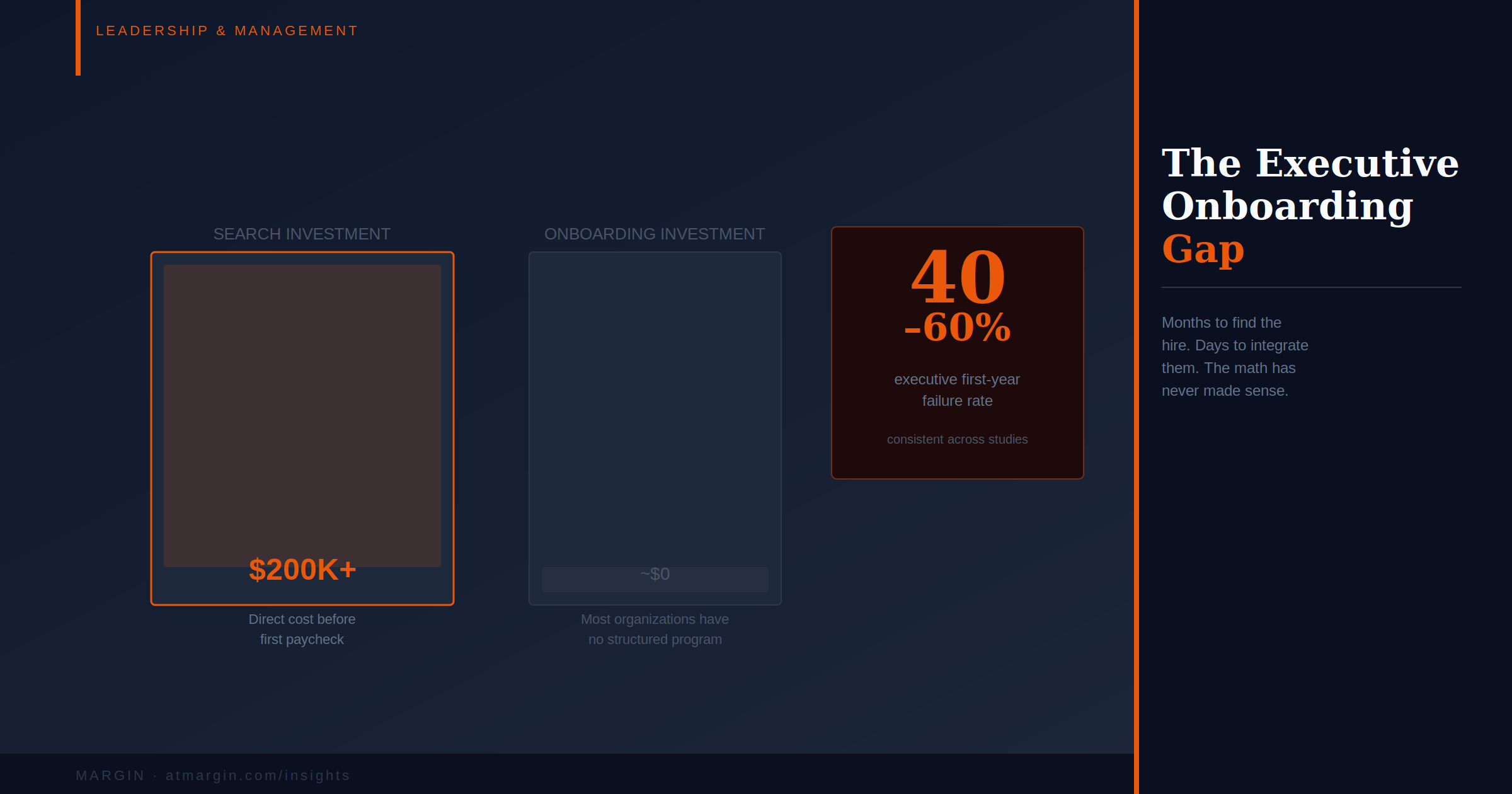
Consider the economics of a senior executive search. The organization identifies a need, develops a position specification, engages a retained search firm, runs a four-to-six month process, selects a finalist, negotiates an offer, and waits out a notice period. From identification to in-seat, the elapsed time is typically six to nine months. The direct cost — search fees, travel, executive time, and the vacancy cost examined elsewhere in these pages — is substantial, often exceeding $200,000 before the first paycheck is issued.
Now consider what happens in the ninety days after the new executive arrives. In most organizations: a brief HR orientation covering benefits and systems access. A round of introductory meetings. An expectation, rarely stated but universally felt, that the new leader will figure the rest out on their own. Because that is what executives do. They are senior. They are capable. They have been through this before.
This logic is understandable, expensive, and wrong. Studies of executive transition outcomes consistently put first-year failure rates for externally hired leaders at between 40 and 60 percent. The definition of failure varies — some studies count involuntary departure, others count failure to meet performance expectations, others track time-to-productivity — but the range is remarkably consistent across methodologies. Roughly half of executive hires do not achieve their intended purpose within their first year. The organizations that have the most structured onboarding practices report significantly lower failure rates. The majority of organizations have no structured onboarding practice above the manager level at all.
The gap between the investment in finding an executive and the investment in integrating one is one of the most expensive and most easily preventable inefficiencies in talent management.
Why Onboarding Stops at the Manager Level
The absence of executive onboarding infrastructure is not an oversight — it reflects a set of beliefs about senior leaders that are partially accurate and significantly overapplied.
The first belief: senior executives have done this before and don't need hand-holding. There is something to this. An experienced executive brings capabilities, judgment, and professional habits that a new college hire does not. The learning curve for systems and processes is shorter. The professional socialization is already complete. The argument that experienced executives need onboarding support in the same form and volume as entry-level employees is not correct.
But the argument that experienced executives don't need onboarding support is also not correct, and the conflation of these two positions costs organizations far more than it saves. What a senior executive needs upon joining is not administrative orientation. It is structured access to the organizational intelligence required to make good decisions in a new environment: an accurate picture of the informal authority structure, the historical context behind current strategic decisions, the cultural norms that are load-bearing versus decorative, the relationships that need to be built before the executive can exercise real influence, and the landmines that exist in every organization but are invisible to anyone who just arrived.
This intelligence cannot be acquired through an org chart, a strategy deck, or a round of introductory coffee meetings. It takes deliberate effort by people who already have it — current organizational leaders who are willing to invest time in transferring it — and a structured process that ensures the right knowledge reaches the new leader in the right sequence. Most organizations provide neither, on the assumption that a capable executive will acquire it organically.
Some do. Many don't. And the ones who don't are failing at the organizational integration task, not the competence task — which is why executive failure is so often attributed to "cultural fit" rather than capability. The executive had the capabilities. The organization failed to integrate them into an environment where those capabilities could be applied effectively.
The second belief driving the onboarding gap: there is organizational pressure to see results quickly. A new executive who is in structured onboarding meetings instead of doing visible work can feel like a liability rather than an asset in the early weeks. The search was visible. The hire was announced. Stakeholders are watching. The new leader feels this pressure acutely and often responds by compressing their integration timeline — trying to demonstrate value before they have the context to do so reliably. This frequently leads to early decisions that, in hindsight, were made without adequate understanding of the environment. Early missteps damage organizational trust and slow the executive's effectiveness for months after the initial mistake.
What Executive Integration Actually Requires
Effective executive onboarding is not a longer version of the employee orientation process. It is a different exercise with a different purpose: accelerating the new leader's ability to exercise judgment in a specific organizational context. The structure should reflect this.
The pre-boarding phase.
“The executive had the capabilities. The organization failed to integrate them into an environment where those capabilities could be applied effectively.”
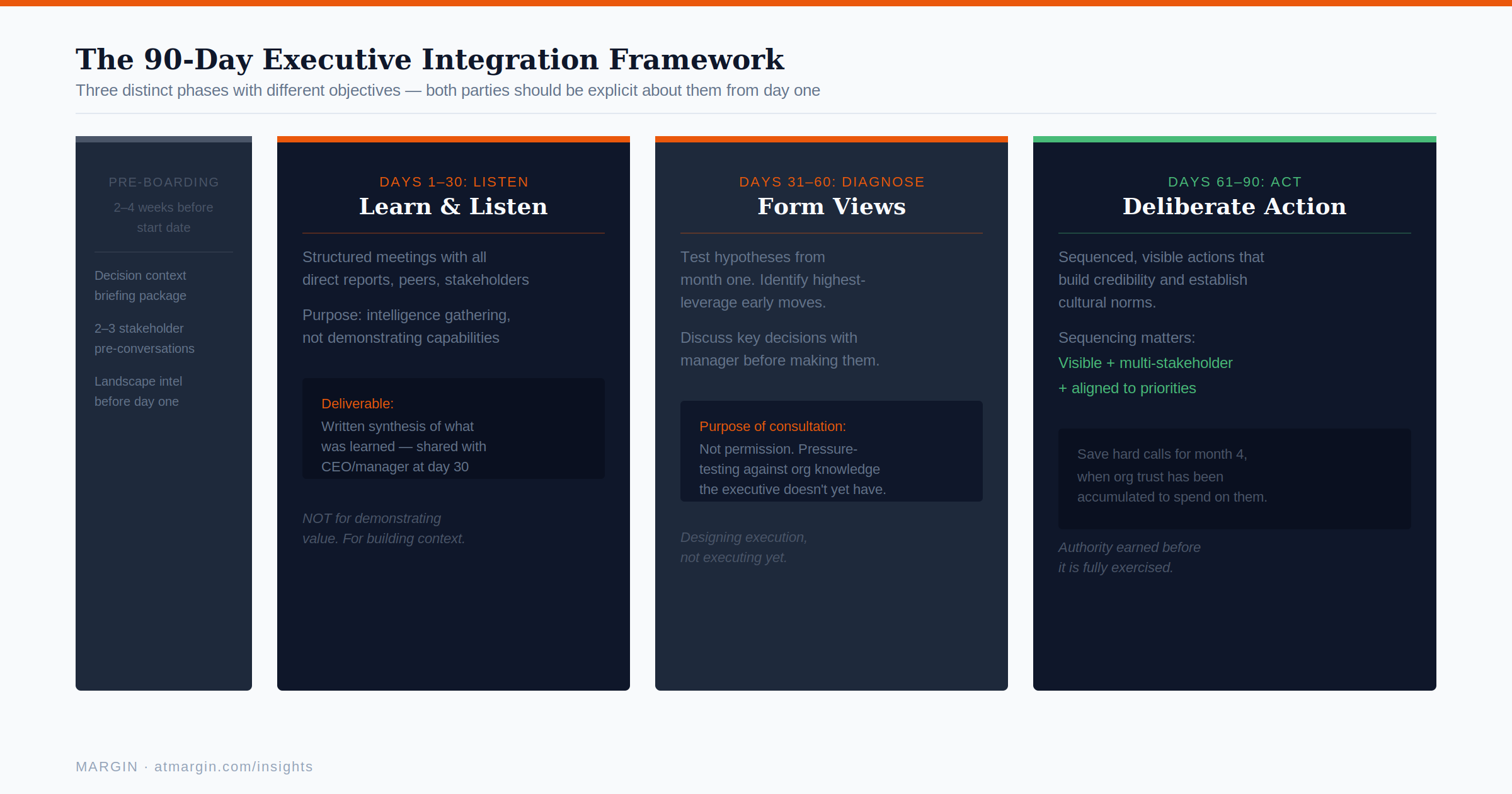
The onboarding process should begin before the executive's first day — ideally two to four weeks before start, while the notice period is being served. During this phase, the organization should provide: a comprehensive briefing package covering organizational structure, key personnel, current strategic priorities, recent significant decisions (and the reasoning behind them), and any near-term challenges the executive will inherit. The briefing package is not a welcome kit — it is a decision context document, organized around what the executive will need to understand to make good judgments in their first 90 days. If the package takes more than a few hours to read and process, it has been overcomplicated.
Separately, the executive should have pre-boarding conversations with two or three key organizational stakeholders — not introductory meetings, but substantive briefings on the landscape they're walking into. Who are the critical relationships? What are the current tensions the new leader should know exist? What decisions are pending that will require early input? This intelligence is almost never transmitted through formal channels, and the new executive who arrives on day one without it is operating blind in an environment that everyone else can navigate from memory.
The 30-60-90 framework.
The first 90 days of executive tenure should be organized around three distinct phases with different objectives, and both the organization and the new leader should be explicit about those objectives from the beginning.
The first 30 days should be almost entirely focused on learning and listening. The new executive should have structured meetings with every direct report, peer, and key stakeholder — not to demonstrate their capabilities or share their early perspectives, but to understand how those individuals experience the organization, what they believe is working and not working, and what they most hope the new leader will do or not do. This is deliberate intelligence gathering, and it should be framed as such. The deliverable from day 30 is a written synthesis of what the executive has learned — a document they produce for themselves and share with their manager or CEO that demonstrates their understanding of the organizational landscape before they begin operating in it.
The second 30 days shift from listening to diagnosis. The executive begins forming views, testing hypotheses developed in the first phase, and identifying the highest-leverage early moves available to them. They are still not executing — they are designing an approach to execution based on informed analysis rather than early impressions. Key decisions from this phase should be discussed with the executive's manager or a designated integration partner before being made, not to obtain permission but to pressure-test the logic against organizational knowledge the executive doesn't yet have.
The third 30 days introduce deliberate, sequenced action. The executive begins exercising their authority in ways that have been carefully selected to build organizational credibility, demonstrate their capabilities, and establish the cultural and relational norms they intend to maintain. The sequencing of early wins matters: actions that are visible, that benefit multiple stakeholders, and that align the new leader with organizational priorities are more valuable than actions that are substantively significant but politically complex or organizationally divisive. Save the hard calls for month four, when the executive has enough accumulated organizational trust to spend on them.
The integration partner role.
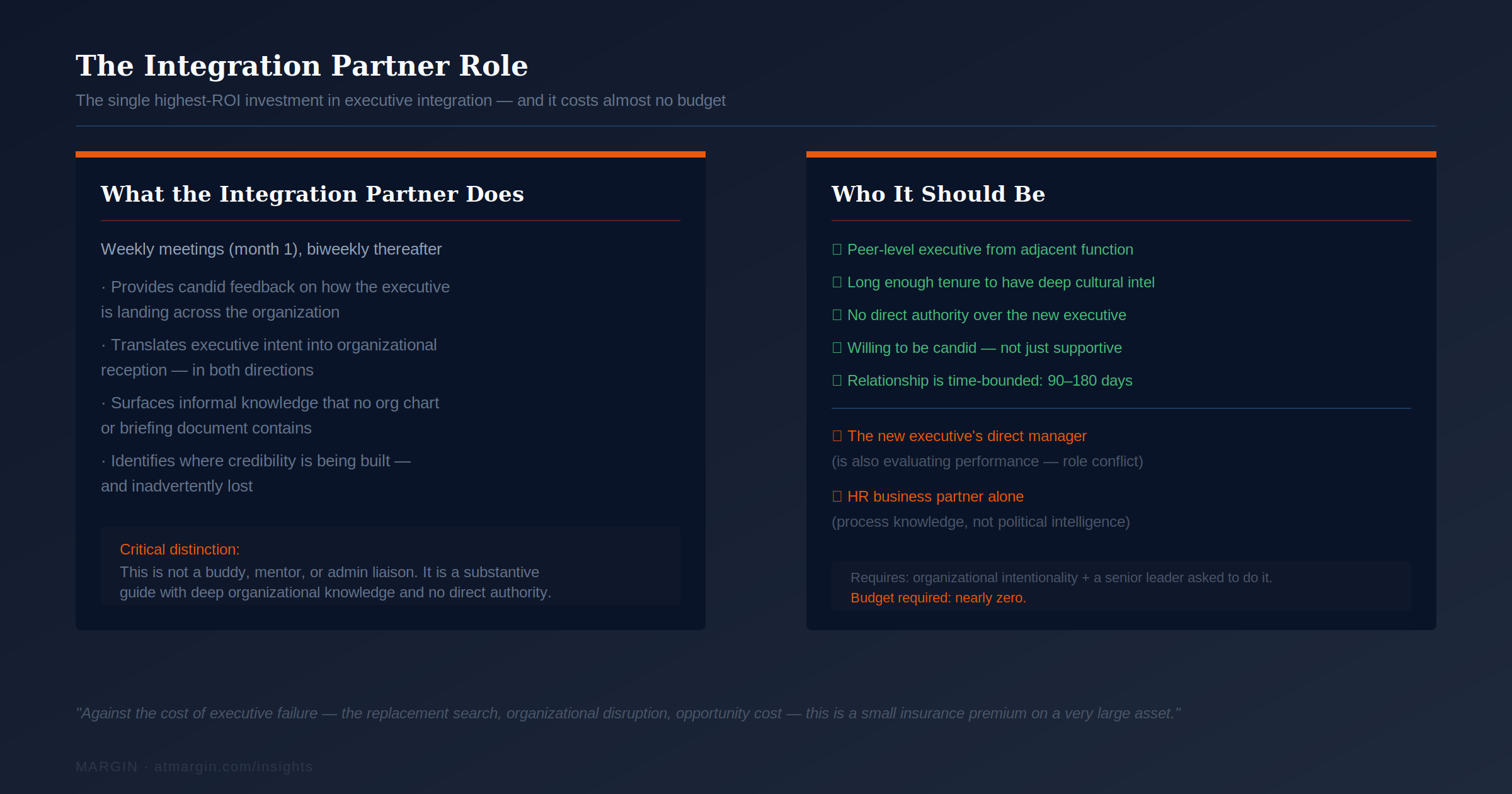
The most consistent differentiator between organizations with high executive integration success rates and those without is the presence of a designated integration partner — a senior internal leader who serves as the new executive's organizational guide for the first 90 to 180 days. This is not a buddy, a mentor, or an administrative liaison. It is a substantive relationship with someone who has deep organizational knowledge, no direct authority over the executive, and an explicit responsibility to accelerate the executive's effectiveness.
The integration partner meets with the new executive regularly — weekly in the first month, biweekly thereafter — and provides candid, specific feedback on how the executive is landing, where they are building credibility, and where they are inadvertently losing it. They serve as a translator between the new executive's intentions and the organization's reception of those intentions — a function that is invaluable and that the executive's direct manager is often not positioned to provide, because the manager is also evaluating the executive's performance.
Integration partners are typically peer-level executives or senior leaders from adjacent functions who have been at the organization long enough to have accurate cultural intelligence. The relationship is time-bounded and purpose-specific. It is among the highest-return investments an organization can make in executive integration, and it requires almost no budget — only organizational intentionality and a willingness to ask someone to do it.
Measuring Integration Success
Executive onboarding programs are rare; executive onboarding programs with defined success metrics are rarer still. This matters because without measurement, there is no feedback loop — no way to know whether the integration investment is producing the intended outcome.
The metrics worth tracking fall into two categories. The first is leading indicators — signals during the integration period that predict eventual success: the new executive's self-reported confidence in their organizational understanding, the quality of decisions made in the first 90 days as assessed by the executive's manager and key stakeholders, and the pace at which the executive is building the relationships identified as critical at the start of the integration process. These are qualitative assessments, and that is fine. They are more predictive than the lagging indicators that organizations typically wait for.
The second is time-to-productivity metrics: how long until the executive is operating at the performance level the organization anticipated when they made the hire? For most senior roles, organizations have an implicit expectation — often 6 to 12 months — but rarely make it explicit or track it formally. Making the expectation explicit, sharing it with the new executive, and tracking performance against it transforms onboarding from an administrative exercise into an accountable process. It also gives the organization early warning when the trajectory is not where it needs to be, while there is still time to intervene rather than simply wait for the outcome to become clear.
The cost of executive failure is not merely the sunk cost of the search. It is the replacement search, the organizational disruption of a second transition in the same role, the damage to the team and function that experienced leadership instability, and the opportunity cost of everything that didn't get done while the role was navigated by someone who never fully arrived. Against that cost, a structured 90-day integration program with an assigned integration partner is not an expensive intervention. It is a small insurance premium on a very large asset.