
The Geography of Pay: How Remote Work Broke Compensation Strategy (And What Replaces It)
Geographic pay differentials gave compensation teams a clean framework for twenty years. Remote work dismantled the logic in three. Most organizations are still improvising their response.
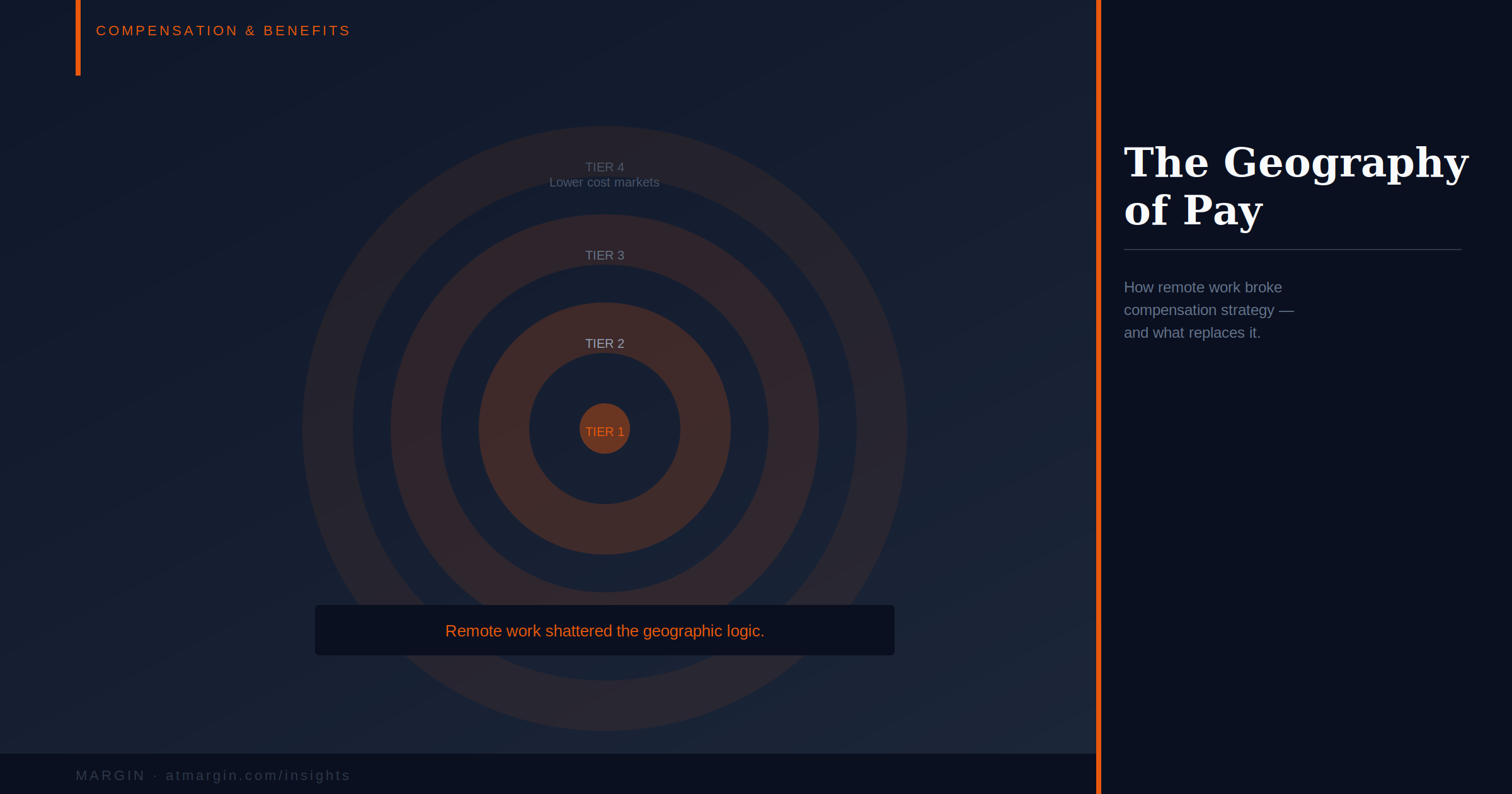
For most of the modern compensation era, geography was a useful simplification. Pay was anchored to the labor market where the employee worked. Cost-of-living adjustments made the math legible. The San Francisco engineer earned more than the Cleveland engineer because the San Francisco labor market priced that role higher and the cost of living demanded it. The system was imperfect — it underpriced talent in emerging markets and overpriced it in expensive ones relative to actual productivity — but it was coherent, administratively manageable, and broadly accepted by employees who understood the logic.
Remote work broke this. Not gradually, and not in a way that organizations had time to build principled responses to. Between early 2020 and the end of 2023, a significant share of the knowledge workforce decoupled from physical office locations, and with that decoupling came a compensation question that most organizations were structurally unprepared to answer: if the employee no longer works in a specific labor market, what labor market prices their role?
The range of responses that emerged reflects the absence of any settled framework. Some organizations pay to employee location — adjusting compensation for where the employee lives rather than where the office is. Some pay to the role's originating office — a San Francisco-based team pays San Francisco rates regardless of where individual members are located. Some pay to a national standard — a single rate for each role regardless of geography. Some apply hybrid models that combine elements of each approach. A meaningful number simply improvised case by case during the hiring frenzy of 2020 and 2021 and are now living with the internal equity consequences of those improvised decisions.
None of these approaches is without defensible logic. Each also has significant costs that are becoming clearer as the dust settles and organizations examine what their improvised geographic pay strategies have actually produced.
What Each Approach Actually Does
Understanding the trade-offs requires being precise about what each geographic pay philosophy produces — not in theory, but in practice.
Pay to Employee Location
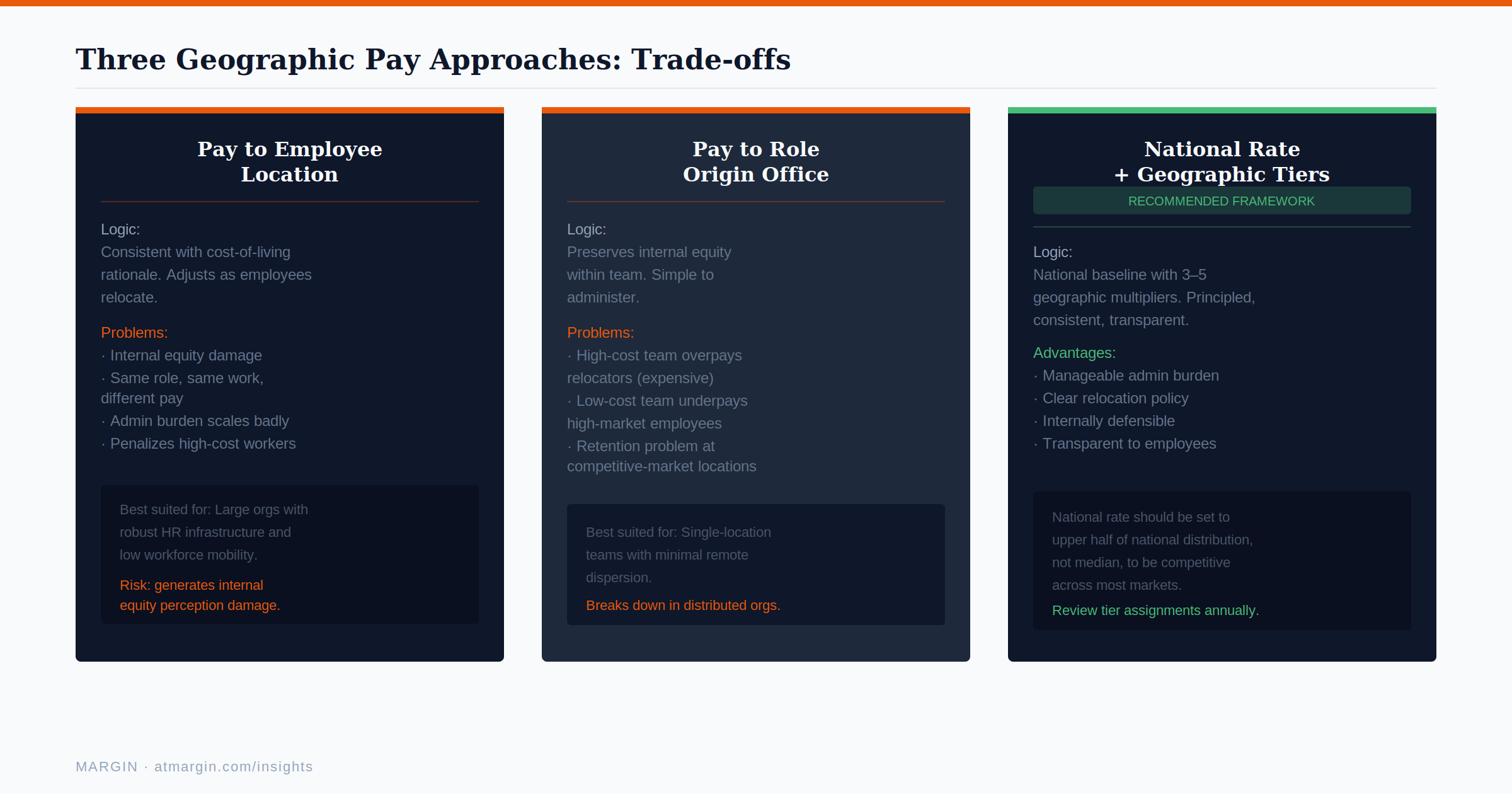
Pay to employee location is the approach most consistent with the cost-of-living logic of traditional geographic differentials. It adjusts compensation for the cost and competitiveness of the labor market where the employee lives. An employee who moves from San Francisco to Austin sees a pay reduction; an employee who moves from rural Ohio to New York sees an increase.
The administrative and equity problems this creates are significant. Remote work has enabled significant workforce mobility, and employees who made relocation decisions based on their compensation expectations now face retroactive adjustments when those expectations prove wrong.
More practically: pay-to-location systems require real-time monitoring of employee addresses and market-rate changes in dozens of labor markets simultaneously — an administrative burden that scales badly with workforce size and geographic dispersion.
There is also a talent problem. Pay-to-location systems create situations where two employees in equivalent roles, doing equivalent work, are paid meaningfully different amounts because one lives in a high-cost market and the other doesn't. To employees who have visibility into each other's compensation — and increasingly, they do — this is experienced as inequity rather than market rationality. The employee in the lower-cost market is not consoled by the cost-of-living explanation if they are performing at the same level and receiving less. The delta in pay does not track the delta in contribution.
Pay to Origin
Pay to role origin preserves internal equity across a team but creates external competitiveness problems in both directions. A team based in a high-cost market pays premium rates to employees regardless of location, which is expensive and creates arbitrary windfalls for employees who relocate to lower-cost areas. A team based in a lower-cost market underpays employees in high-cost locations relative to the local market, making retention difficult precisely where talent supply is most competitive.
National Pay Standard
National pay standards — single rates for each role regardless of location — solve the internal equity problem directly but face a competitiveness problem in high-cost markets. A national rate anchored to a median market will undercut the rates needed to attract and retain talent in New York, San Francisco, Boston, and Seattle, while potentially overpaying in lower-cost markets. For organizations operating primarily in lower-cost geographies, this is a manageable trade-off. For organizations competing for talent in multiple high-cost markets simultaneously, it is not.
The Internal Equity Problem Nobody Budgeted For
“Employees can accept almost any principled approach to geographic pay if it is applied evenhandedly and communicated transparently. What they cannot accept is the perception that the rules are being applied differently to different people.”
The most immediate and underexamined consequence of improvised geographic pay decisions made during the 2020-2022 hiring period is internal equity damage. Organizations that extended premium geographic rates during competitive talent periods, regardless of employee location, and then shifted to more disciplined geographic policies as the labor market cooled, now have internal compensation structures that are difficult to defend on any principled basis.
The engineer hired at San Francisco rates in 2021 who is working remotely from Nashville is earning a premium that the 2023 hire at national rates is not — for the same role, the same responsibilities, and plausibly the same performance level. The employee hired during the competitive period may not even know they are a compensation outlier; they simply know what they accepted. The 2023 hire may learn about the gap through informal channels, through pay transparency requirements, or through a benefits conversation. When they do, the retention risk is significant.
This is not an abstract equity concern. Research on pay equity perceptions consistently shows that employees respond more strongly to internal pay comparisons than external ones — the gap between what I earn and what my colleague earns matters more, psychologically and behaviorally, than the gap between what I earn and what the market would pay me elsewhere. An organization with a significant cohort of employees who perceive themselves as internally underpaid relative to comparable colleagues is carrying a retention liability that is not visible on any HR dashboard until the departures begin.
Addressing this liability requires, first, knowing where it exists. Compensation audits that map role, performance, and geography against current pay rates — for the full workforce, not just new hires — are the starting point. Most organizations run these audits for gender and race equity purposes. The same audit, run for remote-era geographic equity, typically surfaces a different set of outliers that are equally consequential and less frequently examined.
Building a Geographic Pay Framework That Holds
The organizations that have navigated the remote work compensation question most effectively have one thing in common: they made an explicit, documented choice about their geographic pay philosophy and then applied it consistently. The specific choice matters less than its coherence and consistency.
Employees can accept almost any principled approach to geographic pay if it is applied evenhandedly and communicated transparently. What they cannot accept — and what drives the retention and equity problems described above — is the perception that the rules are being applied differently to different people, or that the organization is making it up as it goes.
Define the geographic tier structure.
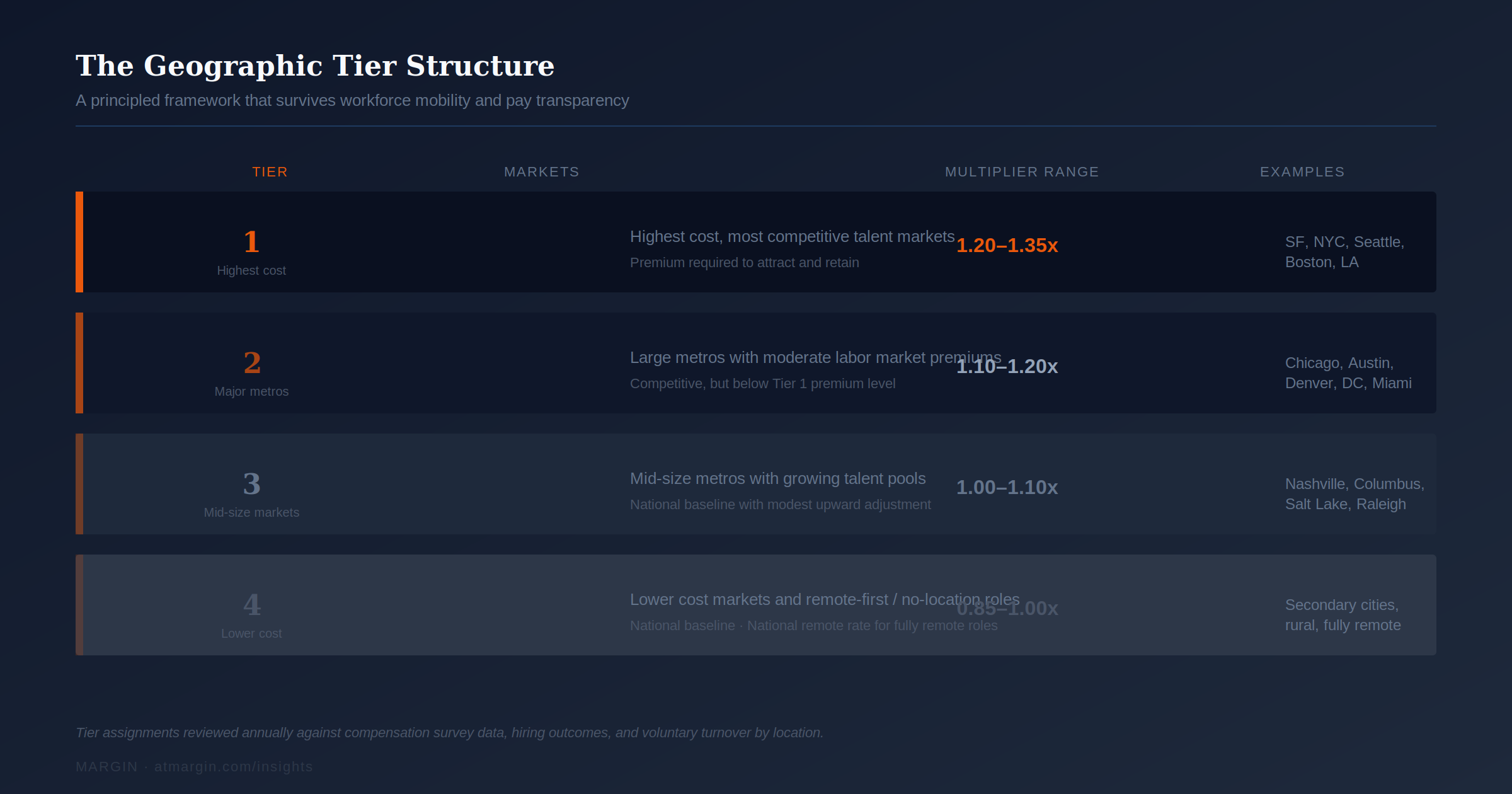
Rather than tracking every labor market in real time, most organizations of meaningful size can operate effectively with three to five geographic tiers that group labor markets by cost and competitiveness. Tier one covers the highest-cost, most competitive markets — New York, San Francisco, Seattle, Boston. Tier two covers major metros with somewhat lower labor market premiums. Tier three covers mid-size markets. Tier four or five covers lower-cost markets and rural areas. Each tier carries a defined compensation multiplier applied to a national baseline rate. This simplifies administration, creates a principled basis for location-based adjustments, and gives employees a predictable framework for understanding how relocation affects their compensation.
The tier assignment for each market should be reviewed annually against labor market data — compensation survey data, actual hiring outcomes, and voluntary turnover by location — and adjusted as market conditions warrant. The review should be documented and the methodology transparent to employees.
Establish a relocation policy.
One of the most significant failure points in remote-era geographic pay is the absence of a clear, communicated policy on how voluntary employee relocation affects compensation. Employees who moved without understanding the compensation implications and then received retroactive adjustments experienced a breach of trust that is difficult to repair. Going forward, the policy should be explicit: voluntary relocation that crosses tier boundaries results in compensation adjustment to the new tier at the next annual review cycle, with no immediate mid-year change unless the move is more than a defined distance. This gives employees accurate information before they make relocation decisions, eliminates the retrospective adjustment problem, and creates a clear administrative trigger.
Distinguish remote roles from office roles explicitly.
For roles designated as fully remote — where no specific office location is required and the organization has made an explicit commitment to remote work as the arrangement — a national rate or a broad national-remote tier is defensible and increasingly common. The compensation premium for a high-cost market is, in part, compensation for the burden of commuting, living in a high-cost area, and being physically present. If the organization is not requiring any of those things, the premium loses its rationale. Fully remote roles at national rates can be competitive in most markets, provided the national rate is set to the upper half of the national distribution rather than the median.
Address the legacy outlier population.
Organizations carrying significant numbers of employees whose compensation is out of alignment with the current geographic framework — typically those hired during the 2020-2022 period at rates that the current framework would not produce — face a choice between compression and correction. Bringing outliers down is legally and ethically problematic and almost certain to trigger departures. Bringing the surrounding population up to close the gap is expensive but produces durable equity outcomes.
A third option — acknowledging the outliers as a legacy population, grandfathering their rates, and applying the new framework only to future hires and moves — preserves equity for the existing workforce while creating clarity going forward. It does not solve the internal equity problem for new hires who will eventually learn about the gap, but it buys time while the legacy cohort naturally turns over.
The Transparency Imperative
Geographic pay strategy exists in a context where pay transparency is increasing, both legally and culturally. The organizations that will navigate the remote work compensation era most effectively are those that treat their geographic pay philosophy as a communication asset rather than an administrative detail.
Employees who understand the framework — what tiers exist, what criteria define tier assignment, how relocation affects pay, what the organization's philosophy is on national versus local rates — are better positioned to make informed decisions about their careers and less likely to feel blindsided by compensation outcomes they didn't anticipate.
The instinct to manage compensation information defensively — to share as little as possible in the belief that transparency creates problems — has a poor track record. It creates the problems it is designed to avoid. Employees who don't understand why they are paid what they are paid will construct their own explanations, and those explanations are rarely charitable to the organization. A clear, communicated geographic pay framework, applied consistently and reviewed regularly, is one of the most straightforward retention and equity investments available. The organizations that haven't built one yet are not avoiding a problem. They are deferring it.