
The Organizational Debt Nobody Is Accounting For
Technical debt has a balance sheet metaphor and a CFO who understands it. Organizational debt has neither — but it carries interest at the same rate and compounds with the same indifference.
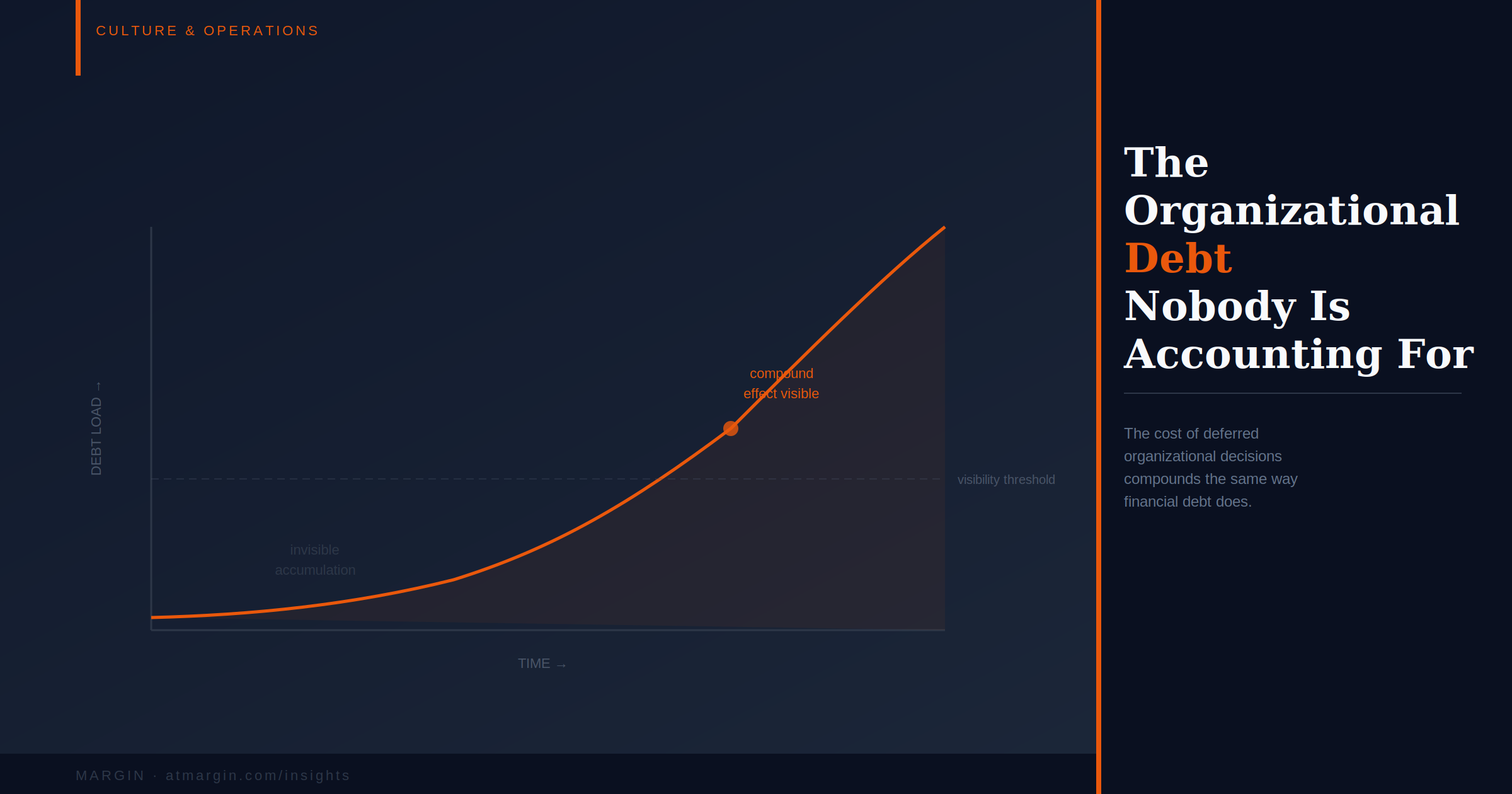
In software engineering, technical debt is a well-understood concept with an established vocabulary. It refers to the accumulated cost of shortcuts taken during development — code written to meet a deadline rather than a standard, systems integrated without clean architecture, patches applied on top of patches until the underlying structure can no longer support what's being built on it. Technical debt doesn't make itself visible until it demands payment, often at the most inconvenient possible moment and at a cost that dwarfs what the original investment would have required.
CFOs have learned to take technical debt seriously. It appears in engineering team briefings, in platform modernization proposals, in board-level discussions about infrastructure investment. There is a shared organizational vocabulary for discussing it and a shared understanding that deferring it is a choice with financial consequences.
Organizational debt is the structural equivalent — and most organizations have accumulated significant amounts of it with no shared vocabulary, no board-level visibility, and no CFO who recognizes it as a financial variable. It accrues through the same mechanism as technical debt: decisions deferred, structures left in place past their useful life, problems managed around rather than solved, processes that worked at one organizational scale and have become friction at another. It compounds in the same way: slowly and invisibly, until the accumulated weight of deferred organizational maintenance produces a failure that appears sudden and is actually years in the making.
The difference is that organizational debt doesn't have a CTO presenting a modernization roadmap. It has a COO who is too busy managing the symptoms to diagnose the cause.
How Organizational Debt Accumulates
Organizational debt is not the product of bad management. It is the predictable byproduct of organizations that grow faster than their structures, change faster than their processes, and succeed faster than their talent development can follow.
Growth
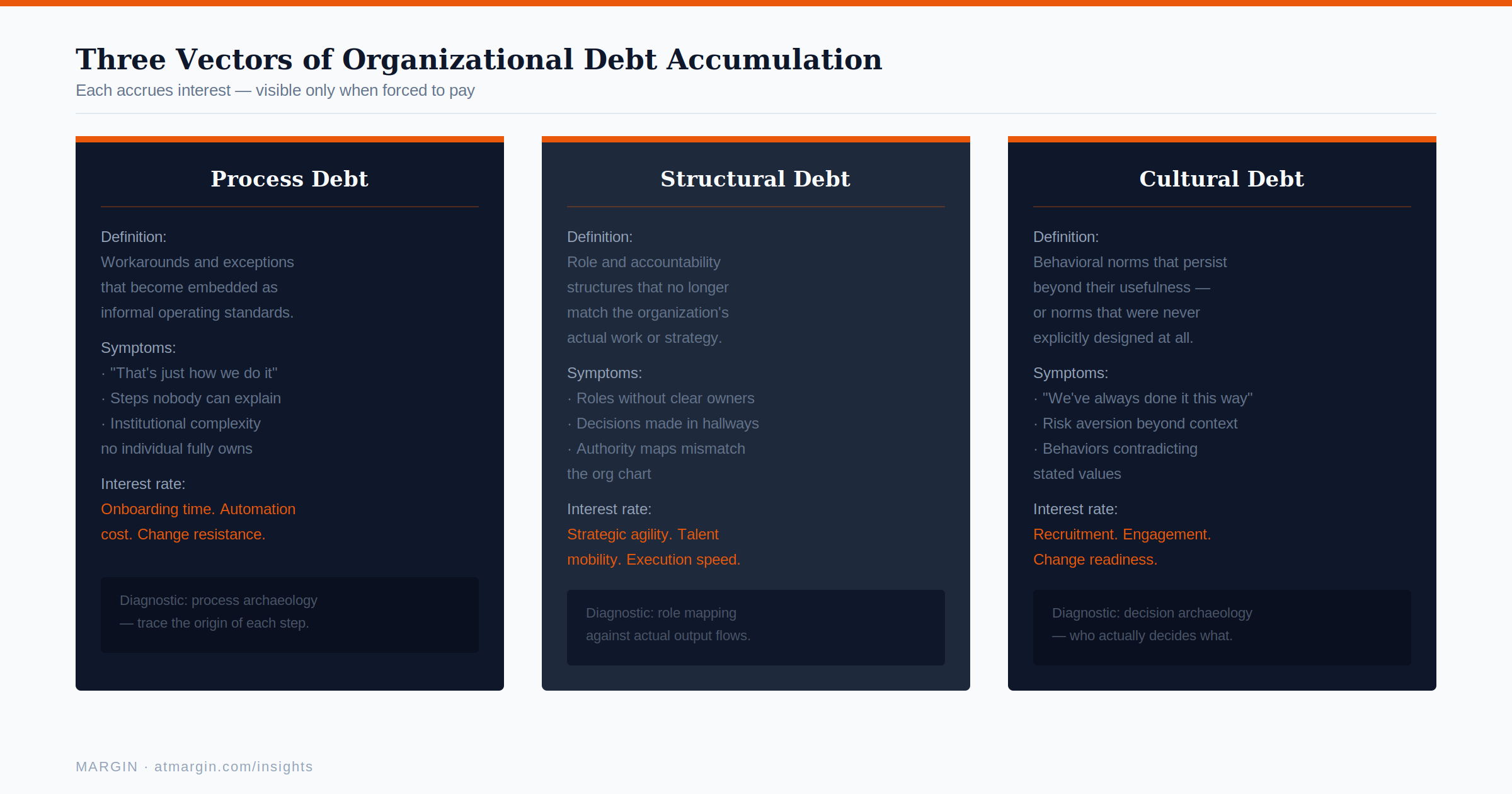
Growth is the most common vector. An organization that scales from 50 to 500 people in three years will almost certainly be operating with reporting structures, decision processes, and role definitions designed for a company a fraction of its current size. The structures that worked at 50 people are not wrong — they were right for the environment that produced them. But organizations under growth pressure rarely stop to rebuild structural foundations while the growth is happening. They add floors to a building whose foundation was designed for two stories. The debt accrues with each floor added, even as the building continues to stand.
Strategy Shifts
Strategy shifts are another major vector. When an organization pivots — from product-led to sales-led growth, from domestic to international operations, from a services model to a product model — the strategy changes before the organizational structure does. For months or years after a significant strategic shift, organizations operate with teams, roles, and incentive systems designed for the prior strategy. People are doing jobs that made sense in a strategic context that no longer exists. Processes are producing outputs that the new strategy doesn't need. Resources are allocated against a priority map that has been quietly superseded. The debt in these situations is not structural — it is strategic misalignment that has crystallized into organizational form.
Leadership Changes
Leadership changes are a third accumulation mechanism, particularly at the senior level. Every incoming executive makes adjustments — restructures a team, redefines a process, establishes a new norm. Not all of these adjustments are formally documented or communicated beyond the people immediately affected. Over time, the organization accumulates a layer of informal modifications — processes that "work the way they work because [former leader] changed them three years ago" — that nobody fully understands and that are increasingly difficult to modify because their provenance has been lost. The institutional memory that explains why things are done a certain way is often stored in the heads of two or three long-tenure employees, and when those employees leave, the organization finds itself unable to make changes it doesn't understand.
Undecided Decisions
Finally, debt accumulates through the accumulation of small decisions to not decide. Role ambiguity that is acknowledged and deferred. Process conflicts between functions that are managed by informal coordination rather than structural resolution. Reporting relationships that are unclear because redesigning them would require a political conversation nobody wants to have. Each of these deferments is, in isolation, a reasonable choice. Collectively, they constitute an organizational structure that has been shaped more by avoidance than by design.
What Organizational Debt Actually Costs
The financial cost of organizational debt operates through several channels that are individually measurable and collectively significant.
Decision velocity degradation.
“Organizational debt doesn’t have a CTO presenting a modernization roadmap. It has a COO who is too busy managing the symptoms to diagnose the cause.”
Organizations carrying significant organizational debt make decisions more slowly than their structure should require, because the decision process has to navigate around accumulated ambiguity rather than through clear authority structures. The cost of slower decisions is the opportunity cost of everything that could have been done sooner — market opportunities not captured, competitive responses delayed, resource allocation that persists past its optimal point because the decision to change it is stuck in an unclear process. This cost is genuinely difficult to quantify, but benchmarking decision velocity against industry peers or against the organization's own prior performance reveals whether the drag is significant.
Manager capacity depletion.
Organizational debt disproportionately affects the manager population, who operate at the intersection of strategy and execution. Managers in debt-laden organizations spend a meaningful portion of their time managing around structural problems — coordinating informally to compensate for formal process gaps, resolving role conflicts that shouldn't require their involvement, navigating decision ambiguity that should have been resolved at the structural level. Research on managerial time allocation consistently finds that managers in high-ambiguity environments spend 20 to 30 percent more time on coordination and conflict resolution than managers in structurally clear environments — time that is not available for development, coaching, or the substantive work of their function.
Turnover concentration in high performers.
This is arguably the most expensive channel. High performers — the employees who have the most employment options and the most acute sensitivity to organizational friction — are the first to experience organizational debt as a quality-of-work problem and the first to leave because of it. The employee who joined a company for the clarity of its operating model and encounters instead a tangle of unclear processes, ambiguous accountabilities, and decisions that go nowhere is experiencing organizational debt as a daily tax on their effectiveness. Unlike lower performers who may be insulated from the friction by narrower role scope or lower expectations, high performers encounter organizational debt at full intensity precisely because they are trying to operate at full capacity.
Onboarding failure concentration.
New executives and senior leaders fail at elevated rates in organizations carrying significant organizational debt — not because they lack capability but because the organizational intelligence required to navigate the informal workarounds, the legacy decisions, and the undocumented norms is only available to long-tenure employees who have accumulated it over years. The new leader who tries to operate through the formal structure in an organization where the formal structure is largely ceremonial will make decisions that confuse colleagues, trigger resistance they don't understand, and generate outcomes that don't match their intent. This is the organizational debt problem manifesting as an executive integration failure — and it is typically diagnosed as a cultural fit issue rather than a structural one.
A Diagnostic Framework
Identifying and quantifying organizational debt requires a deliberate diagnostic process, because the debt is by definition invisible to standard management reporting. The following diagnostic is not exhaustive, but it reliably surfaces the most consequential concentrations.
Process archaeology.
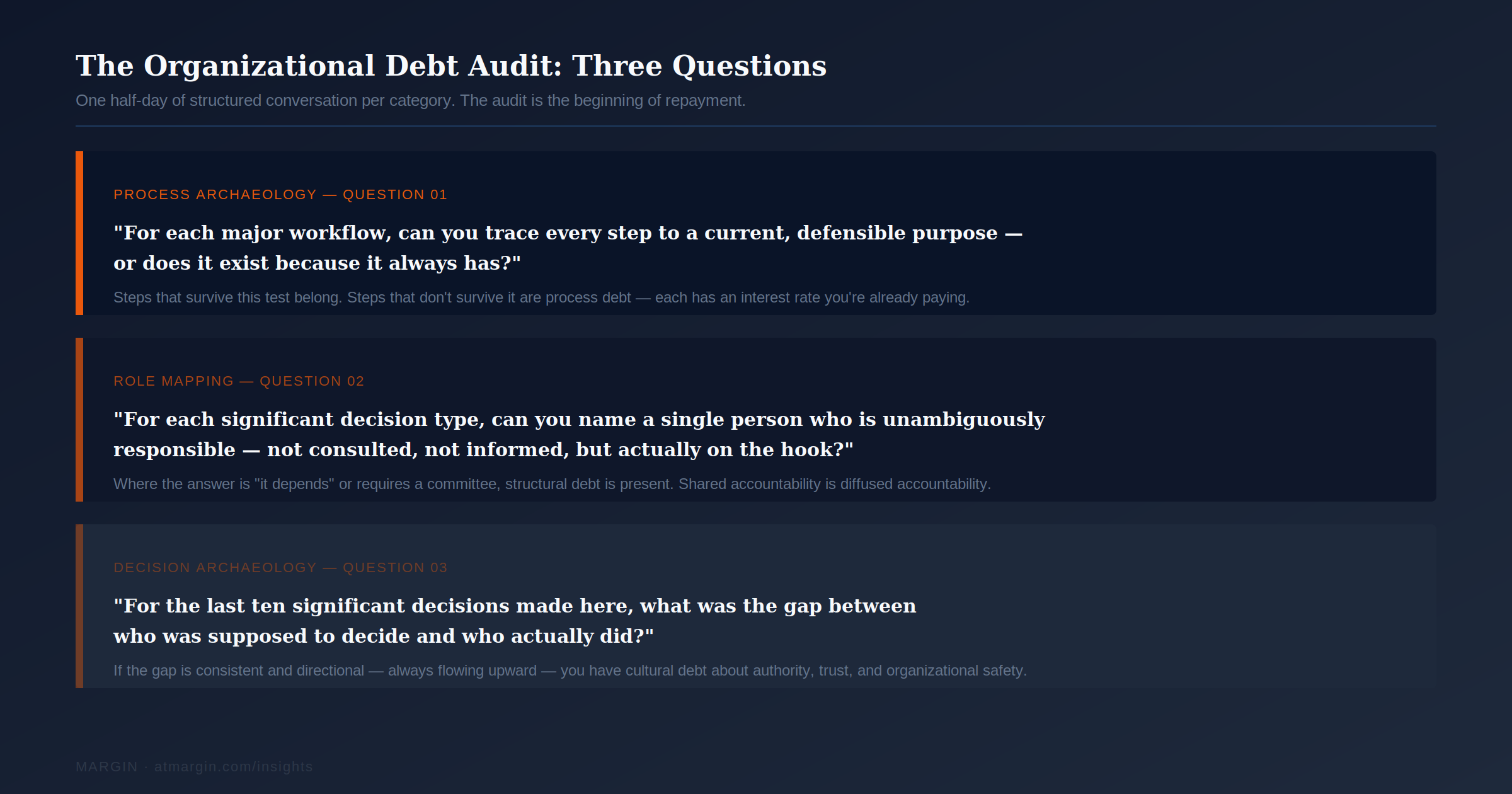
For each major organizational process — how decisions are made, how resources are allocated, how performance is evaluated, how cross-functional work is coordinated — document how the process actually works today and trace back the last two or three significant changes to that process. Who made them, why, and whether they were formally documented and communicated. In most organizations, this exercise reveals a significant gap between the documented process and the actual process, and a significant gap between the reasoning that produced the process and the conditions that currently exist. Process archaeology is uncomfortable because it surfaces decisions that were made without adequate thought, by people who are no longer available to explain them. It is also one of the most useful exercises an organizational leadership team can undertake.
Role clarity mapping.
For each role in the organization — or, for large organizations, for each role above a defined seniority level — map the formal responsibilities against what the person in the role actually does, and identify the gaps and overlaps. Roles that have significant gaps (things that fall between two role definitions and therefore belong to no one) and significant overlaps (things that are claimed by multiple roles and therefore produce conflict or redundancy) are debt concentration points. The mapping does not require sophisticated methodology — a direct conversation with role occupants asking "what do you do that isn't in your job description" and "what is technically in your job description that you don't actually do" produces the relevant information quickly.
Decision archaeology.
Identify the five decisions that took the longest to resolve in the previous quarter and trace the delay back to its source. Was the delay caused by unclear authority (nobody knew who was supposed to decide)? Insufficient information (the right decision-maker didn't have what they needed)? Political conflict (multiple stakeholders had competing interests that the decision process couldn't resolve)? Each cause pattern points to a different type of organizational debt: structural debt in the case of unclear authority, process debt in the case of information gaps, cultural debt in the case of political conflict. The diagnosis determines the remediation.
The Debt Reduction Program
Organizational debt, like technical debt, cannot be eliminated all at once without stopping the organization — which is not a realistic option. The practical approach is a deliberate debt reduction program that prioritizes the highest-cost concentrations and addresses them systematically while the organization continues to operate.
Prioritize by carrying cost, not by ease.
The natural instinct is to address the most accessible problems first. The financially rational approach is to address the problems with the highest carrying cost first, regardless of difficulty. A decision authority ambiguity that is costing six managers 15 percent of their capacity every week is a more urgent remediation target than a process redundancy that produces minor inefficiency but affects few people. Making this prioritization explicit, in financial terms, creates the organizational will to tackle the hard problems rather than paper over them.
Assign ownership.
Organizational debt reduction efforts fail when they are managed as collective responsibilities. Every specific debt item should have a named owner — a leader who is accountable for developing and executing the remediation, with a defined timeline and defined success criteria. The owner should have enough organizational authority to make changes within their scope and clear escalation paths for changes that require broader coordination.
Build in structural maintenance.
Organizations that successfully reduce their accumulated debt and then return to growth or strategy change will reaccumulate it without structural maintenance habits. Quarterly structural reviews — brief, focused assessments of whether current roles, processes, and decision structures are matched to current organizational needs — are the operational equivalent of technical debt review sessions. They do not require significant time investment. They require the organizational discipline to make them non-negotiable, even during periods of high operational pressure — especially during periods of high operational pressure, when debt accumulates fastest.
The CFO who asks the COO about organizational debt is asking a question most COOs have never been asked in those terms. The answer, in most mature organizations, will be longer and more expensive than either of them expected. That conversation is worth having before the debt demands payment on its own schedule.