
The Vocabulary Trap: Why Shared Language Isn't the Same as Shared Understanding
When every leader in the room nods at the same phrase, agreement feels complete. It often isn't. The gap between shared vocabulary and shared meaning is where strategy goes to die.
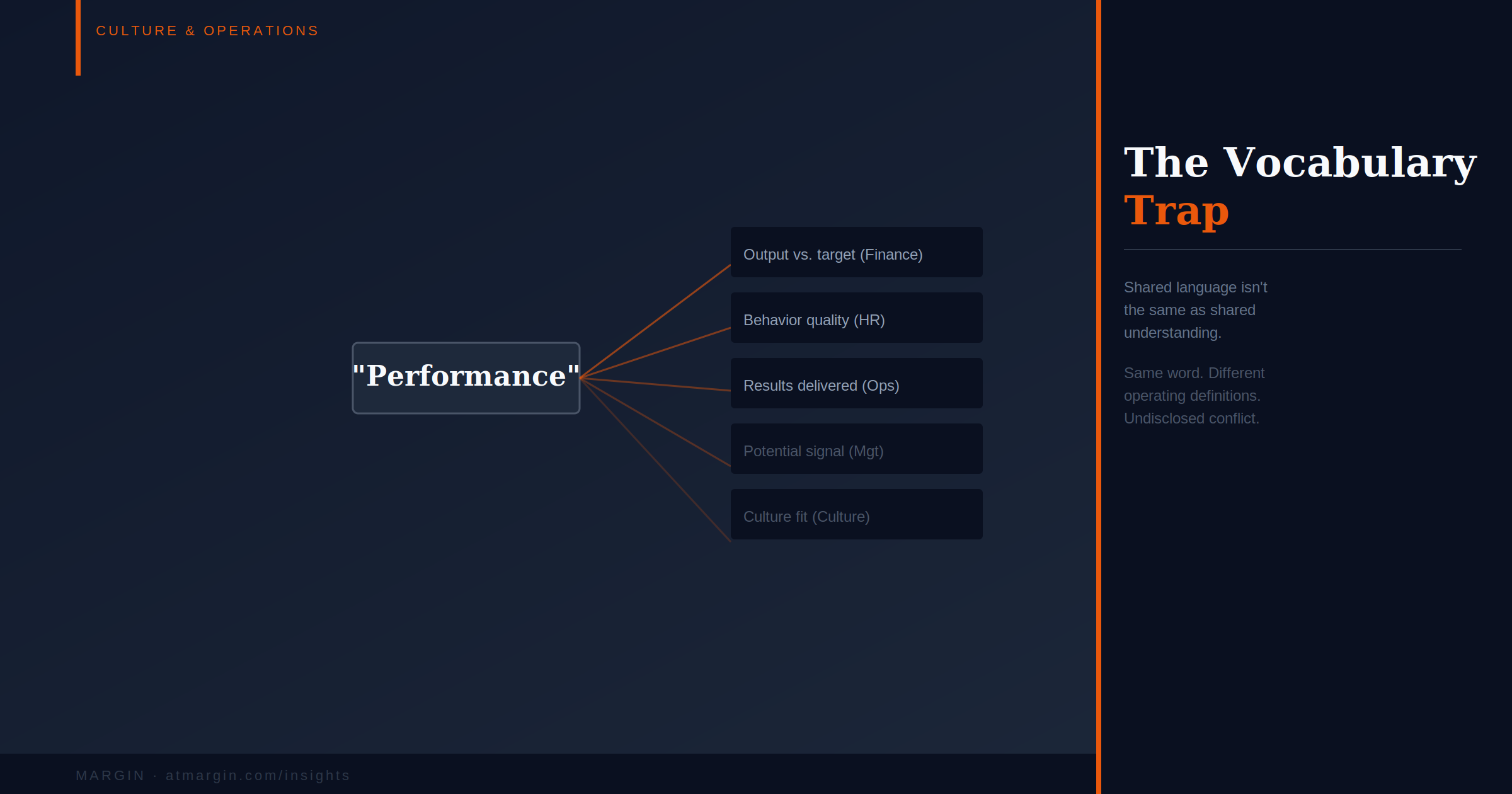
There is a particular kind of meeting that most executives will recognize. The leadership team is discussing a strategic priority — accountability, customer-centricity, innovation, high performance, whatever the current vocabulary of the organization is — and there is visible agreement around the table. Heads nod. Nobody objects. The meeting concludes with a sense of alignment. The strategy is off the table and into execution.
Three months later, three different functions are executing three different strategies, each of which is a reasonable interpretation of the agreement that was reached in that meeting. The disagreement that surfaces is attributed to execution failure, to siloed thinking, to the difficulty of cross-functional coordination. Rarely is it attributed to its actual cause: the leadership team agreed on a word and mistook that for agreement on a meaning.
This is the vocabulary trap. It is one of the most pervasive and least-examined sources of organizational misalignment, and it is structurally enabled by the very sophistication of executive communication. Leaders are skilled at deploying shared vocabulary. That skill produces consensus at the surface level — everyone in the room has heard the terms before, has used them before, and signals comprehension through the body language of agreement. What it does not produce is actual alignment on what the terms mean in practice, how they should be applied in specific situations, or what tradeoffs they imply when they conflict with other terms that have also been agreed to.
The organizations that perform best on execution are not, as a rule, the ones with the most sophisticated strategic vocabulary. They are the ones that have done the unglamorous work of defining their terms — of translating the vocabulary of strategy into the operational specificity that allows people to act on it without constant interpretation.
Why Sophisticated Organizations Are Most Vulnerable
The vocabulary trap is not primarily a problem of low organizational sophistication. Unsophisticated organizations often have alignment failures too, but they tend to be failures of strategy — the goals are wrong, the priorities are unclear, the leadership is not capable. These failures are visible and diagnosable.
The vocabulary trap is most insidious in organizations where the leaders are smart, the strategy is coherent at the abstract level, and the communication is skilled. In these organizations, the shared vocabulary creates a strong social signal of alignment that is difficult to question. Challenging the definition of "accountability" in a leadership meeting is awkward — it implies that the person asking doesn't already understand what accountability means, which feels like a confession of low sophistication. So the definition is never challenged, never made explicit, and never aligned.
The organizational lexicon of most executive teams contains dozens of high-frequency terms that are used daily, deployed with confidence, and never operationally defined. Accountability. Ownership. Alignment. Agility. Customer-centric. High performance. Collaborative. Empowered. These words have genuine meaning — they are not empty — but they have multiple legitimate meanings, and different leaders in the same organization have learned different ones through different career experiences.
When the VP of Sales says "accountability" she may mean a culture where commitments are public and missed commitments produce visible consequences. When the VP of HR says "accountability" he may mean a system where performance expectations are clearly documented and consistently evaluated. When the CEO says "accountability" she may mean something closer to personal ownership — an attitude of taking responsibility for outcomes regardless of whether a formal process exists. All three meanings are legitimate. None is the organizational meaning, because the organizational meaning has never been established.
The cost of this ambiguity is not felt in the leadership meeting where everyone nodded. It is felt six months later when the VP of Sales has built a public commitment board that the VP of HR finds punitive, and the CEO is frustrated that neither approach seems to have changed the behavior she was trying to produce. The conversation that resolves this conflict — if it happens at all — will consume significant leadership time and generate organizational friction. It could have been avoided entirely by fifteen minutes of definitional work at the beginning of the process.
The Interview as Diagnostic Tool
One of the most reliable ways to surface definitional misalignment is the question a sophisticated candidate asks in a job interview — and that most organizations are not prepared to answer.
“The leadership team agreed on a word and mistook that for agreement on a meaning.”
The question is some version of: "How does this organization define [high performance / accountability / collaboration / whatever term appears prominently in the job description or culture document]? Can you walk me through a specific example of how that value showed up in a recent decision?"
This question is diagnostic at two levels simultaneously. At the surface level, it is gathering information the candidate genuinely needs — they are trying to understand whether the organization's operational definition of a value matches their own.
But at a deeper level, it is revealing whether the organization has done the definitional work at all. A leadership team that has operationally defined its values can answer this question immediately and specifically. A leadership team that has declared its values without defining them will answer with a generality that sounds like the question being asked back — "we really value high performance, we hold people to high standards" — and then struggle when the follow-up presses for specifics.
Organizations that find themselves unable to answer definitional questions concretely have surfaced something important. The answer is not to prepare better interview responses. It is to do the definitional work that the interview question revealed is missing.
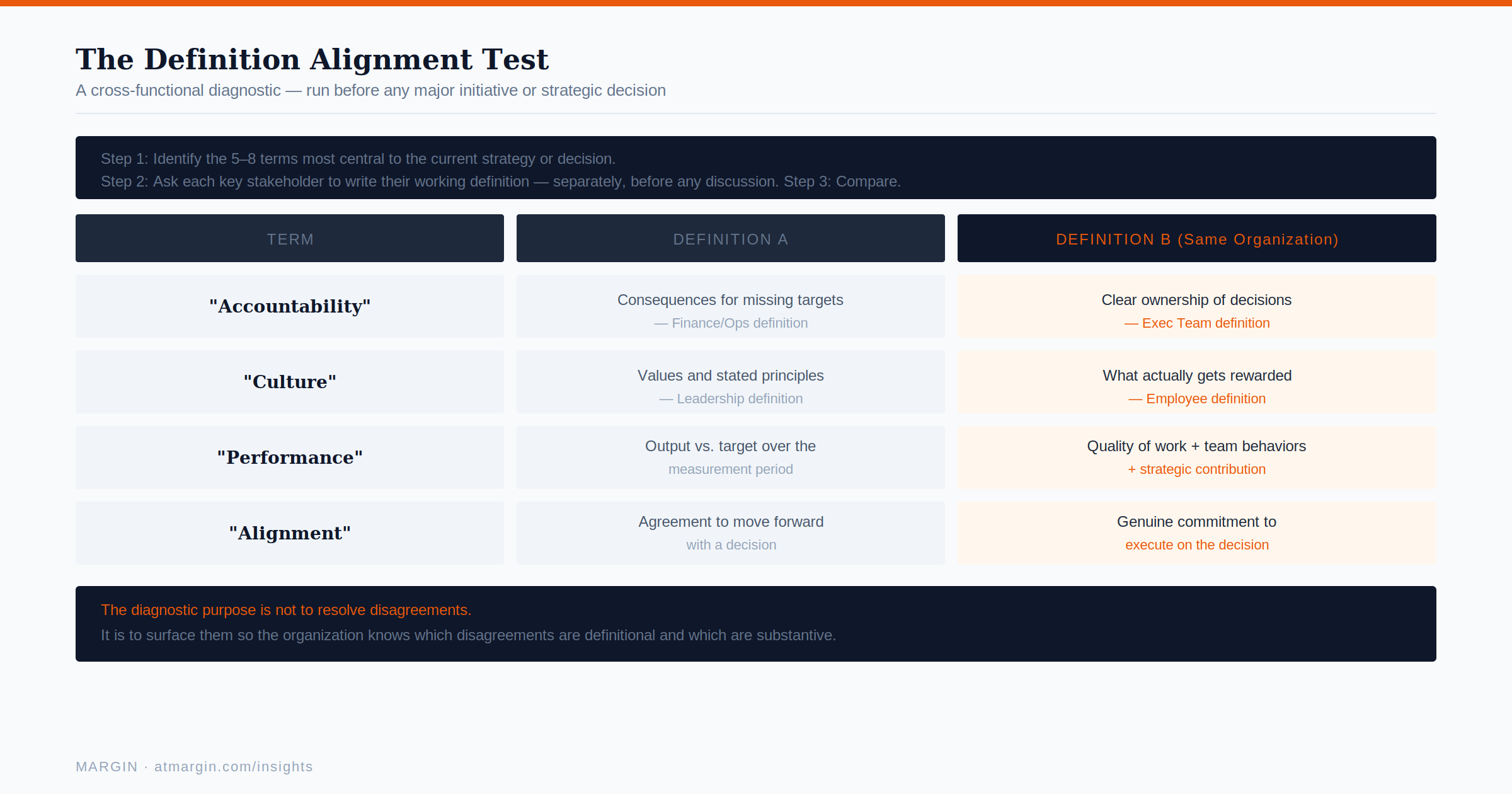
The same diagnostic logic applies internally. Leaders who want to test for definitional alignment within their own organization can ask each member of their leadership team, individually, to write down their operational definition of the organization's two or three most important stated values — what would an employee need to do, or not do, to demonstrate that value in their role? Comparing the responses across a leadership team typically reveals a range of interpretations that surprises even experienced executives who have worked together for years. The exercise is uncomfortable and useful in exactly the right proportion.
What Operational Definition Actually Requires
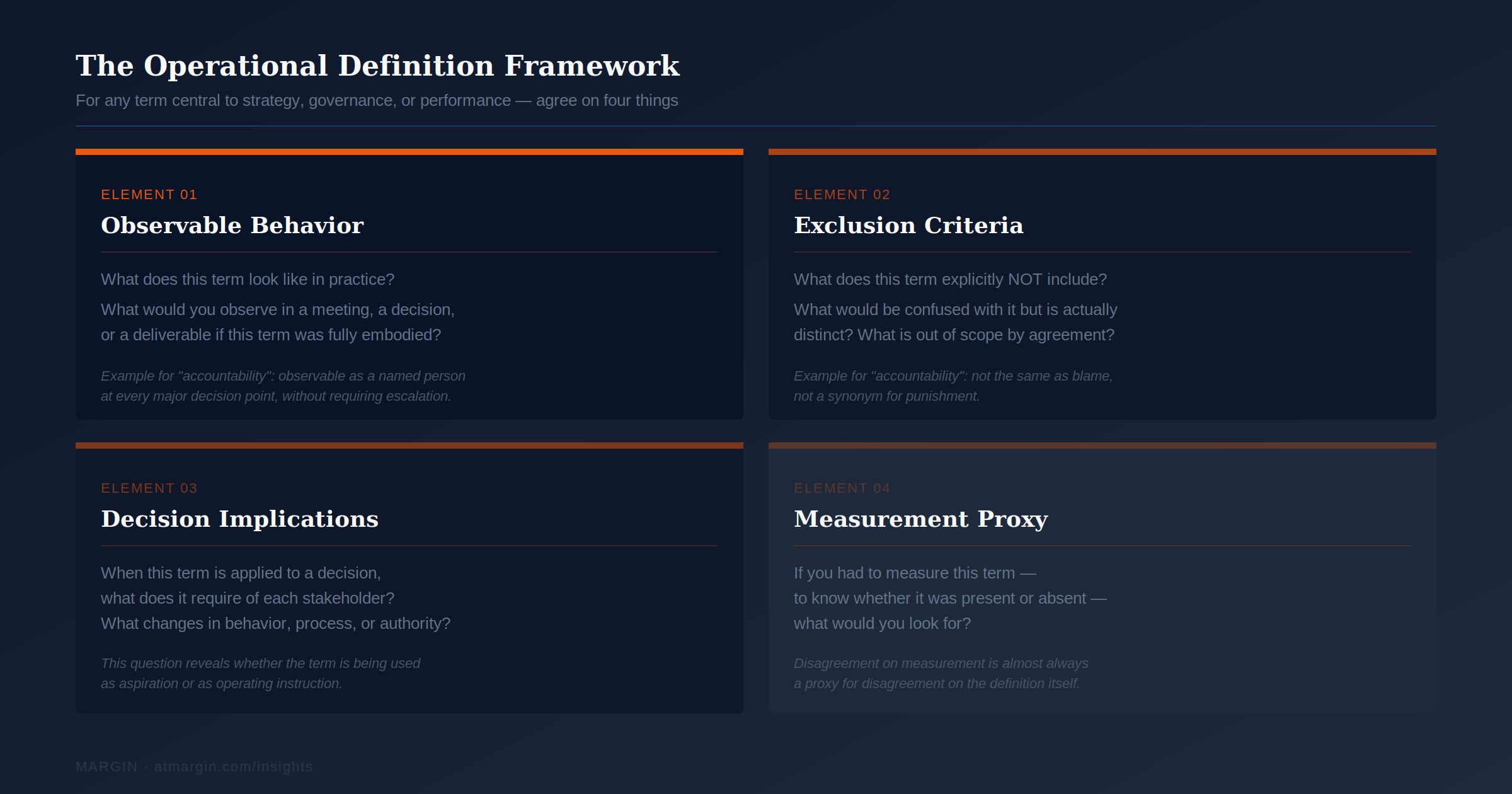
Defining organizational terms operationally is not a semantic exercise. It is a decision-making exercise that forces the leadership team to resolve substantive disagreements that the shared vocabulary has been papering over.
To operationally define "accountability" in a way that can actually guide behavior, the leadership team must answer several questions that have no self-evident answer: Does accountability require public commitment, or is private ownership sufficient? When a commitment is missed, what is the appropriate response — documentation, consequence, collaborative problem-solving? Does accountability mean owning outcomes regardless of whether they were within the individual's control, or does it apply only to process and effort? How does accountability interact with learning culture — can an organization that values accountability also value failure as a learning mechanism, and if so, what is the distinction between a failure that demonstrates accountability and one that doesn't?
These are not gotcha questions. They are the questions that different members of the leadership team have already answered differently in their own minds, and whose different answers have been producing different organizational behaviors that the team attributes to "execution challenges." Getting the leadership team into a room to resolve them explicitly — not to find a definition that everyone can theoretically agree with, but to find a definition that resolves the specific tensions that exist in this organization between the people in this room — is harder and more valuable than any off-site agenda item typically is.
The output should be a written, specific operational definition that can be communicated to the broader organization, used in performance conversations, and tested against real situations to see whether it produces consistent interpretations. The test of a good operational definition is not that it sounds right — it is that two different leaders, applying it independently to the same situation, reach the same conclusion about whether the value was demonstrated or violated.
Building Definitional Alignment Into Organizational Rhythm
The definitional work described above is not a one-time exercise. Organizations evolve, leadership teams turn over, and the operating context that gave a definition its original meaning changes. A definition of "customer-centric" that was adopted during a phase of rapid customer acquisition may not describe the right behavior during a phase of customer expansion and retention. An accountability framework designed for a 50-person organization may not translate to a 500-person one without significant modification.
Definitional review should be built into the organizational calendar — not as a standalone exercise but as a component of existing strategic review processes. When the leadership team is reviewing the annual strategy, they should also be reviewing the organizational vocabulary: are the terms we are using still the right terms? Do our definitions still produce the behaviors we need? Where are we observing behavior that doesn't match our stated values, and is that a behavior problem or a definition problem?
The distinction between a behavior problem and a definition problem is consequential. Organizations that respond to every value-behavior gap with a culture initiative are often solving the wrong problem. When the definition is wrong or absent, training people on the stated value produces a trained compliance with something that nobody can clearly describe. The behavior that results is not the desired behavior — it is employees' best guess about what the organization wants, which is the definition of the vocabulary trap operating at scale.
Incorporating definition into hiring and onboarding.
The most durable way to ensure organizational vocabulary is shared is to make it explicit at the earliest possible point of contact. Job descriptions that include operational definitions of key values — not "we value accountability" but "our people take ownership of outcomes, communicate proactively when they encounter obstacles, and hold commitments in the absence of oversight" — give candidates the information they need to self-select accurately and give hiring managers a clearer basis for evaluation. Onboarding that walks new employees through not just what the organization values but how it defines and applies those values operationally reduces the time-to-alignment dramatically and sets a foundation for the kind of consistent behavior that high-performing organizations depend on.
Making the definition the beginning of the conversation, not the end.
Organizationally, definitions work best when they are treated as shared starting points for judgment rather than as rules that predetermine outcomes. The goal of definitional work is not to eliminate the need for judgment — it is to ensure that judgment is being exercised from a common baseline rather than from individually constructed interpretations that diverge in proportion to the complexity of the situation. Leaders who communicate their definitions while making decisions — "I'm choosing this option because it reflects our commitment to X, which I understand to mean Y" — are doing the most important kind of definitional work: modeling the application of shared meaning in real situations, which teaches the organization more about what the vocabulary actually means than any document ever will.
The vocabulary trap is not closed by adding more words to the organizational lexicon. It is closed by demanding that the words already in use be made specific enough to act on. That is, in most organizations, a more urgent and more tractable problem than any strategic priority currently on the agenda — and it is the one that receives the least attention, because the vocabulary of strategy makes it easy to mistake fluency for alignment.