
The Informal Org Chart That Actually Runs Your Organization
Real decision-making authority in most organizations bears little resemblance to the hierarchy on paper — and the gap between the two creates operational risk that leaders routinely underestimate.
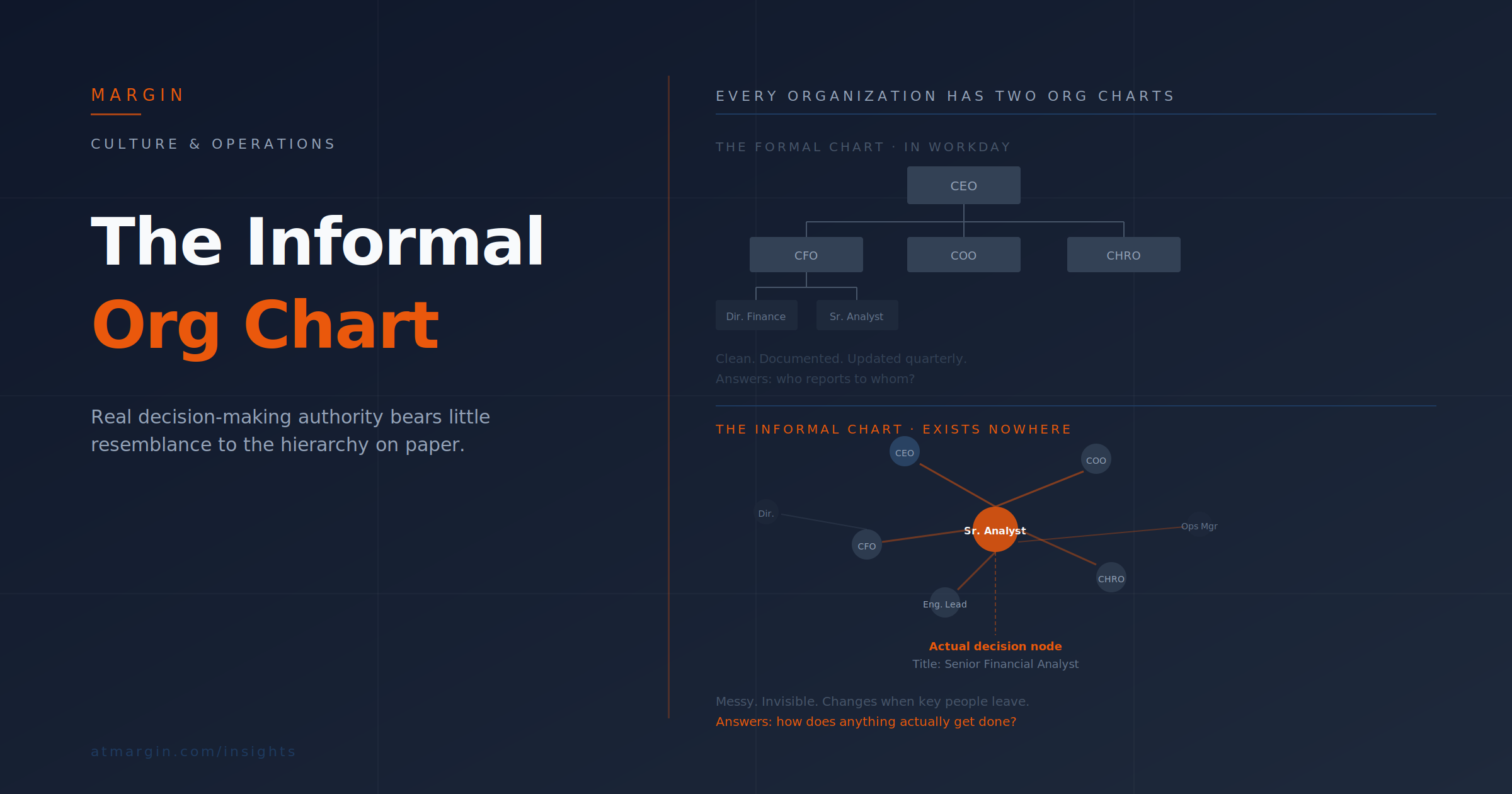
Every organization has two org charts. The first is the one in Workday or BambooHR — the formal hierarchy of reporting relationships, titles, and spans of control that governs how the organization is officially structured. It is updated when someone is hired, promoted, or exits. It is the answer to the question "who does this person report to?"
The second org chart exists nowhere in a system of record. It is the map of how decisions actually get made — who has informal authority to stop or accelerate a project, whose opinion shapes leadership judgment before a formal decision is made, who people go to when they need something real to happen, and whose approval is functionally required even when the organizational chart suggests otherwise. This is the informal org chart, and in most organizations it is more operationally significant than the formal one.
The gap between these two maps is not merely an interesting organizational observation. It is a source of operational risk, succession planning failure, and strategic execution drag that is paid for in slow decisions, derailed initiatives, and the occasional organizational crisis when the person who actually ran a critical function walks out the door.
How Informal Authority Develops
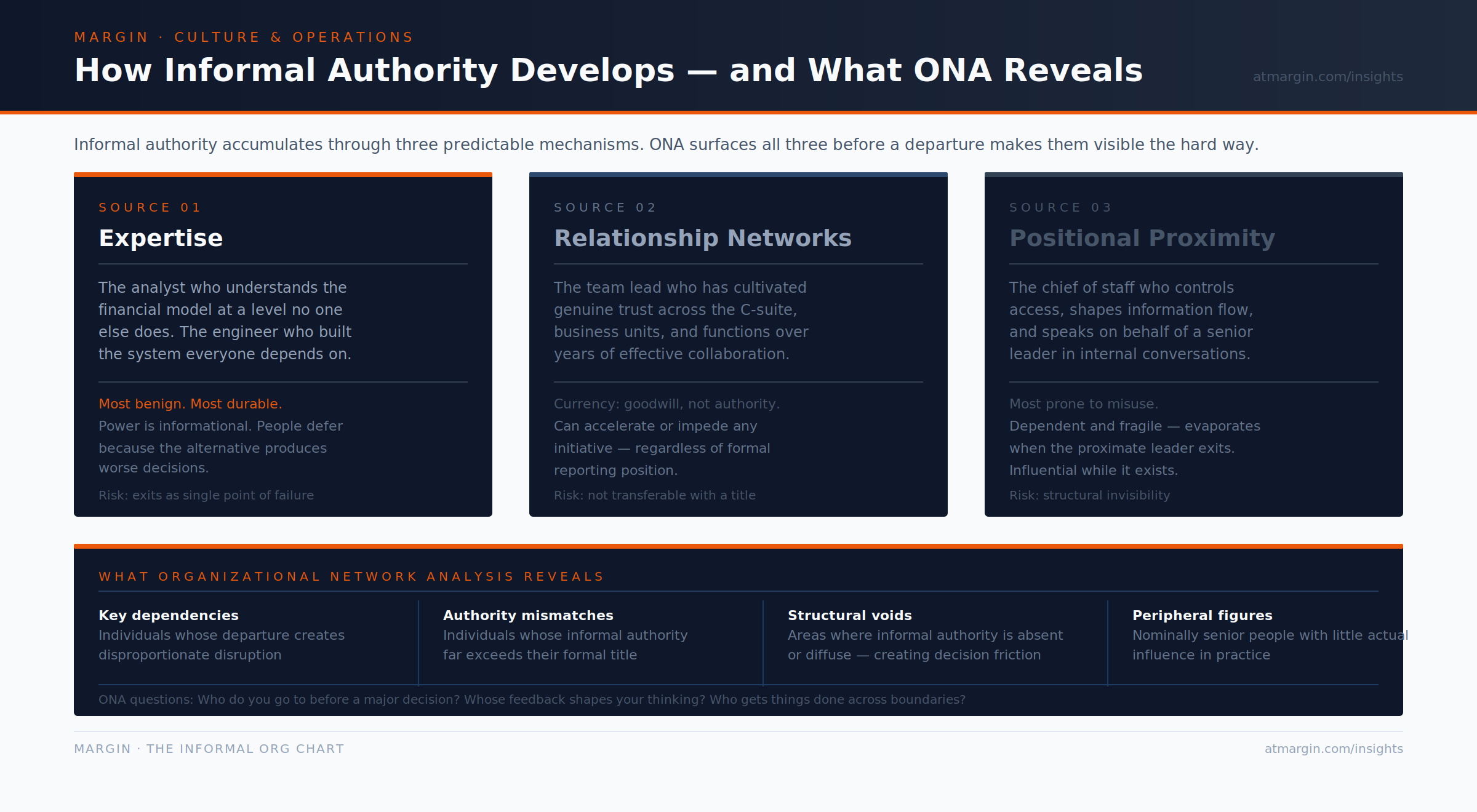
Informal authority is not randomly distributed. It accumulates through specific mechanisms that are worth understanding because they are largely predictable and, in some cases, designable.
Informational Power
Expertise is the most benign source of informal authority. The engineer who has built the system everyone depends on, the financial analyst who understands the company's financial model at a level no one else does, the HR leader who has navigated every organizational change in the last decade — these individuals develop informal authority because they possess knowledge that the organization needs to function.
Their power is informational. People defer to them because the alternative — making decisions without their input — has historically produced worse outcomes.
Relationship Power
Relationship networks are a second source. In every organization, certain individuals have disproportionate relationship capital: broad networks of trust and reciprocity built over years of effective collaboration. These individuals can move things across organizational boundaries in ways that the formal hierarchy cannot, because their currency is goodwill rather than authority.
The head of an internal team who has cultivated genuine relationships across the C-suite, across business units, and across functions can accelerate or impede organizational initiatives with remarkable efficiency — and their position on the formal org chart may not reflect this capability at all.
Proximity Power
Positional proximity is a third mechanism, and the one most prone to misuse. Individuals who are physically, logistically, or relationally proximate to senior leaders often accumulate informal authority that exceeds their formal mandate.
The chief of staff to a CEO who controls access, shapes the information that reaches the executive, and speaks on the executive's behalf in internal conversations occupies a position of informal authority that is structurally invisible but operationally consequential.
This form of informal authority is dependent and fragile — it evaporates when the proximate leader exits — but it is influential for as long as it exists.
What the Gap Costs
The gap between formal and informal authority structures creates operational costs that are diffuse and therefore easy to dismiss in the moment, but significant in aggregate.
“When the person who informally runs a critical function leaves, the organization often discovers the gap only after the departure — and the informal network does not transfer with the reporting lines.”
Decision Latency
Decision latency is the most immediate cost. In organizations with large gaps between formal authority and actual influence, decisions route incorrectly — they escalate through formal channels to people who will check with someone else before deciding, adding time and friction to every material choice.
The formal approver who cannot act without the informal approver's sign-off creates a hidden step in every process. Organizations that have never mapped their informal decision networks are often operating with process latency they attribute to bureaucracy, complexity, or culture — when the actual mechanism is a misalignment between where authority officially sits and where decision-making power actually lives.
Strategic Initiative Failure
Strategic initiative failure is a more expensive consequence. Large organizational initiatives — technology implementations, culture change programs, strategic pivots — depend on the active engagement of individuals with informal authority, because formal mandates alone are insufficient to produce behavioral change at scale.
The transformation initiative that has executive sponsorship but lacks the buy-in of the informal network's key nodes will stall at implementation. The individuals whose informal authority allows them to shape the pace and direction of change will do so regardless of whether they are in the room when the initiative was designed.
Succession Risk
Succession risk is the most consequential and least recognized cost. Organizations build succession plans based on formal organizational charts. They identify who is in each box, who might fill each box if vacated, and what development investments are needed for the identified successors.
What they systematically fail to capture is the informal authority that makes each current role occupant effective — the network relationships, the institutional knowledge, the informal decision-making currency that cannot be transferred with a title.
When the person who informally runs a critical function leaves, the organization often discovers the gap only after the departure. The incoming occupant of the formal role finds that decisions that used to happen fluidly now require explicit negotiation. Initiatives that used to advance smoothly now encounter resistance at unfamiliar points.
The informal network that the predecessor had cultivated over years does not transfer with the reporting lines. In some cases, it reorganizes around someone else — someone lower in the formal hierarchy who is better positioned to accumulate informal authority in the successor's absence.
Mapping the Informal Network
Organizational network analysis (ONA) is the formal methodology for mapping informal authority structures, and it has been available as a tool for organizational design and succession planning for more than two decades. Its adoption in practice, outside of a small number of sophisticated large enterprises, has been limited — partly because it requires deliberate investment, partly because the results can be politically uncomfortable, and partly because most HR functions are not equipped to conduct or interpret network analysis.
The methodology at its core is straightforward. It asks employees a structured set of questions designed to surface actual relationship and influence patterns: Who do you go to for information or advice before making an important decision? Whose feedback significantly influences your thinking? Who do you seek out when you need to get something done across organizational boundaries?
The response patterns map to a network diagram that reveals the actual topology of organizational influence — the connectors, the bridges, the central nodes, and the individuals who appear highly placed on the formal chart but are peripheral on the influence map.
The practical output of this analysis is actionable on several dimensions. It identifies individuals whose informal authority substantially exceeds their formal authority — candidates for either formal recognition through advancement or explicit succession investment to ensure their capabilities are not concentrated in a single point of failure.
It identifies key dependencies: single individuals whose departure would create disproportionate disruption to decision-making capacity. And it identifies structural voids — areas of the organization where informal authority is absent or diffuse, creating the kind of decision friction that slows execution in those domains.
Managing What You Don't Officially Own
For senior leaders, the informal org chart is both a tool and a risk to be managed. The tool dimension is straightforward: leaders who understand the informal network around them are more effective at moving initiatives, building coalitions, and anticipating resistance than leaders who operate only through the formal hierarchy.
The risk dimension is less often discussed. Organizations can develop unhealthy dependencies on informal authority concentrations — single individuals whose accumulated influence creates a form of organizational fragility.
When that individual's interests align with the organization's, the arrangement is efficient. When their interests diverge — when they begin to pursue external options, develop personal conflicts with key leaders, or simply become protective of information that others need — the concentration of informal authority becomes a liability.
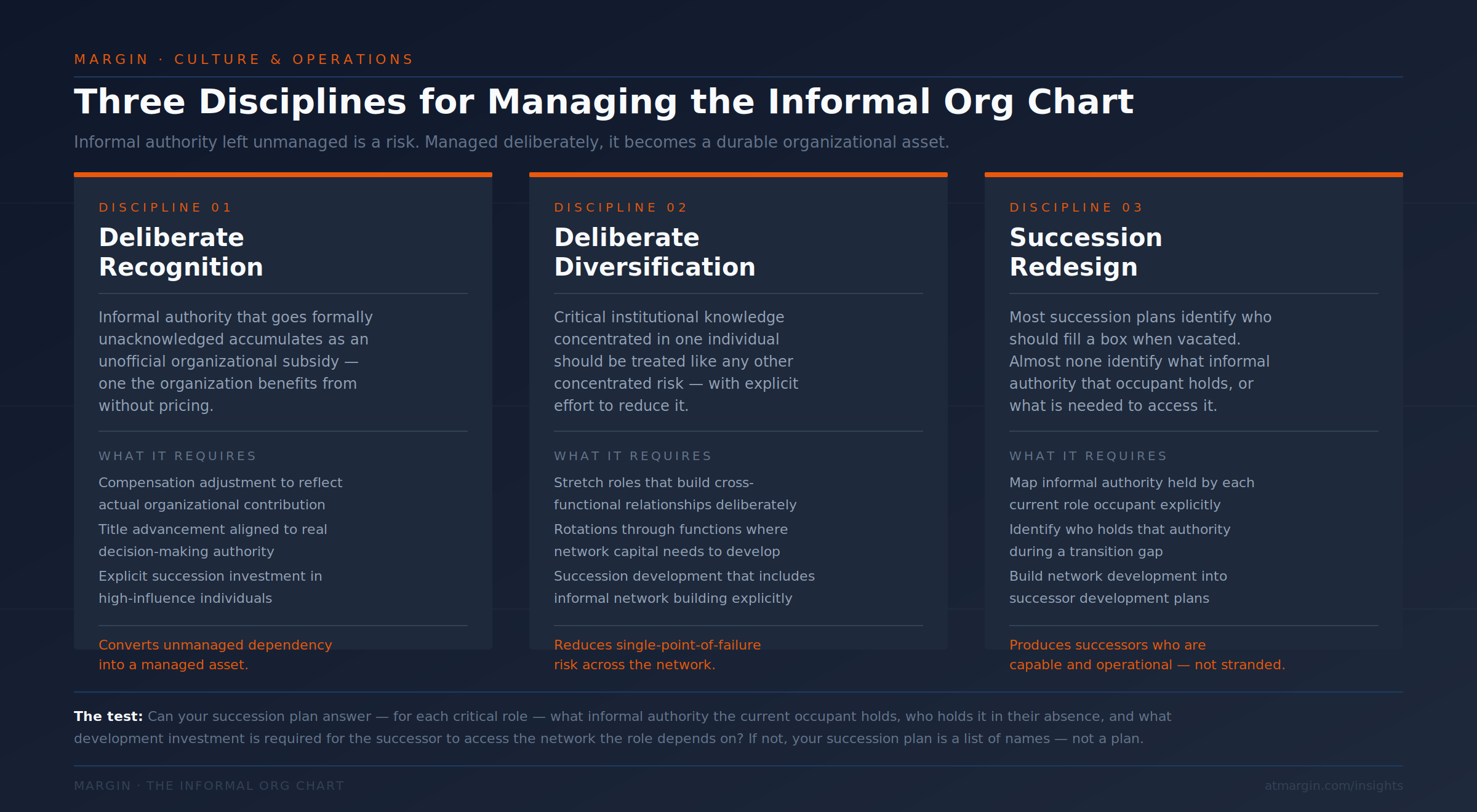
Managing this risk requires the same discipline applied to any other concentrated organizational dependency. Diversifying informal authority means deliberately developing relationship capital and institutional knowledge in multiple individuals rather than permitting it to concentrate.
It means recognizing informal authority in formal ways — through advancement, investment, or explicit organizational design — rather than allowing it to exist as an unofficial subsidy that the organization benefits from without acknowledging. And it means building succession thinking that accounts for informal network position, not just title replacement.
The org chart is a useful administrative document. It describes who is accountable to whom and who has formal authority to make which decisions. It does not describe how the organization actually works.
Leaders who understand the difference — and invest in mapping and managing the gap — operate in a more accurate version of their own organization than leaders who don't. In an environment where execution speed and decision quality are competitive advantages, that accuracy compounds.