
Incentives Are Culture
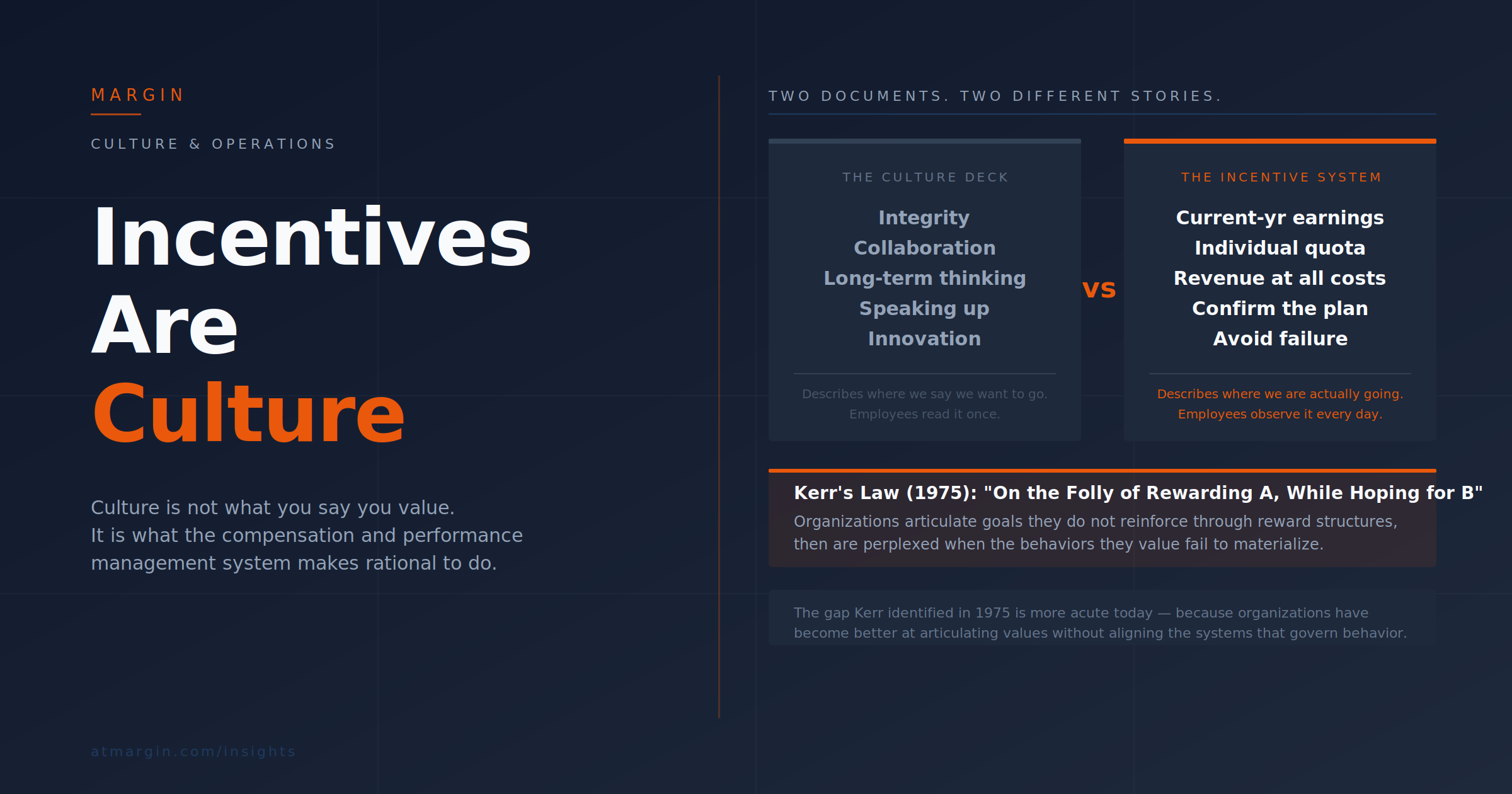
Every culture initiative that operates independently of the compensation and performance systems that govern daily behavior is decorative. Culture is not what you say you value. It is what you pay for.
In 2019, the Business Roundtable issued a statement signed by 181 CEOs declaring that the purpose of a corporation extends beyond shareholder returns to encompass employees, communities, suppliers, and society. The announcement generated substantial media coverage and considerable goodwill. Six years later, it was accompanied, in nearly every signatory organization, by no change whatsoever to the executive compensation structures that govern how organizational leaders are actually evaluated and rewarded.
This is not a story about corporate hypocrisy, though it is that too. It is a story about the relationship between stated values and revealed preferences — and what that relationship tells us about how organizational culture actually works.
Culture, in its operational form, is not the values on the wall or the deck shared at the all-hands. It is the accumulated pattern of behaviors that employees learn through experience, and are rewarded and punished in an organization. It is what gets promoted. It is what gets overlooked. It is what managers tolerate and what they escalate. It is, most fundamentally, what the compensation and performance management system makes rational for employees to do.
Every culture initiative that operates independently of these systems — the values workshop, the culture committee, the core values merchandise — is producing a signal. The question is whether that signal is stronger or weaker than the signal produced by last year's bonus pool distribution.
In most organizations, there is no contest.
The Incentive Signal and the Culture Deck
The foundational insight here is not new. In 1975, Steven Kerr published what became one of the most cited papers in organizational behavior: "On the Folly of Rewarding A, While Hoping for B." Kerr's argument was straightforward: organizations consistently articulate goals they do not reinforce through their reward structures, and then are perplexed when the behaviors they value fail to materialize.
The examples he catalogued were specific. Military organizations that claimed to value long-term strategic thinking while rewarding short-term tactical success. Healthcare organizations that claimed to value preventive care while reimbursing interventions. Corporations that claimed to value innovation while penalizing the failures that are the necessary byproduct of genuine experimentation. In each case, the stated value was real — leaders genuinely believed in it and communicated it sincerely. But the incentive structure attached to different behavior, and behavior followed the incentive.
The dynamic Kerr identified in 1975 is more acute today for a specific reason: the gap between stated organizational values and actual incentive structures has widened as corporate communication has become more sophisticated. Organizations have become very good at articulating values — at producing culture decks, mission statements, and employer brand narratives that describe what the organization aspires to be. They have not become commensurately better at aligning their compensation and performance management systems with those aspirations.
The result is an organizational credibility problem of the first order. Employees are not naive. They read the culture deck and they watch what happens to the people around them. They observe who gets promoted, who gets the largest variable compensation, who survives a restructuring, and who gets PIP'd. The organizational culture they internalize is the one produced by those observations — not the one described in the materials.
How Incentive Systems Shape Behavior at Scale
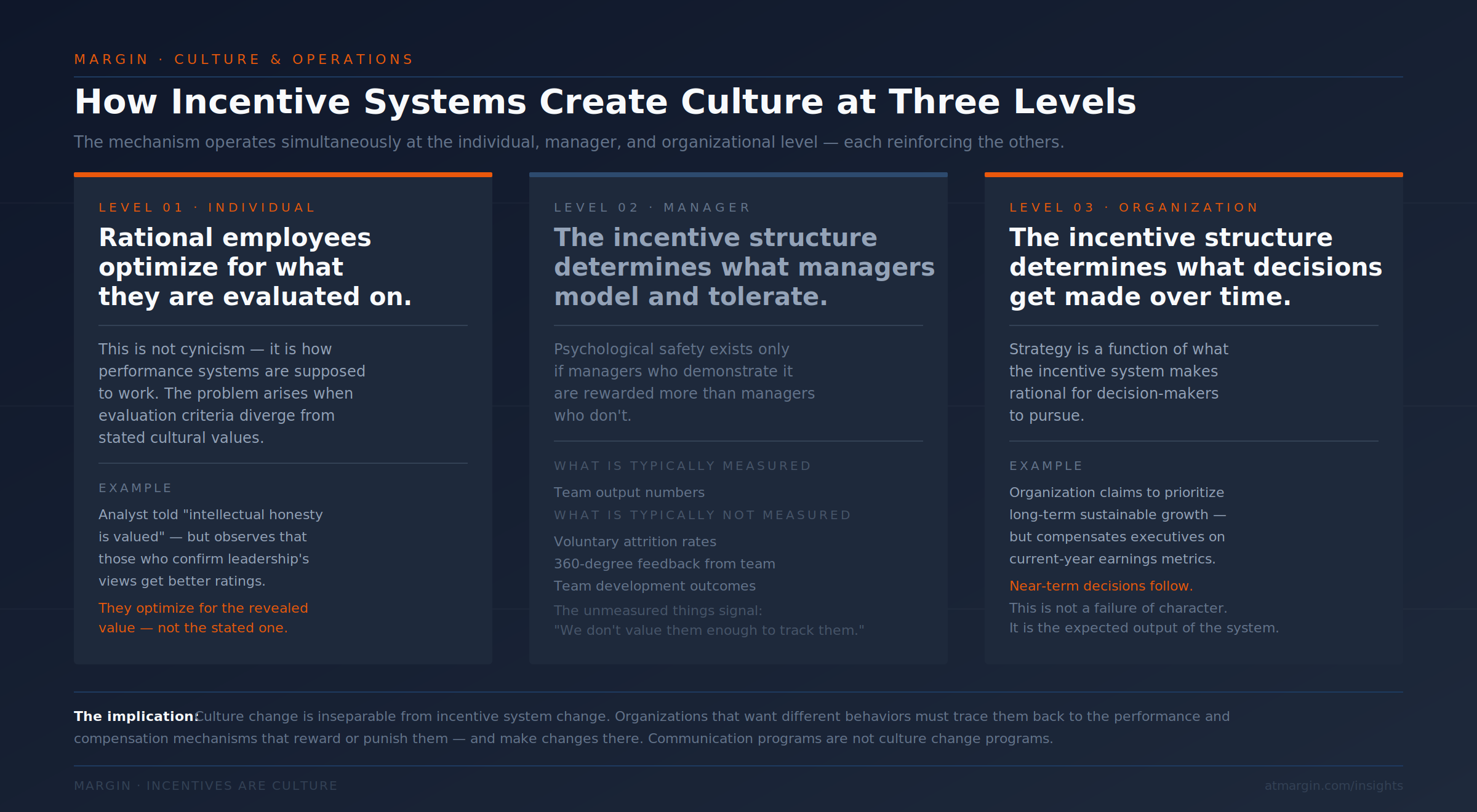
The mechanism through which incentive systems create culture operates at three levels: the individual, the manager, and the organizational.
Individual Level
At the individual level, rational employees optimize for the criteria on which they are evaluated. This is not a cynical observation — it is a description of how performance management systems are supposed to work. The problem arises when the evaluation criteria are misaligned with the stated cultural values.
A financial analyst who is told that intellectual honesty and constructive challenge are valued, but who observes that analysts who confirm senior leaders' existing views receive better performance ratings, will learn quickly that the stated value and the revealed value are different things. They will optimize for the revealed value, because their compensation and career trajectory depend on it.
Manager Level
At the manager level, the incentive structure determines what behaviors managers model and what they tolerate. A culture that claims to value psychological safety and candid feedback will produce those things only if the managers who demonstrate them are rewarded more than the managers who don't.
If the performance review process rewards managers for hitting numbers with no behavioral component — no measurement of voluntary attrition rates, no 360-degree feedback incorporated into compensation decisions, no assessment of team development outcomes — then the culture is defined not by what the organization says it values in managers but by what the performance review rewards them for.
Organizational Level
At the organizational level, the incentive structure determines what kinds of decisions get made over time. Strategy is, in meaningful part, a function of what the incentive system makes rational for decision-makers to pursue. An organization that claims to prioritize long-term sustainable growth but compensates executives primarily on current-year earnings metrics will consistently make decisions that optimize for the near-term. This is not a failure of character in the executives. It is the expected output of the incentive system.
The Silence of What Isn't Measured
One of the most important ways incentive systems shape culture is through what they do not measure as much as what they do. The behaviors and outcomes that are not reflected in performance evaluations and compensation decisions are, implicitly, communicating that the organization does not value them enough to hold people accountable for them.
“Culture is not what you say you value. It is what the compensation and performance management system makes rational for employees to do.”
Consider the typical treatment of manager effectiveness in performance reviews. Most organizations evaluate managers primarily on team output metrics — the numbers the team produced. Very few systematically incorporate team-level engagement data, voluntary attrition rates, or upward feedback from direct reports into compensation and promotion decisions for those managers. The implicit message: what your team produces matters; how you treat them in producing it is secondary, optional, or your personal business.
The same logic applies to how organizations handle values violations. An organization that claims integrity as a core value but does not hold revenue-generating leaders to the same standard as administrative ones when integrity violations occur is communicating, through the differential response, what the actual hierarchy of values is. A star performer who behaves in ways the culture deck would disqualify but who survives in the organization because they produce — this is not a difficult situation. It is a clear organizational signal, received and understood by everyone watching.
There is also the question of how organizations treat employees who challenge the status quo, surface uncomfortable information, or advocate for changes that benefit the long-term at the cost of the short-term. If these behaviors are not explicitly valued in the performance system — if they carry career risk rather than career reward — the culture will not produce them, regardless of what the values statement says about "speaking truth to power."
Designing Incentive Systems That Produce the Culture You Want
The practical implication is not that culture change is impossible — it is that culture change is inseparable from incentive system change. Organizations that want to produce different behaviors at scale need to trace those behaviors back to the performance and compensation mechanisms that either reward or punish them, and make changes there.
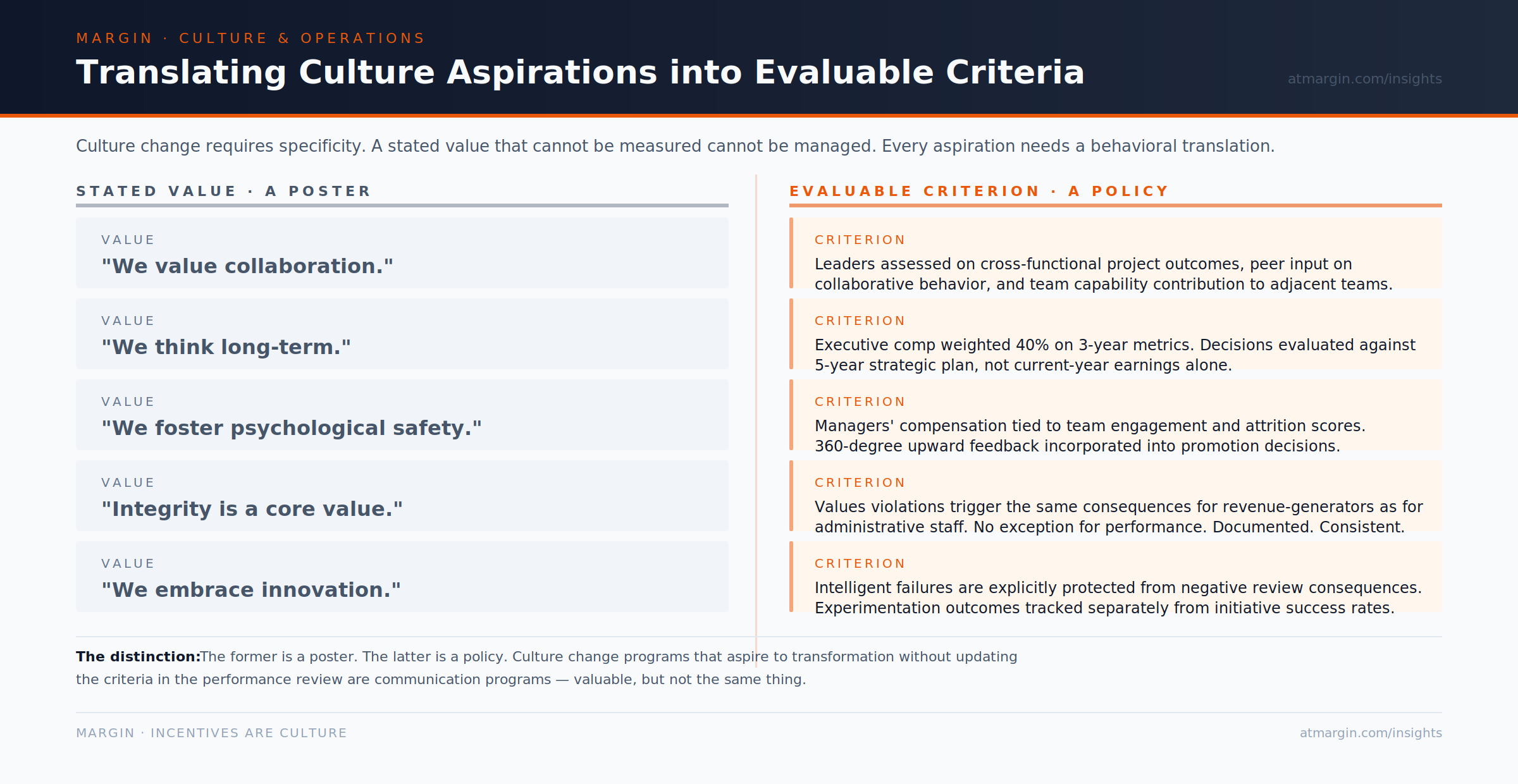
This requires specificity. The culture aspiration needs to be translated into behavioral criteria specific enough to be measured and incorporated into evaluation systems. "We value collaboration" is not an evaluable criterion. "Leaders are assessed on cross-functional project outcomes, peer input on their collaborative behavior, and the degree to which their team's capabilities contribute to adjacent teams" is. The former is a poster. The latter is a policy.
The translation exercise is more demanding than most organizations expect, and more revealing. Consider what it requires to operationalize a handful of common culture aspirations:
"We think long-term" becomes meaningful only when executive compensation is explicitly weighted on three- to five-year metrics, and when decisions are evaluated against a stated strategic horizon rather than current-year earnings alone. If that weighting does not exist, the aspiration is decoration.
"We value psychological safety and candid feedback" becomes evaluable when managers' compensation incorporates team engagement scores and voluntary attrition rates — and when upward feedback from direct reports is built into promotion criteria, not collected and filed. If managers are rewarded only for what their teams produce and not for how they treat them in producing it, the organization is communicating its actual hierarchy of values precisely and continuously.
"Integrity is a core value" becomes credible only when values violations trigger the same consequences for revenue-generating leaders as for anyone else — documented, consistent, and independent of performance ratings. A star performer who behaves in ways the culture deck would disqualify but who survives because they produce is not an edge case. They are the most important communication the organization makes about what integrity actually means.
"We embrace innovation and intelligent risk-taking" requires that intelligent failures be explicitly protected from negative performance review consequences. If the performance system cannot distinguish between a failure of execution and a failure of a well-designed experiment, the incentive structure will consistently produce risk-aversion regardless of what the values statement says.
Communication Programs vs. Culture Change Programs
The distinction that matters most in this conversation is one most organizations are unwilling to make clearly: the difference between a culture change program and a communication program.
A communication program improves the quality and consistency of how an organization articulates its values. It produces better culture decks, more frequent all-hands conversations about what the organization believes, and more sophisticated employer brand narratives. These things have real value. They attract candidates who are aligned with the stated values. They create shared language. They make aspirations visible in ways that matter.
What they do not do is change the incentive system. And because behavior follows incentive, not aspiration, communication programs that operate independently of compensation and performance system changes produce a specific and predictable result: a more articulate version of the same organizational culture. The values are stated more clearly. The gap between stated values and actual behavior may actually widen, because the aspiration has become more explicit while the mechanism remains unchanged.
The diagnostic question an organization can ask to determine which kind of program it is running is direct: have we changed what we measure, what we pay for, and what we are willing to tolerate in the performance review — or have we only changed what we say? If the answer is the latter, the program is communication. That is not a failure — it may be the right investment at that moment. But it should be named accurately.
What CFOs and CHROs Should Actually Own
The organizational implication of this argument is that the CFO and CHRO share ownership of culture in a way most organizations do not acknowledge. The CHRO owns the performance management system. The CFO owns the compensation and incentive architecture. These two systems, in combination, define the actual culture of the organization more reliably than any initiative, workshop, or values statement.
This means that culture transformation is not a communication and engagement project that happens to need executive sponsorship. It is a systems redesign project that requires finance and HR to jointly audit what the current incentive structure is actually producing — which behaviors it makes rational, which ones it implicitly discourages, and which stated values it systematically contradicts — and then to make deliberate changes to the measurement and reward architecture.
The organizations that have changed their cultures in durable ways share a common pattern: they changed what they measured, what they rewarded, and what they were willing to hold onto versus let go based on values-alignment, not just performance. They treated culture as the output of a system, not the subject of an initiative.
The culture deck describes where you say you want to go. The incentive system describes where you are actually going. In most organizations, these documents tell different stories. The employees know which one to believe — and they have been watching long enough to know the difference between a program and a policy.