
Why Internal Promotions Fail
Organizations promote their best individual contributors into leadership roles and then seem surprised when the results disappoint. The selection methodology is the problem, and most organizations are running the same flawed process on repeat.
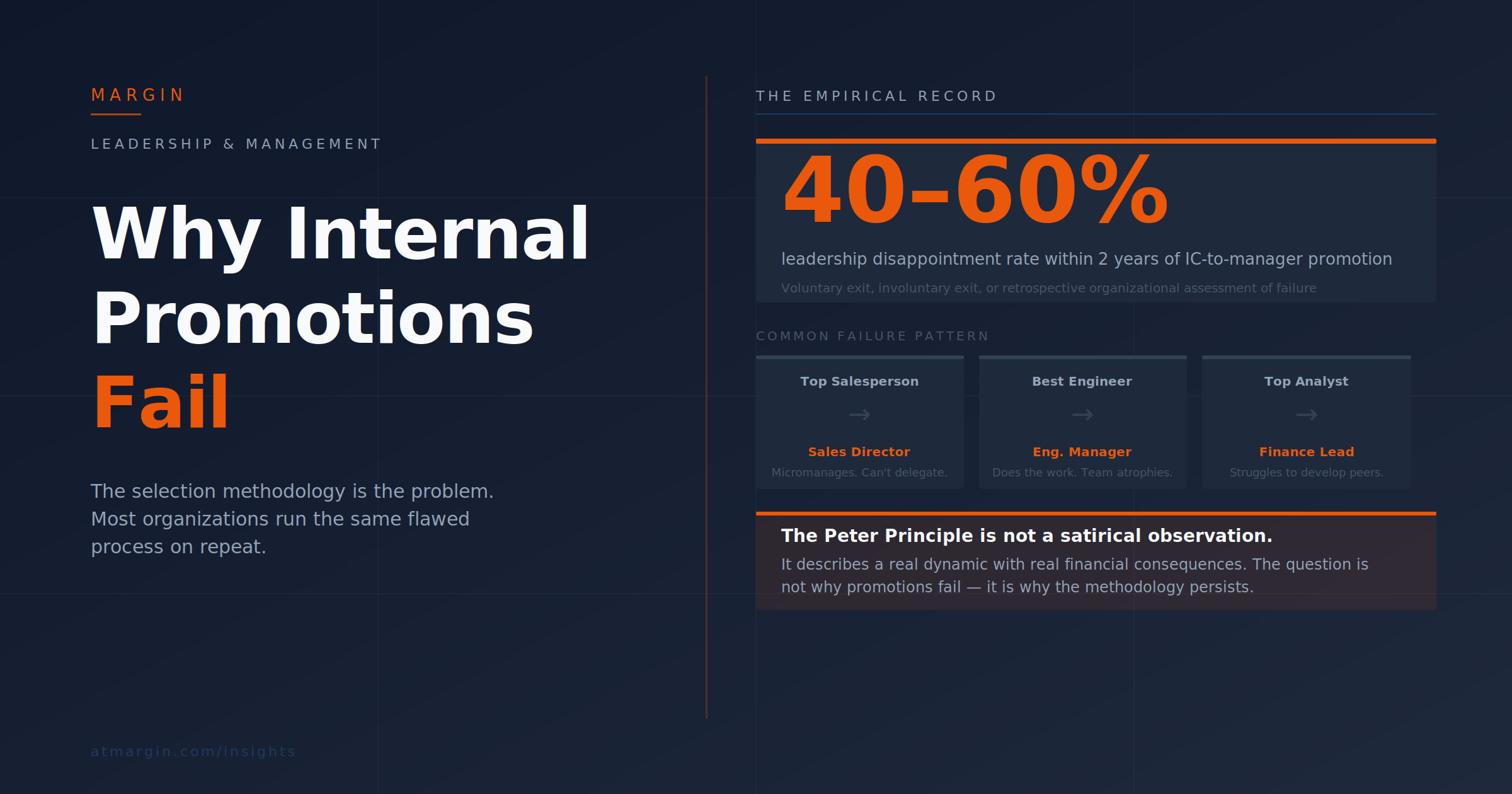
There is a promotion decision made in organizations every day that follows a logic so deeply embedded in organizational culture that almost no one questions it. The best performer in a role is promoted into leadership of that role. The top salesperson becomes the sales director. The most technically proficient engineer becomes the engineering manager. The highest-producing financial analyst becomes the finance lead.
The logic has a certain intuitive appeal. Performance in a role demonstrates capability, commitment, and domain expertise. Promotion rewards that performance and signals to others what the organization values. The organization retains a high performer while filling a leadership vacancy with someone proven.
The empirical record on this approach is considerably less appealing. Studies consistently show that promotion-based leadership selection, when driven primarily by individual contributor performance, produces leadership disappointment rates between 40 and 60 percent within the first two years: measured either by the promoted leader's voluntary exit, involuntary exit, or the organization's retrospective assessment that the promotion was a mistake. The Peter Principle, the observation that in a hierarchy every employee tends to rise to their level of incompetence, is not merely a satirical observation. It describes a real organizational dynamic with real financial consequences.
The question worth asking is not why individual promotions sometimes fail. It is why the methodology that generates them continues to be applied without revision.
The Competency Discontinuity
The core problem with performance-based promotion is that it conflates two distinct competency sets that share a domain but differ in almost everything that matters for success.
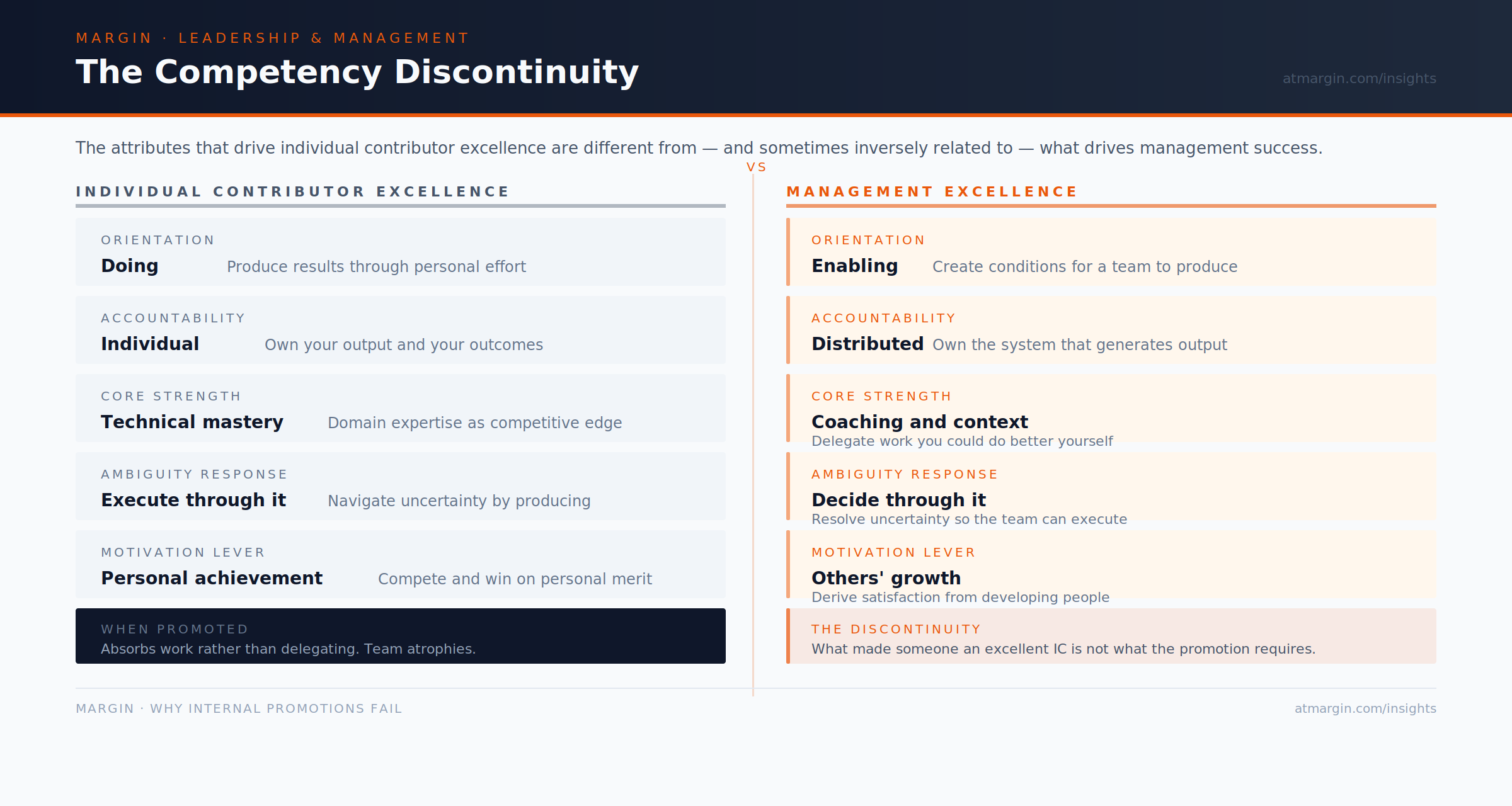
Individual contributor excellence in most professional roles is driven by a cluster of attributes: domain expertise, personal productivity, competitive drive, precision in execution, and the ability to produce results through one's own effort. These are real and valuable attributes. They are also, in important ways, mismatched with what effective management requires.
Effective management is fundamentally an act of resource allocation and system design. The good manager does not produce results; they create conditions in which a team of people produces results. This requires a different cognitive orientation: from doing to enabling, from personal output to team output, from individual accountability to distributed accountability. It requires comfort with delegating work that the manager could personally do better. It requires the ability to motivate through context and autonomy rather than example. It requires a different relationship with ambiguity. Individual contributors can navigate ambiguity by executing; managers must resolve it by deciding.
The attributes that predict individual contributor excellence do not predict management success. In some cases, they actively predict management failure. The most technically precise individual contributor often makes the most technically micromanaging manager. The most competitive top performer often struggles with developing direct reports who they unconsciously evaluate against their own standard of excellence. The individual whose personal productivity was a competitive advantage becomes an individual whose personal productivity substitutes for the management behaviors they haven't developed; they absorb work rather than delegating it, and their team atrophies from underutilization.
This is not a character flaw. It is a competency discontinuity, a gap between what got the person to the promotion and what the promotion actually requires.
What Most Organizations Get Wrong at the Promotion Gate
The promotion decision process in most organizations is inadequately rigorous relative to its organizational consequences. A senior individual contributor promotion to a management role, with a team of six to ten direct reports and a fully-loaded labor cost of $800,000 to $1.5 million under their oversight, is a decision that will affect business outcomes for multiple years. Most organizations make it based on performance ratings, manager recommendation, and an informal conversation.
“Organizations believe that internal visibility substitutes for formal assessment. What they know is the candidate as an individual contributor. What they need to know is whether they can manage.”
The contrast with external hiring decisions is instructive. When an organization hires externally for a management role of comparable consequence, it typically deploys structured interviews, skills assessments, reference checks, and in some cases leadership behavioral instruments. Multiple stakeholders review candidates. The process takes weeks.
When the same role is filled internally, the rigor is frequently absent, partly because the organization believes it already knows the candidate, and partly because applying selection rigor to internal candidates can feel bureaucratic or distrustful.
The belief that internal visibility substitutes for formal assessment is one of the most expensive assumptions in talent management. Organizations do know their internal candidates; they know them as individual contributors. They have genuine and often accurate information about what those individuals are capable of in their current roles.
What they typically lack is validated information about the specific competencies that predict management success: the ability to deliver feedback effectively, to coach rather than direct, to navigate team dynamics, to delegate without abdicating, to influence without authority in cross-functional settings.
The assessment gap is compounded by a common organizational failure mode: the absence of deliberate management readiness development before the promotion is made. Organizations that identify high-potential individual contributors and invest in their management readiness (assigning them stretch projects with people leadership components, providing coaching on management competencies, giving them opportunities to lead without a title) are creating a pre-promotion development runway that both builds the competency and provides signal about whether the candidate can develop it. Organizations that wait until the promotion to discover whether the candidate can manage are running an expensive experiment with real organizational stakes.
The Cost of a Failed Promotion
The financial consequences of a failed internal promotion are substantial and typically underestimated, because they operate through multiple channels simultaneously.
Direct Costs
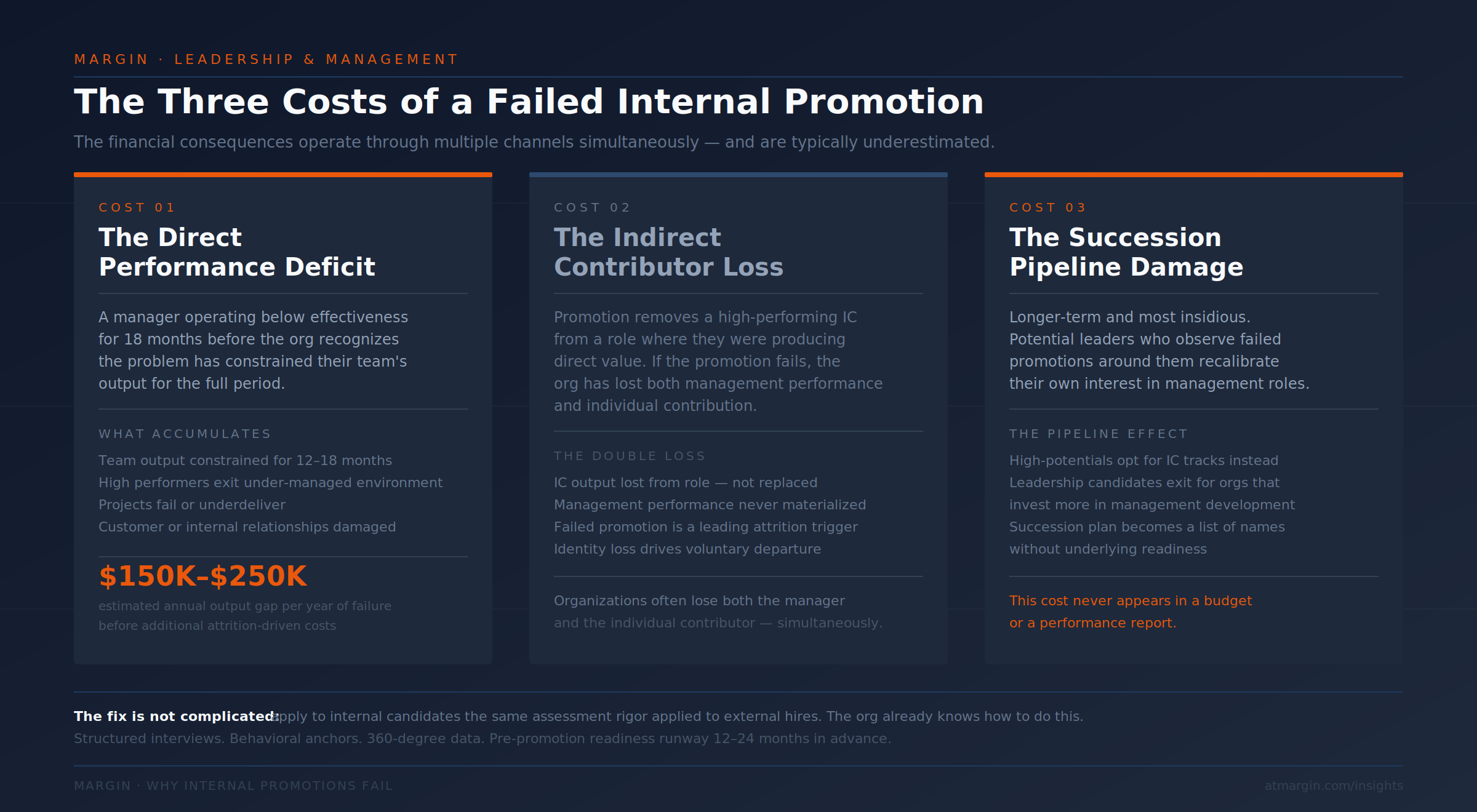
The direct cost is the performance deficit accumulated while the newly promoted leader learns, struggles, or fails in the role. A manager who is operating below effectiveness for eighteen months before the organization recognizes the problem and intervenes (through additional support, role redesign, or transition) has overseen a team whose output was constrained throughout that period. The team may have lost high-performing members who departed rather than remain in an under-managed environment. Projects may have failed or underdelivered. Customer or internal relationships may have been damaged.
Indirect Costs
The indirect cost is the loss of the individual contributor. Promotion removes a high-performing individual from a role where they were creating direct value. If the promotion fails, the organization has lost both the management performance it was seeking and the individual contribution it was generating. Depending on the subsequent transition, it may also lose the individual themselves: a failed promotion attempt is among the most predictive precursors to voluntary attrition for the individuals involved. The loss of identity and status that accompanies a promotion failure, even when handled supportively, is a significant departure trigger.
The succession cost is longer-term. Organizations that make consistently poor internal promotion decisions degrade their own succession pipeline. Potential leaders who observe failed promotions around them recalibrate their own interest in management roles. They conclude, rationally, that the organization's promotion path involves risk that is not offset by appropriate support or development. High performers who might have grown into leadership elect instead to stay in individual contributor tracks or exit for organizations that appear to invest more thoughtfully in management development.
A Better Selection Model
Repairing the internal promotion process does not require bureaucratic complexity. It requires applying to internal candidates the same analytical rigor that organizations already apply, inconsistently, to external ones.
The foundation is a clear competency model for the management role in question, not a generic leadership competency library, but a specific behavioral profile grounded in what the role actually requires. The management competencies for a front-line sales manager are materially different from those for a finance director. The behavioral evidence sought in the assessment should reflect those differences.
The assessment approach should include structured interviews with behavioral anchors, asking candidates to describe specific situations in which they demonstrated relevant management behaviors, rather than asking hypothetical questions about what they would do. It should include 360-degree data from peers and direct reports who have worked with the candidate in contexts requiring management-adjacent behaviors. Where available, it should include data from experiences that served as readiness indicators: how the candidate managed in informal leadership roles, project lead assignments, or mentoring relationships.
The development component should precede the promotion wherever possible. Organizations that build internal talent pipelines, identifying potential management candidates twelve to twenty-four months before the promotion opportunity arises and investing in structured management readiness development, produce materially better promotion outcomes than organizations that make the selection decision at the moment of vacancy.
The methodology that produces 40 to 60 percent management disappointment rates does so because it is measuring the wrong things at the wrong time. The fix is not complicated. It is simply a willingness to apply to the promotion decision the rigor we already apply to decisions of comparable financial consequence.