
The Off-Cycle Adjustment Trap
The off-cycle adjustment is treated as a surgical, contained intervention. It is a broadcast signal to the rest of the workforce — and it creates the next at-risk employee on a more reliable schedule than the one it retained.
Pay information leaks faster than it ever has. Sixteen states now require employers to disclose pay ranges in job postings; several extend the requirement to internal mobility and to current employees who request range information for their own roles. Direct disclosure between peers has always been more common than HR leaders assumed.
Indirect disclosure (paystubs visible on shared screens, benefits enrollment changes, lifestyle inflections that peers connect to timing) fills in whatever the formal channels miss. The cumulative effect is that an off-cycle compensation adjustment in 2026, regardless of intent, is for practical purposes a public statement about how compensation gets set at the company.
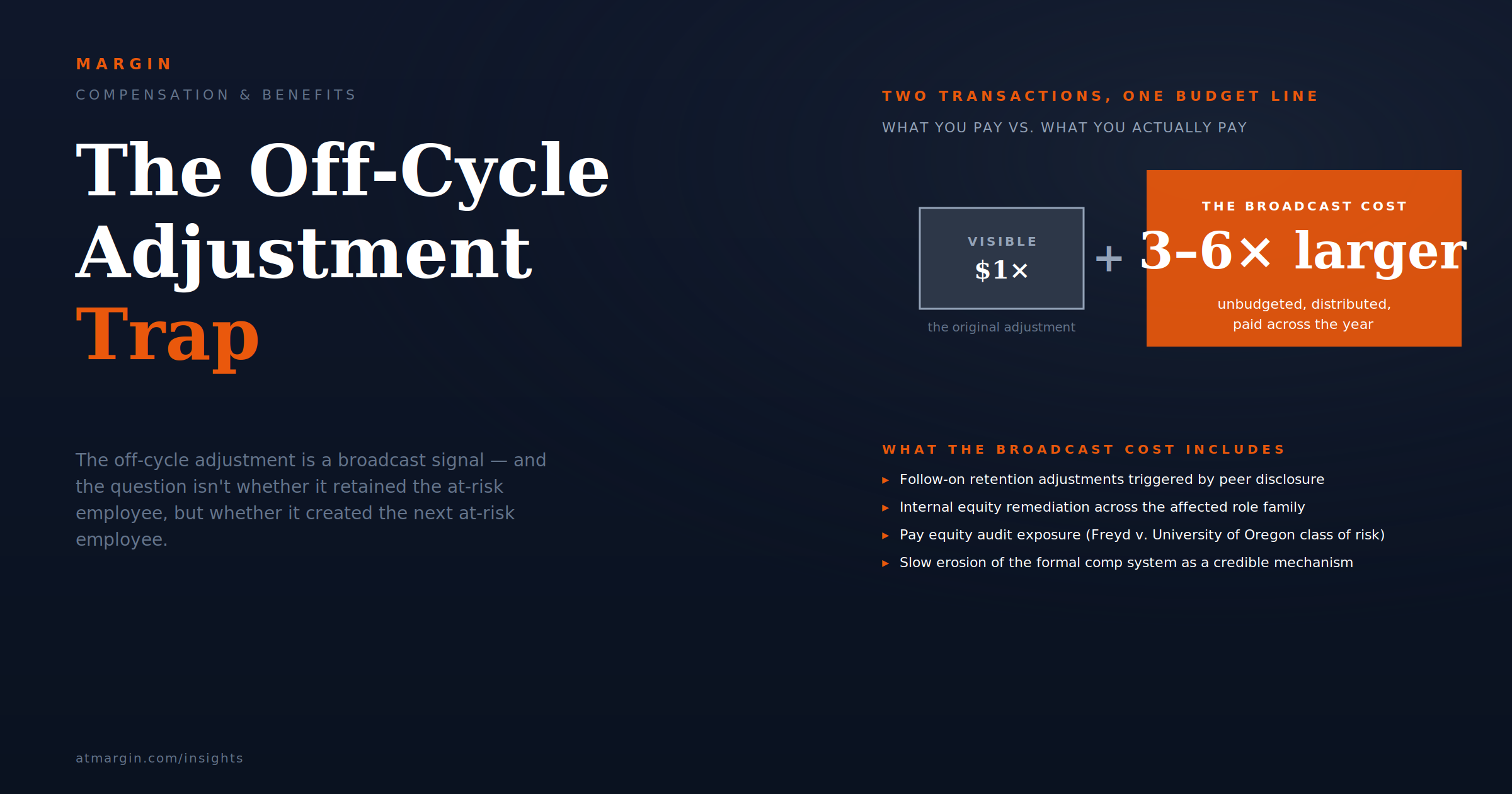
Most CFOs are not auditing the public statement. They are auditing the visible cost — the increase paid to the at-risk employee — and asking whether the retention math was justified. The harder audit, the one almost no companies run, asks a second question: what implicit policy did the adjustment broadcast, who learned about it, and what did the broadcast cost the company over the following twelve months.
The visible cost lands on a budget line. The broadcast cost gets absorbed across follow-on retention requests, internal equity remediation, and the slow erosion of the formal comp system as a credible mechanism for setting pay. Almost none of it gets connected back to the original adjustment that produced it.
This is the off-cycle adjustment trap. Companies treat retention adjustments as surgical interventions: identify the at-risk employee, calibrate the increase, deliver it discreetly, retain the employee. The mental model is medical — a targeted treatment for a specific patient.
The actual mechanism is closer to broadcast. Every off-cycle increase sends a signal to the broader workforce about how compensation actually gets set in the company, and the signal compounds in ways the original decision rarely accounts for. The visible transaction shows up on a budget line. The invisible transaction does not. Most CFOs are paying for both. Most are budgeting for only one.
The Illusion of Containment
The first assumption underlying the off-cycle adjustment is that the adjustment will remain confidential. This was approximately true twenty years ago. It has been eroding for two decades and is now, in most American jurisdictions, structurally false.
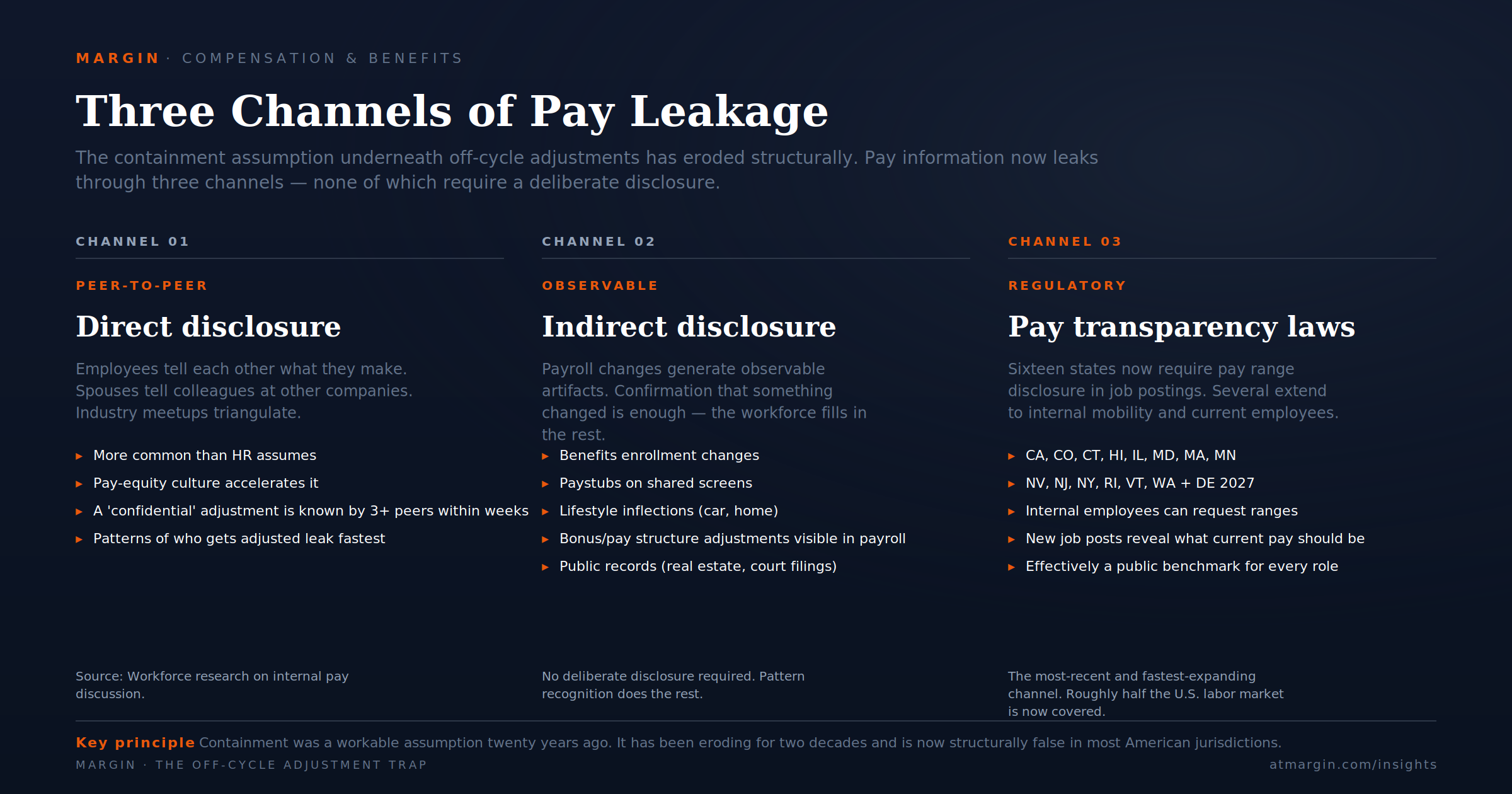
Pay information leaks through three channels, each of which has expanded dramatically.
Direct Disclosure
The first channel is direct disclosure. Employees tell each other what they make. They tell their spouses, who tell colleagues at other companies, who triangulate. They tell former coworkers in industry meetups. Direct disclosure was always more common than HR leaders assumed; it is more common still in workforces where pay equity has become an explicit cultural concern. A retention adjustment that the manager thinks of as confidential is, in many cases, known by at least three of the employee's peers within thirty days.
Indirect Disclosure
The second channel is indirect disclosure. Payroll changes generate observable artifacts: a colleague mentions a benefits enrollment change, a paystub gets accidentally visible on a shared screen, a new car or home purchase signals a financial inflection that peers connect to the timing. These signals do not reveal exact numbers, but they confirm that something has changed. Confirmation is enough; the workforce will fill in the rest with reasonable estimates and shared discussion.
Regulations
The third channel, and the one that has changed most dramatically since 2021, is regulatory. Sixteen states and a growing number of cities now require employers to disclose pay ranges in job postings, and several extend the requirement to internal job postings, transfer opportunities, and ranges for current employees who request them. California, Colorado, Connecticut, Hawaii, Illinois, Maryland, Massachusetts, Minnesota, Nevada, New Jersey, New York, Rhode Island, Vermont, Washington, and others have laws on the books with varying thresholds and effective dates.
New Jersey's law, in effect since June 2025, requires employers to make reasonable efforts to inform existing employees of internal promotion opportunities, with pay ranges disclosed. Massachusetts' Frances Perkins Workplace Equity Act, effective October 2025, requires pay ranges to be provided to current employees offered a promotion or transfer. Delaware's law takes effect in 2027.
The cumulative result is that an employee in a transparency state can, with minimal effort, determine the pay range for their own role. They can determine the range for the role of the colleague who just received an off-cycle adjustment. They can determine whether their own pay sits at the top, middle, or bottom of the range, and they can compare that placement to the placement of a peer who threatened to leave. The "containment" model the off-cycle adjustment was built on assumed an information asymmetry that no longer exists in roughly half the U.S. labor market and is steadily disappearing in the rest.
The math compounds. If a single off-cycle adjustment leaks to even three peers, and the company makes ten such adjustments a year, the workforce learns within twelve months that retention threats produce comp adjustments at this organization. The signal does not require any individual leak to be dramatic. It requires only the cumulative inference from ten data points, distributed across a workforce that talks to itself.
The Implicit Policy
Once the workforce has learned the pattern — that retention threats produce off-cycle adjustments — the incentive structure of the entire compensation system inverts.
“Every off-cycle increase sends a signal to the broader workforce about how compensation actually gets set in the company — and the signal compounds in ways the original decision rarely accounts for.”
Under the formal policy, compensation is set by performance, market data, and band placement at annual review. Under the implicit policy the workforce now operates on, compensation is set by negotiation pressure applied at moments of leverage. The two policies coexist.
The formal policy describes how compensation is supposed to get set. The implicit policy describes how it actually gets set for the share of employees willing to apply pressure.
Stable Performers Become Subsidizers
This produces three structural effects. The first is that stable performers become subsidizers.
An employee who shows up, performs well, and does not threaten to leave receives the formal-policy comp adjustment — typically a merit increase in the three to four percent range. An employee who applies pressure at the right moment receives the implicit-policy adjustment — typically ten to twenty percent in a single move.
Over three years, the gap between these two compensation paths becomes structural. Employees notice. Some begin to apply pressure of their own. The proactive-to-reactive ratio of off-cycle adjustments — the share that respond to genuine market shifts versus the share that respond to retention threats — drifts toward reactive.
Industry benchmarks suggest healthy organizations maintain at least a 40/60 split between proactive and reactive adjustments; ratios above 80 percent reactive are taken as evidence of systemic underpayment. Many companies do not measure the ratio at all and discover it has tipped only when the off-cycle budget runs dry in October.
Internal Equity Erosion
The second structural effect is internal equity erosion. An off-cycle adjustment for a single employee almost always creates new pay compression — a peer in a similar role, with similar performance, now paid materially less than the adjusted employee. The compression generates a new round of equity claims, which the company must either address (further inflating the off-cycle spend) or refuse (further damaging trust in the formal policy).
Workleap and several compensation advisory groups note that knee-jerk retention adjustments routinely produce pay compression that takes years to remediate. Payscale's data places the share of off-cycle adjustments driven by retention at roughly 62 percent — a level that strongly suggests the formal review process has been displaced by negotiation as the primary determinant of pay.
Reputational Risk
The third structural effect is legal and reputational risk. Counter-offer practices are not demographically neutral. Studies and litigation — including Freyd v. University of Oregon — have surfaced patterns in which neutral retention practices produce disparate-impact pay disparities, typically because the employees most willing or able to apply leverage skew demographically.
A counter-offer policy that is informal and unreviewed becomes, at scale, a comp system whose disparate effects are documentable in any reasonably structured pay equity audit. The Equal Employment Opportunity Commission and state enforcement bodies have increasingly focused on systemic compensation practices over individual complaints. The off-cycle counter-offer pattern is precisely the kind of practice these reviews surface.
A CFO at a multi-state specialty contractor described the realization:
"We had a director-level retention case last spring. We approved a seventeen percent off-cycle increase to keep him. By August, three other directors at peer locations had asked for similar reviews. By October, we had spent the entire year's off-cycle budget, the original director had left anyway, and we were running a special comp band review six months ahead of schedule because the implicit policy we'd created was untenable. We never put any of that on the same financial conversation as the original adjustment."
Call the cumulative cost of these three effects the broadcast cost: the full financial weight of an off-cycle adjustment, including the follow-on adjustments it produces, the equity remediation it triggers, the legal exposure it accumulates, and the slow erosion of the formal comp system as a credible mechanism for setting pay.
The visible cost — the original increase — is typically a small fraction of the broadcast cost. Most companies budget for the visible cost and absorb the broadcast cost as overhead, market pressure, or a series of separate conversations that never get connected back to the original decision.
Evaluating Off-Cycle Adjustments Honestly
The corrective is to evaluate every off-cycle adjustment as a two-part transaction rather than a one-part one. Three questions, applied before any retention adjustment is approved, change the calculus.
What Signal Does This Send to the Workforce?
The first question is what signal the adjustment sends to the rest of the workforce. Not whether the adjustment is justified for the at-risk employee, assume it is, but what implicit policy it broadcasts.
If the adjustment is being made specifically because the employee threatened to leave, the broadcast signal is that retention threats produce raises. If the adjustment is being made because a market analysis revealed the employee's pay had drifted below market, the broadcast signal is that the company corrects market drift.
The same dollar increase carries different broadcast costs depending on the framing the workforce can credibly attribute to it.
Who Will Learn About the This?
The second question is who will learn about the adjustment. In a pay transparency state, the answer is structurally everyone in the role, regardless of intent to disclose. In a non-transparency state with a small team, the answer is most of the team within sixty days.
The question is not whether the adjustment will be discovered; it is what the discovery will reveal about how compensation gets set. Adjustments that reveal a coherent, defensible compensation philosophy do less broadcast damage than adjustments that reveal an ad-hoc, threat-responsive system.
What Policy Does This Create?
The third question is what implicit policy the adjustment creates if repeated. If the company makes one retention adjustment this quarter, two next quarter, and three the quarter after, the cumulative implicit policy is "we adjust for retention threats." That policy will produce more retention threats. The adjustment that feels like a singular event is rarely singular; it is the first data point in a pattern the workforce will read as policy.
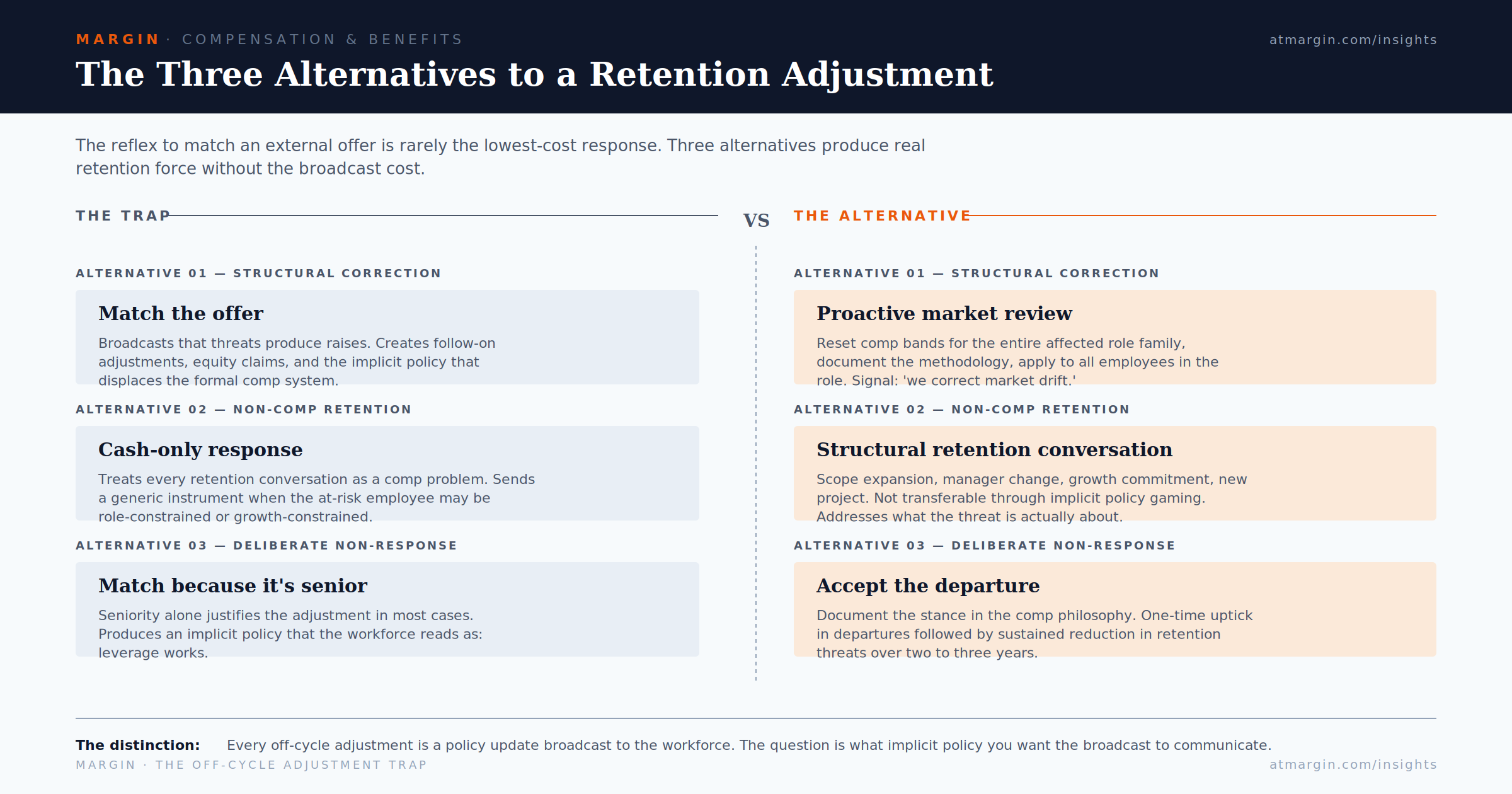
These three questions usually produce a different conversation than "do we match the offer?" The alternative responses worth considering — when the answers to the three questions weight against the adjustment — fall into three categories.
Proactive Market Review
The first alternative is the proactive market review. If retention threats are surfacing, the comp bands have likely drifted below market for the affected role. The structural correction is to reset the bands proactively, document the methodology, and apply the correction to all employees in the affected roles — not just the one who threatened to leave.
The total spend is sometimes higher than a single retention adjustment. The broadcast cost is dramatically lower because the signal is "the company corrects market drift," not "the company responds to threats."
Structural Retention Discussion
The second alternative is the structural retention conversation, decoupled from comp. Many at-risk employees are not primarily comp-constrained. They are role-constrained, manager-constrained, or growth-constrained. A scope expansion, a manager change, a new project, an explicit growth commitment — these produce real retention force without sending the broadcast signal that compensation is negotiable. They are also dramatically harder to extract through implicit policy gaming, because they are not transferable: another employee cannot threaten to leave and expect the same scope expansion, because scope expansion is not a generic instrument the way a comp adjustment is.
Accept the Departure
The third alternative is to accept the departure. Sometimes the right answer to a retention threat is to let the employee leave. This is uncomfortable for managers who have invested in the employee, and it is uncomfortable for CFOs who have run the replacement-cost math.
But the broadcast cost of refusing the adjustment — particularly when the refusal is documented in the comp philosophy as a deliberate stance — produces an implicit policy that is, on balance, cheaper than the alternative.
Companies that have publicly refused to make counter-offers as a policy matter typically see a one-time uptick in departures, followed by a sustained reduction in retention threats over the following two to three years.
What This Requires
Adopting an honest evaluation of off-cycle adjustments requires four organizational changes.
Exclusion of Retention Threats as Triggers
The first is a compensation philosophy that explicitly excludes retention threats as a valid trigger for adjustments. Most comp philosophies are silent on this point or include language so general that any adjustment can be justified.
An explicit philosophy might state: "off-cycle adjustments are made for market correction, role expansion, internal equity remediation, and exceptional performance recognition. Off-cycle adjustments are not made in response to external offers or threats of departure."
This is a documented stance, defensible against pay equity audits, and visible to the workforce. The visibility is the point. Employees calibrate their behavior to the stated policy when the stated policy is credibly enforced.
Annual Market Reviews
The second is annual market reviews with structural comp band updates. If the comp bands are reviewed and updated annually, market drift gets corrected before it produces retention threats. The proactive-to-reactive ratio shifts toward proactive without any individual heroic intervention. Most companies review comp bands every two to three years; the cost of more frequent review is small relative to the broadcast cost of the retention adjustments produced by stale bands.
Manager Training
The third is manager training in retention conversations that are not comp conversations. Many managers default to comp because comp is the only retention lever they have explicit authority to pull. Equipping managers with scope, growth, and role-design authority gives them retention conversations that do not run through the comp system.
A manager who can offer an at-risk employee a meaningful expansion of responsibility, in a defined timeframe, with documented growth commitment, is making a retention investment that does not broadcast across the workforce as a comp policy. A manager whose only retention tool is comp will use comp, and the broadcast costs will accumulate.
Off-Cycle Discipline
The fourth is CFO discipline on the off-cycle pool. Industry benchmarks place the off-cycle budget at one to two percent of total payroll. Holding the line at two percent — and refusing to expand it when retention requests proliferate — forces the underlying conversation about why retention requests are proliferating. The expansion of the pool, year over year, is the financial signal that the implicit policy is displacing the formal one. Holding the line surfaces the displacement and forces a structural correction.
These four changes restructure the off-cycle adjustment from a manager-driven, ad-hoc tool into a financial system with documented inputs, predictable outputs, and visible accountability. The changes do not eliminate retention adjustments. They eliminate the ones whose broadcast costs exceed their retention value, which is the larger share of the ones most companies are currently making.
The Two Transactions
The companies that audit the second transaction — the broadcast cost — will design comp systems that don't require the broadcast in the first place. The companies that don't will keep paying for both transactions every year, while the broadcast cost compounds and the formal comp system loses credibility one adjustment at a time.