
The Six-Month Tax
Every month an executive seat stays empty, the organization is paying a cost that never appears on the search invoice — and most companies have no idea how large it is.
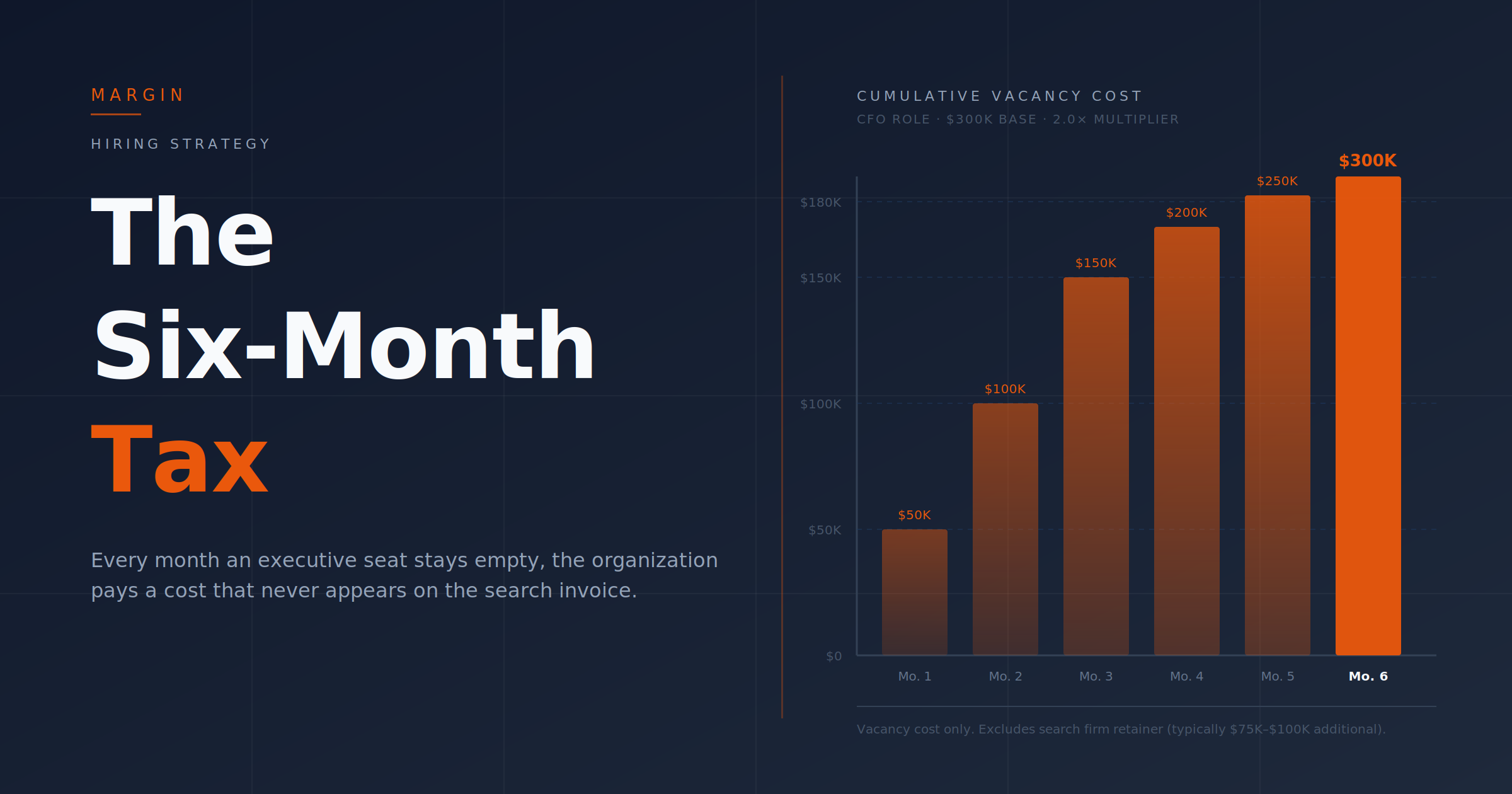
There is a number that almost never appears in a recruiting budget. It isn't the retained search fee, which typically runs 25 to 33 percent of first-year compensation. It isn't the cost of advertising, assessments, or travel for finalist interviews. It is the cost of the empty chair itself; the accumulated drag of deferred decisions, diluted accountability, and organizational paralysis that compounds quietly every week a senior role goes unfilled.
Call it the Six-Month Tax. For most executive-level searches, it is the largest single cost in the hiring process. It is also the least measured.
The average time-to-fill for a director-level or above role in the United States currently sits between 90 and 120 days from brief to accepted offer. Factor in notice periods, relocation, and onboarding ramp time, and a company that begins a search in January may not have a fully functioning executive in seat until June or July. Six months. In that window, every business decision that required that role's authority, expertise, or accountability is either delayed, redistributed, or made badly by someone who wasn't hired to make it.
Most finance leaders, when they think about recruiting cost at all, anchor to the search firm fee. That is the wrong number to anchor to.
What the Invoice Doesn't Capture
The retained search fee is a known, visible cost. It shows up in a purchase order, gets approved by a budget owner, and sits in a line item. This visibility gives it disproportionate psychological weight in how companies evaluate search spending.
The actual cost of a prolonged search operates differently; it is invisible and spread across functions that will never connect it to the recruiting process. Consider what actually happens during a six-month executive vacancy:
The departing executive's direct reports lose a primary decision node
They begin escalating decisions upward, consuming the time of the next level of leadership. Work that required sign-off slows. Strategic initiatives that needed executive ownership get shelved or quietly defunded. Teams operating under an interim leader, whether a peer covering the role or an acting manager elevated above their authority, make conservative decisions. They are not wrong to do so. They are acting rationally under conditions of uncertainty. But conservatism at the executive level has a measurable cost in slowed execution, missed market timing, and deferred growth investments.
There is also the talent multiplier effect
A six-month vacancy in a senior HR or finance role doesn't just cost what that individual would have contributed. It costs the decisions they would have made that affect the performance of their entire organization. A CFO vacancy means six months of sub-optimal capital allocation, delayed financial modeling, and deferred strategic analysis. The cost isn't one person's salary; it is the output leverage of everything that person would have influenced.
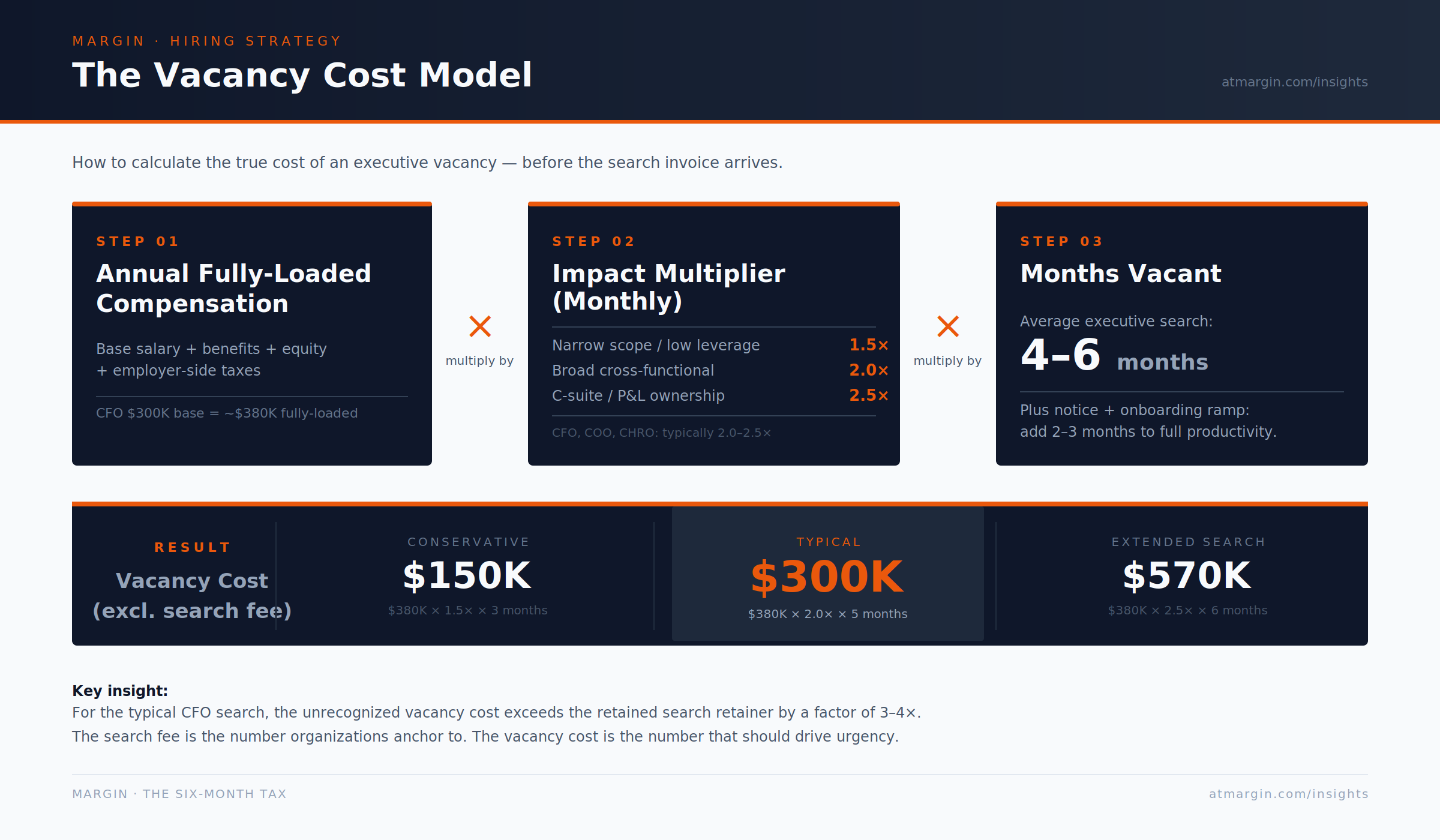
A useful heuristic: for a role with meaningful organizational span, the true monthly cost of vacancy is approximately 1.5 to 2 times the monthly fully-loaded compensation of the position. For a $300,000 base salary CFO, that implies a vacancy cost of $37,500 to $50,000 per month, independent of search fees. Over six months, that is $225,000 to $300,000 in unrecognized cost, before a single invoice is generated.
The Interim Illusion
Many organizations respond to executive vacancies by appointing interim leaders. On the surface this appears to solve the problem. Decisions continue to get made. Direct reports have someone to report to. The organization doesn't look leaderless. But the interim arrangement typically creates its own cost structure that offsets much of its apparent value.
Interim leaders are not empowered to make decisions
First, interim leaders are rarely empowered to make consequential decisions. An acting CFO who knows they are serving a temporary function will not redesign the financial reporting structure, will not restructure a vendor relationship, and will likely not make the difficult headcount or budget calls that require institutional confidence in the person making them. They are, by rational self-interest, caretakers, and caretaker management is a form of organizational stasis.
Interim leaders are pulled away from their own role
Second, the individual absorbing the interim responsibility is being pulled away from their own role. The COO covering a CFO vacancy, the VP of HR acting as CHRO; these are not redundant resources. They are expensive executives whose primary responsibilities are now competing with an added workload. The cost of their diverted attention shows up nowhere, but it is real.
Interim roles often create a more complicated hire
Third, organizations that install a strong interim often create a more complicated hire. The internal candidate develops expectations. The incoming external hire enters with a more difficult political terrain to navigate. The transition cost (social, operational, and sometimes in retention of interim-era loyalists) can extend well beyond the onboarding period.
Why Companies Misjudge Search Speed
If the cost of a prolonged vacancy is this substantial, why do companies routinely allow searches to extend six months or more? The answer lies in a combination of process design failures and misaligned incentives.
Most executive searches begin too late
The typical trigger for initiating a search is a resignation, a termination, or a reorganization; events that are often predictable well before they become official. A CFO who has been visibly checked out for two quarters, a CHRO approaching retirement eligibility, a COO who didn't get the CEO role and is quietly exploring — these are leading indicators that a search will be needed. Organizations that wait for the formal separation notice are already months behind.
The search process itself is frequently the bottleneck
Retained search engagements often spend four to six weeks on brief development, research, and initial outreach before a single candidate is presented. Internal approval chains for offers add additional weeks. Interview processes that require consensus from eight stakeholders create scheduling friction that compounds across rounds. None of these delays feel like failures in the moment; they feel like thoroughness. But thoroughness has a price, and that price is rarely acknowledged.
Misaligned incentives also play a role
The internal HR team is measured on process quality, not search velocity. The retained search firm's fee is fixed regardless of time-to-fill. The hiring executive may actually prefer a longer process because it postpones a decision they are uncertain about. No one in the process is explicitly accountable for the organizational cost of each passing week.
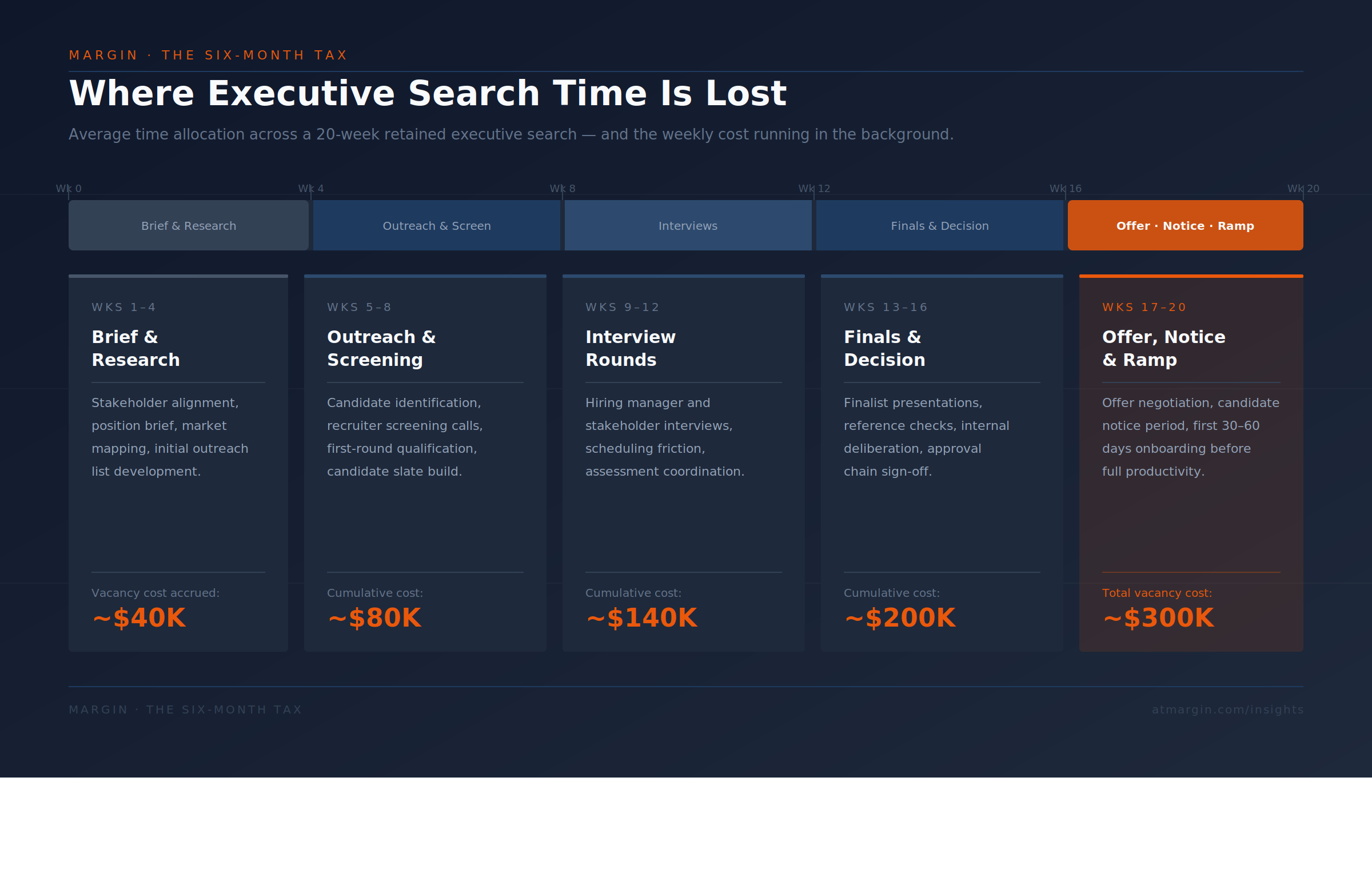
The Six-Month Tax Framework
Organizations that want to bring discipline to executive search timelines need to start by making the vacancy cost visible. This requires building a simple vacancy cost model that can be run at the start of every senior search.
The inputs are straightforward: the role's annual fully-loaded compensation, an organizational impact multiplier based on reporting span and decision authority (1.5x for roles with limited organizational leverage, 2.0x or higher for roles with broad cross-functional influence), and an anticipated search duration based on historical time-to-fill data for comparable roles.
The output is a weekly cost figure that should be presented alongside the search budget. If a CFO search carries a $120,000 retained search fee and a weekly vacancy cost of $11,500, a sixteen-week search has already generated $184,000 in unrecognized cost before the offer letter is signed. The total cost of that hire is not $120,000. It is north of $300,000.
This reframe changes the calculus on search investment. Organizations that understand their true vacancy cost are more likely to authorize a higher search fee in exchange for a materially faster process. They are more likely to streamline internal interview stages when they can see what each additional round costs. They are more willing to move quickly at the offer stage rather than deliberating for weeks at the finish line.
The Six-Month Tax is, ultimately, a consequence of treating executive hiring as an administrative process rather than a capital allocation decision. Vacancies at the senior level are not paperwork problems. They are operating risks with compounding costs. The organizations that treat them as such (that build vacancy cost models, that track time-to-productivity alongside time-to-fill, that create explicit accountability for search velocity) consistently outperform those that treat recruiting as a back-office function.
Compressing the Timeline: What Actually Works
Knowing the cost of vacancy changes the conversation. Changing the process requires more specific interventions, and most of them are structural rather than motivational.
Search Initiation Time
The most impactful lever is search initiation timing. Organizations that begin a formal search process the moment a senior departure becomes probable, rather than the moment it becomes official, compress the timeline by four to six weeks before the first interview is scheduled.
The signals that predict a departure are usually visible well in advance: a missed promotion, a new reporting relationship the executive didn't want, a competitor circling, a compensation review that didn't go well. HR and operational leaders who treat these signals as search triggers rather than background noise consistently reduce their time-to-fill without changing anything else about their process.
Process Architecture
Process architecture is the second lever. The average executive interview process involves too many rounds, too many stakeholders, and too little decision velocity at the end. A three-round interview structure (an initial conversation with the hiring manager, a working session with two to three key stakeholders, and a final panel) is sufficient for almost every senior hire when each round is preceded by alignment on what the next conversation is designed to test.
Adding rounds because the organization wants more certainty typically produces more delay without more signal. Scheduling friction alone in a six-round process can add three to four weeks to a search that has no other inefficiencies.
Offer Approval Chains
Offer approval chains are where searches die quietly. A finalist who has been through five rounds of conversations, whose references have been checked, and who has indicated a readiness to move should receive an offer within 48 to 72 hours of the final meeting. Organizations that route offer letters through three levels of approval, run them past legal as a matter of process, and then deliberate for another week at the finish line are paying the vacancy cost for every day of that delay, and risking the candidate's continued availability in a market where strong executives receive multiple approaches simultaneously.
Rethinking the Interim Arrangement
For searches that will unavoidably run long (complex roles with thin candidate markets, or situations where the organization needs to run a genuinely thorough process) the interim arrangement deserves more strategic investment than it typically receives.
The internal caretaker model, as described earlier, is the path of least resistance and the one most likely to produce the quiet organizational stasis that compounds vacancy cost. The alternative is a properly scoped interim executive engagement: an experienced operator brought in specifically to hold genuine decision-making authority during the search window, empowered to make the calls the role requires and accountable for outcomes rather than just continuity.
The distinction between a caretaker and an empowered interim is not semantic. A caretaker preserves the status quo. An empowered interim can advance a budget process, make a critical vendor decision, assess and restructure a team, or stabilize a function that was in active deterioration under the departing leader.
The cost of a qualified external interim engagement, typically $15,000 to $30,000 per month for C-suite scope, is almost always below the vacancy cost the organization is absorbing anyway. The difference is that the interim cost appears on an invoice and gets scrutinized, while the vacancy cost does not appear anywhere and gets ignored.
The decision criterion for whether to pursue an external interim is straightforward: if the role carries an organizational impact multiplier above 2.0x and the anticipated search duration is longer than three months, the economics of a properly scoped interim engagement are almost always favorable. The math is not complicated. The organizational will to do it tends to be the harder problem.
Choosing the Right Search Partner
The search firm selection decision deserves the same analytical rigor the organization applies to any other vendor relationship of comparable financial consequence, which is to say, considerably more than most organizations apply to it.
The commodity approach to executive search (selecting a firm on the basis of lowest retainer, or defaulting to whichever firm the HR team has an existing relationship with) is a false economy in precisely the context this article has described. If the true cost of a CFO search running twenty weeks instead of twelve is $150,000 in unrecognized vacancy cost, then a search firm that commands a higher retainer but consistently delivers faster, better-calibrated results is generating a measurable return on the fee premium.
The criteria worth evaluating when selecting a search partner are specific.
Average time-to-fill for comparable roles and seniority levels is the most directly relevant metric, and reputable firms should be able to provide it.
Candidate slate quality (measured not by volume of names presented but by offer acceptance rates and first-year retention of placed executives) is a more reliable signal of search effectiveness than the number of calls a firm makes.
The firm's process for brief development matters: a search partner that spends meaningful time building a performance-based brief, rather than simply aggregating a requirements list, is operating from a fundamentally different model than one that takes a job description and starts dialing.
There is also the question of market coverage. Firms with genuine relationships in the passive candidate market (executives who are not actively searching but who would consider the right opportunity) consistently outperform contingency-model recruiters who work only the active candidate pool. For senior roles where the best candidates are almost never circulating their résumés, the depth of a firm's network is not a marketing claim. It is the primary determinant of whether the search reaches the right people at all.
The organizations that treat search firm selection as a procurement exercise (focused on fee negotiation and contractual terms) tend to get exactly the outcome that approach implies. The organizations that treat it as a strategic partnership, selected on the basis of demonstrated capability and aligned incentives around search velocity and hire quality, consistently reduce both their time-to-fill and the downstream costs that a poor executive hire generates.
The search firm fee is the visible line item. The Six-Month Tax is the real bill.