
Why Your Job Description Is a Screening Tool for the Wrong Candidates
The requirements you post to attract top talent are, in most cases, systematically filtering them out before the first conversation.
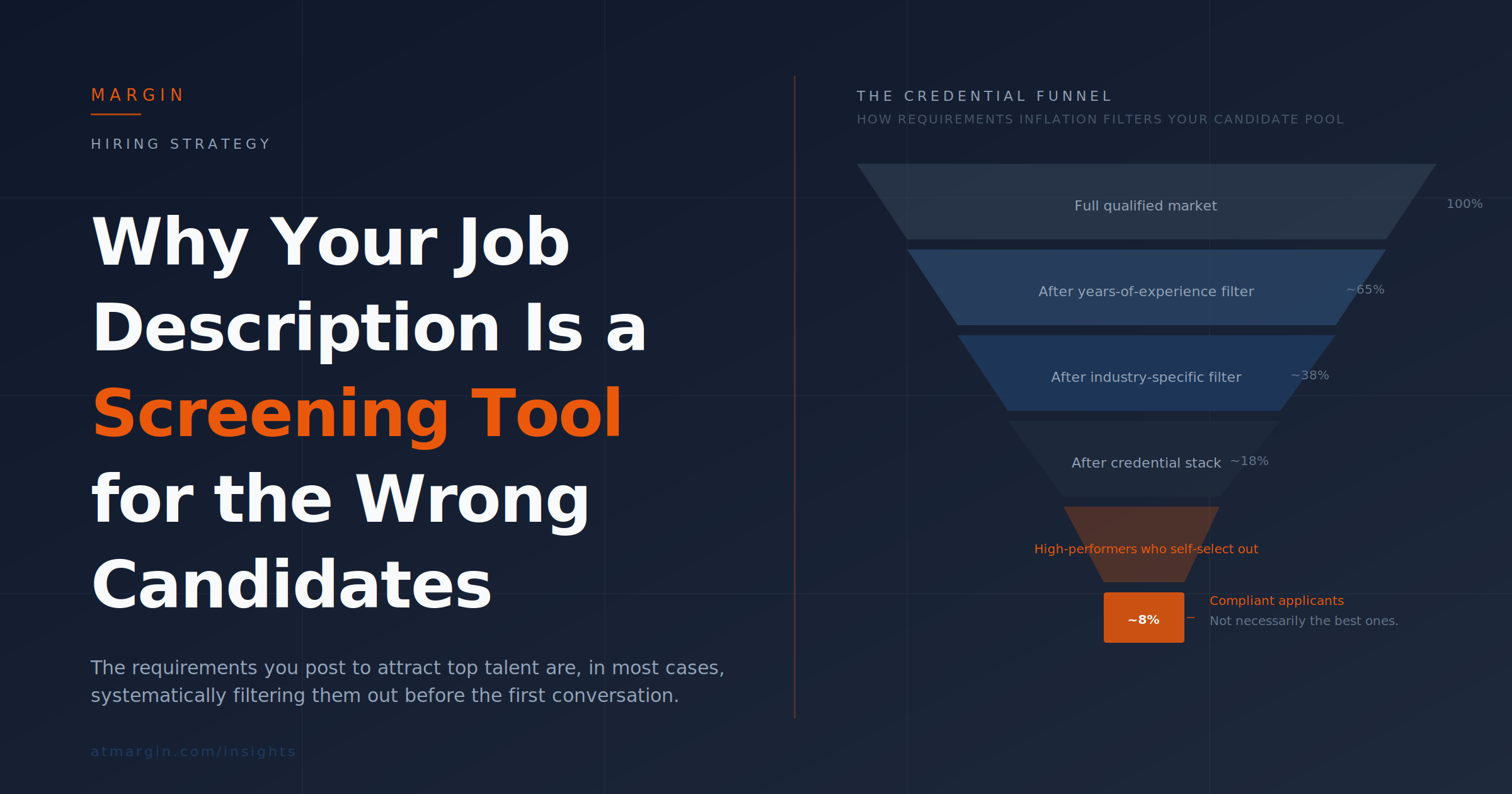
There is a well-documented phenomenon in behavioral economics called the confidence gap — the tendency for high-performing individuals to apply only when they meet nearly all stated requirements, while lower-performing individuals apply regardless of fit. The research is consistent across industries and seniority levels. And yet the average corporate job description continues to be written in a way that exploits this gap in entirely the wrong direction.
The typical executive job description is not a talent strategy document. It is an aggregation of every wish, preference, and political compromise from every stakeholder consulted during the brief development process. The result is a requirements list that screens for credentialism, keyword compliance, and a very specific career path, while systematically discouraging the candidates who are most likely to actually perform in the role.
This is not a minor calibration issue. It is a structural failure in how most organizations think about the relationship between job requirements and job performance.
The Aggregation Problem
Understanding why job descriptions fail requires understanding how they are built. In most organizations, the process works roughly as follows: HR schedules a brief call with the hiring manager. The hiring manager describes what they are looking for. HR adds language from a template or a prior version of the description. Other stakeholders are consulted. Legal reviews it. Someone adds a few additional requirements to address a gap from the last person in the role. The resulting document is a palimpsest — layers of preferences, reactions, and institutional memory with no coherent logic connecting them.
“A requirements list that is clearly internally negotiated rather than externally market-aware signals an immature hiring process — and the best candidates are reading those signals.”
What gets added almost never equals what gets removed. Requirements inflate because addition is politically easy and subtraction is politically difficult. If the prior CFO had an MBA and the search didn't fill well last time, this time the MBA goes in as required. If a previous hire lacked international experience and that became a pain point, international experience goes into the next posting as mandatory. Each addition is locally rational. Collectively, they produce a description that may match no actual high-performer in the market.
The credential inflation problem is particularly acute in finance and HR leadership searches. The "required" column on a senior finance posting will often list a CPA, an MBA, ten-plus years of experience, specific industry background, ERP system fluency, and public company experience simultaneously. This is not a coherent description of what drives performance in the role. It is a list of attributes that previous occupants happened to have.
What Requirements Actually Predict
The relevant question, and the one almost never asked during brief development, is what attributes actually predict performance in this specific role, at this specific company, in this specific moment.
The answer is rarely found in credential lists. A substantial body of research in industrial-organizational psychology, most influentially the work built on the General Mental Ability and Conscientiousness literature, suggests that the best predictors of job performance are cognitive ability, learning agility, and specific competencies tied to the role's core challenges. Academic credentials correlate with some of these, weakly. Years of experience correlates with them more weakly still, particularly above the threshold of basic competency development.
What the research actually shows is that after roughly five to seven years of relevant experience, additional years of experience predict performance at close to zero. A senior finance leader with twelve years of experience is, on average, no more likely to succeed in a CFO role than one with twenty-two years. Yet job postings routinely specify "10+ years required" without any underlying logic connecting that number to role performance.
The same holds for industry specificity. Organizations routinely require same-industry experience on the theory that industry knowledge is essential for senior performance. In practice, what matters is whether the business challenge (managing a capital structure, scaling a finance function through growth, integrating acquisitions) is structurally similar, not whether the candidate's prior employer was in the same SIC code. An experienced CFO from a high-growth SaaS business often brings more relevant financial architecture experience to a scaling technology company than a candidate from a larger, more established company in the "correct" industry.
The Self-Selection Mechanism
Job descriptions don't just describe a role; they signal who the organization believes belongs in the conversation. And candidates read those signals.
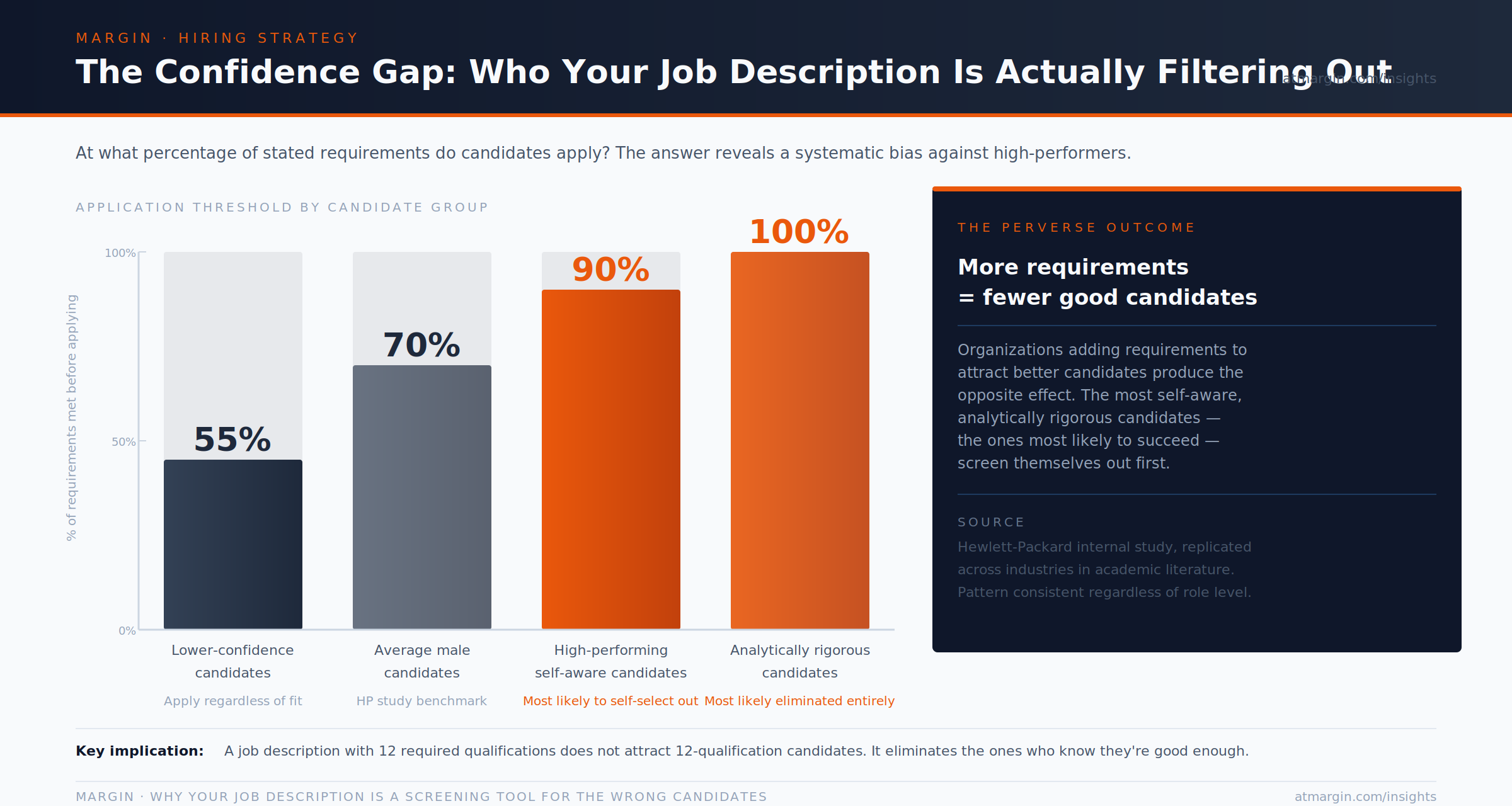
The behavioral research on application rates is instructive. A widely cited internal study at Hewlett-Packard, later replicated in broader academic settings, found that men apply for roles when they meet roughly 60 percent of stated requirements, while women apply only when they meet close to 100 percent. The pattern varies by demographic group, but the directional finding is consistent among similar studies: stringent, highly-specific requirement lists systematically reduce application rates among the most self-aware and analytically rigorous candidates, the precise population most likely to be high performers.
This creates a perverse dynamic. Organizations that write maximally specific job descriptions in an effort to attract well-qualified candidates are, in effect, producing a more compliant and less distinguished applicant pool. The candidates who apply despite meeting 70 percent of requirements tend to be higher in confidence and lower in self-critical assessment. The candidates who decline to apply because they don't tick every box include a disproportionate share of the high-performers who would have been most valuable.
There is also a market signaling problem. Senior executives, particularly the passive candidates who are not actively searching, read job descriptions as organizational intelligence. A poorly constructed posting signals poor organizational thinking. A requirements list that is clearly internally negotiated rather than externally market-aware signals an immature hiring process. The best candidates, who have options and are evaluating organizations as much as roles, are making assessments about organizational quality based on the quality of the posting itself. A requirement for "excellent communication skills" on a CFO posting tells a sophisticated candidate something about the sophistication of the people who wrote it.
Rewriting the Brief as a Performance Document
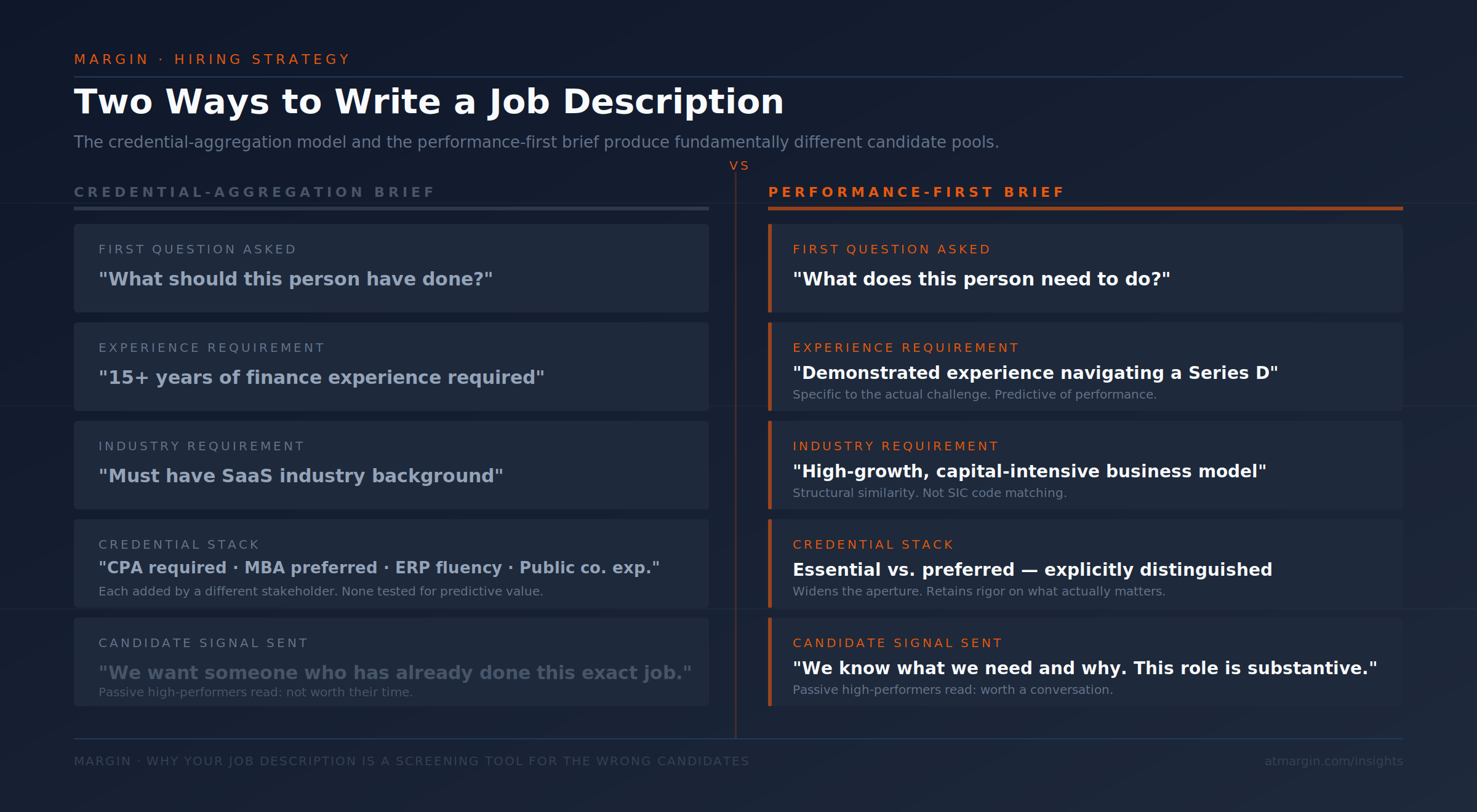
The alternative to the credential-aggregation model is a performance-first brief, a document built around what the person in this role needs to accomplish in their first 12 to 24 months, and what capabilities are genuinely necessary to do it.
This approach starts with a different first question. Not "what should this person have done?" but "what does this person need to do?" If the CFO hire is principally about taking the company through a Series D and preparing for an eventual liquidity event, then the performance brief should describe that challenge explicitly.
The required experience is not "15 years in finance" — it is demonstrated experience navigating capital markets, managing investor relationships, and building the financial infrastructure that precedes a public market readiness process. Those are more specific and more predictive requirements. They also attract a different and better-calibrated candidate pool.
The performance brief model also forces clarity on what is genuinely essential versus what is merely preferred. Most organizations, when pushed, can distinguish between capabilities the hire must bring on day one versus capabilities they could develop or supplement. Making that distinction explicit, both internally and in the external posting, widens the aperture for the right candidates while maintaining rigor on what actually matters.
Finally, a performance-first posting signals organizational sophistication to the candidate market. A posting that describes business challenges, articulates what success looks like, and explains what the role needs to accomplish in concrete terms tells a passive senior candidate something meaningful about the organization: that the people hiring have actually thought about what they need, and that the role is substantive. That signal compounds over time into employer brand equity in the executive market.
The job description is often treated as administrative output, a compliance document that precedes the real work of recruiting. In practice, it is the first filter in a high-stakes talent process, and it operates on the talent pool before anyone in recruiting has made a single call. Organizations that treat it as a strategic document (built around performance, not credentials, and calibrated to attract rather than filter) run systematically better searches. The ones that treat it as a checklist get checklist candidates.