
Exit Interviews Are an Autopsy
By the time an employee agrees to an exit interview, the retention decision has long since been made. The organizations winning on retention aren't studying departures; they're predicting them.
Every year, thousands of HR departments collect exit interview data with remarkable consistency and act on it with remarkable rarity. The forms get filled out, the responses get aggregated into themes, the themes get presented in a quarterly talent report, and the quarterly talent report gets discussed briefly before the meeting moves on to something more urgent. Meanwhile, the employees who are currently in the same psychological position the departed employee occupied six months ago are approaching the same decision point, and no one is talking to them.
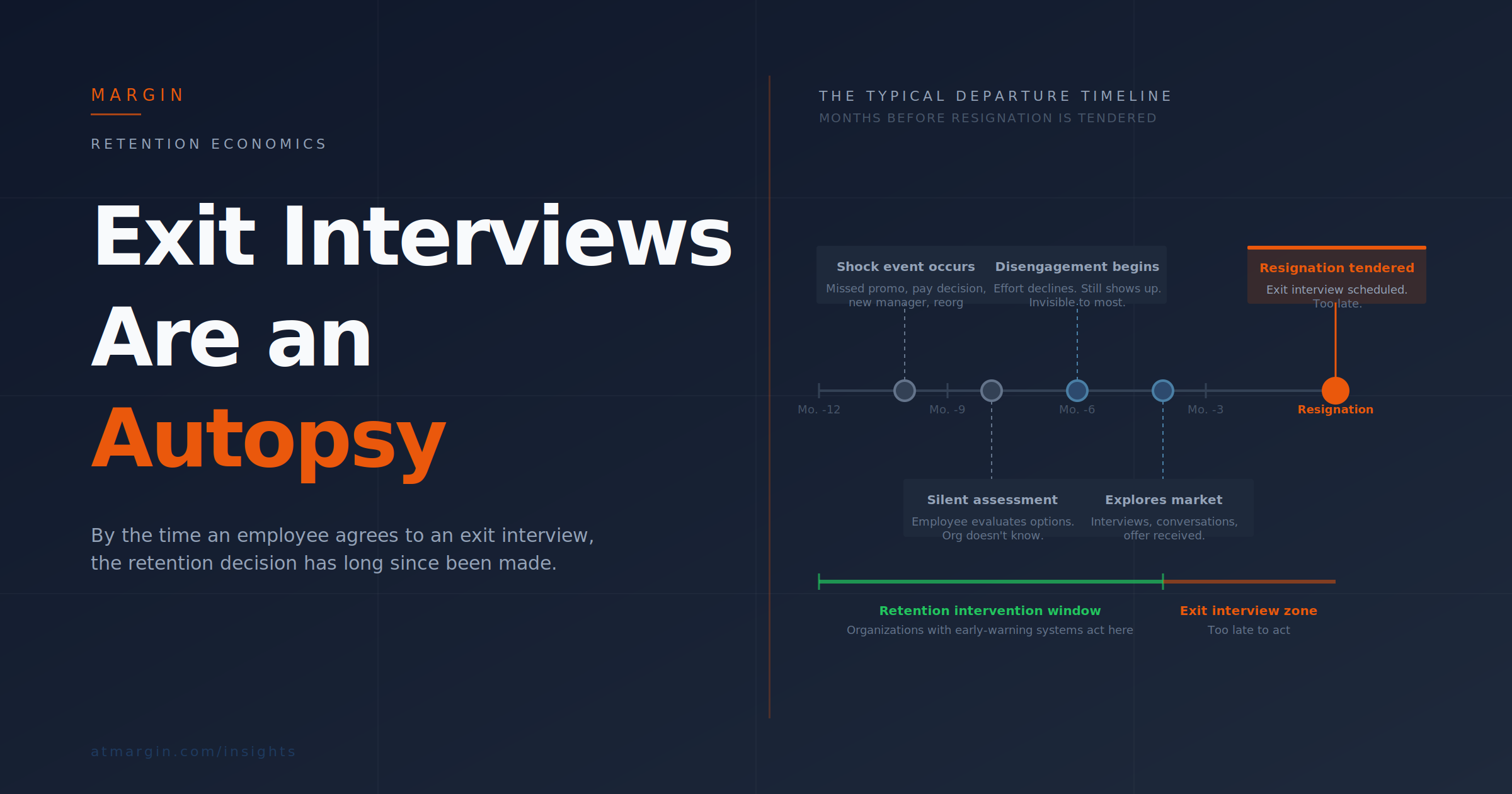
The exit interview is a structurally flawed retention instrument. Its fundamental problem is not methodological, though its methods are poor. The fundamental problem is timing. By the time a voluntary resignation is tendered, the employee has typically been disengaged or actively considering departure for an average of six to twelve months, depending on seniority level and labor market conditions. The resignation conversation is not the beginning of an employee's exit; it is the public announcement of a private decision that was made, revised, and finalized long before HR scheduled the offboarding call.
Treating exit data as a retention tool is like a hospital measuring its effectiveness by studying the patients who died. The information is real. The analysis may be accurate. But the intervention window has closed.
The Archaeology of Departure
What actually happens in the months before a voluntary resignation is reasonably well understood, and it follows a more predictable pattern than most organizations acknowledge.
Research by organizational psychologists identifies a progression they call the "unfolding model" of voluntary turnover, a sequence of shocks, evaluations, and decision points that precede an exit by weeks or months. The process typically begins with a shock event: a compensation decision that feels inequitable, a promotion that went to someone else, a new manager who operates differently, a promise that was broken, a reorganization that changes the role's scope or trajectory. These events are not, by themselves, resignation triggers. They are evaluation prompts. They cause the employee to reassess their current position against their perceived alternatives.
“The resignation is the conclusion of a story the organization wasn’t reading.””
This assessment phase is where retention is won or lost. The employee who receives a shock event and finds that their current employer offers a compelling response (acknowledgment, adjustment, development opportunity, transparent communication) is far more likely to remain engaged. The employee whose assessment yields no response from the organization, because the organization doesn't know the assessment is happening, will continue moving toward the exit.
By the time a resignation arrives, the employee has typically completed this cycle multiple times. The shock occurred. The assessment happened. The organization did not respond, because it did not know to respond. The employee explored alternatives. An offer materialized or they resolved to find one. The resignation is the conclusion of a story the organization wasn't reading.
Exit interview data, in this context, is archaeology. It describes a process that concluded months ago. Its value for the individual case is zero. Its aggregate value, as a signal about organizational conditions that generate shock events and unmet expectations, is real but heavily discounted by the response lag. By the time patterns emerge in exit data, they have already damaged the retention numbers they might have informed.
What a Retention Early-Warning System Actually Looks Like
The alternative is not a better exit survey. It is a fundamentally different measurement orientation: predictive rather than retrospective, continuous rather than episodic, embedded in the operational rhythms of the organization rather than sequestered in an HR offboarding process.
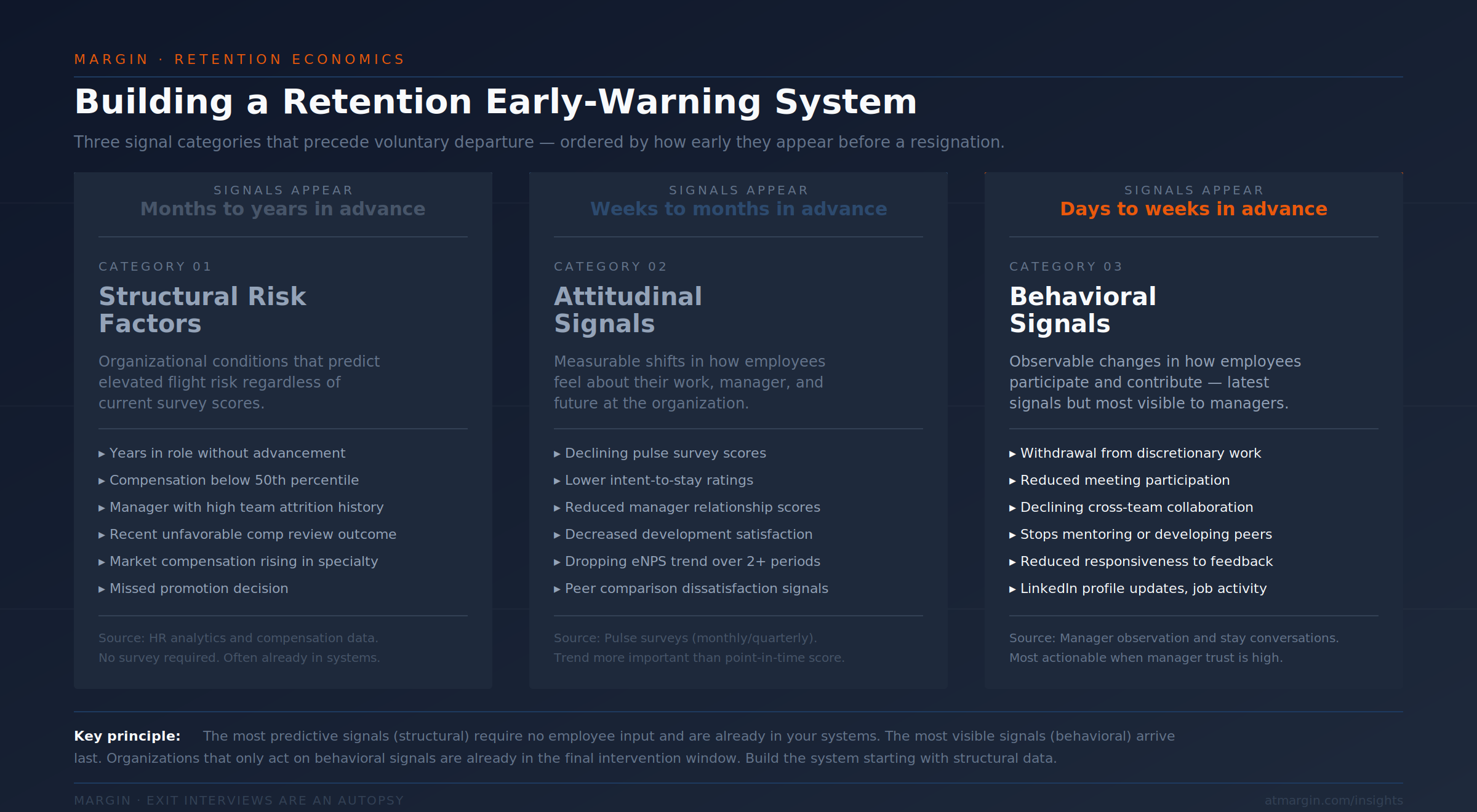
Building a retention early-warning system requires identifying the leading indicators that precede voluntary departure rather than the lagging indicators that confirm it. These fall into roughly three categories: behavioral signals, attitudinal signals, and structural risk factors.
Behavioral Signals
Behavioral signals are the earliest and often most reliable indicators. Engagement in discretionary work (volunteering for projects, contributing in meetings, mentoring peers) tends to decline substantially before a formal disengagement or departure event. Participation patterns in company communications, collaboration tool activity, and even meeting attendance can serve as weak but directionally useful signals. The challenge is that behavioral monitoring requires both data infrastructure and organizational care about how it is used. Surveillance and retention insight are not the same thing, and the line between them matters.
Attitudinal Signals
Attitudinal signals are more directly accessible through the tool most organizations already deploy poorly: the employee survey. The failure mode of most engagement surveys is not the instrument itself; it is the frequency and the follow-through. Annual surveys capture a snapshot. They miss the dynamic. Organizations that move to shorter, more frequent pulse surveys (monthly or quarterly, with a smaller number of targeted questions) create a continuous signal rather than a point-in-time measurement. The critical question is not whether the survey is conducted but whether the results create action within a window that is still useful for retention.
Structural Risk Factors
Structural risk factors are the most underutilized category. These are the organizational and biographical conditions that predict elevated flight risk regardless of current engagement scores: recent compensation review outcomes, promotion decisions and their fairness perception, time in current role relative to typical advancement timelines, manager tenure and performance, and market compensation movement in the employee's specialty. An employee who has been in the same role for three years without advancement, whose compensation is now below the 50th percentile for their market, and who is working for a manager with a history of high team turnover is a flight risk, whether or not their most recent engagement survey score reflects it.
The Stay Interview as Operational Practice
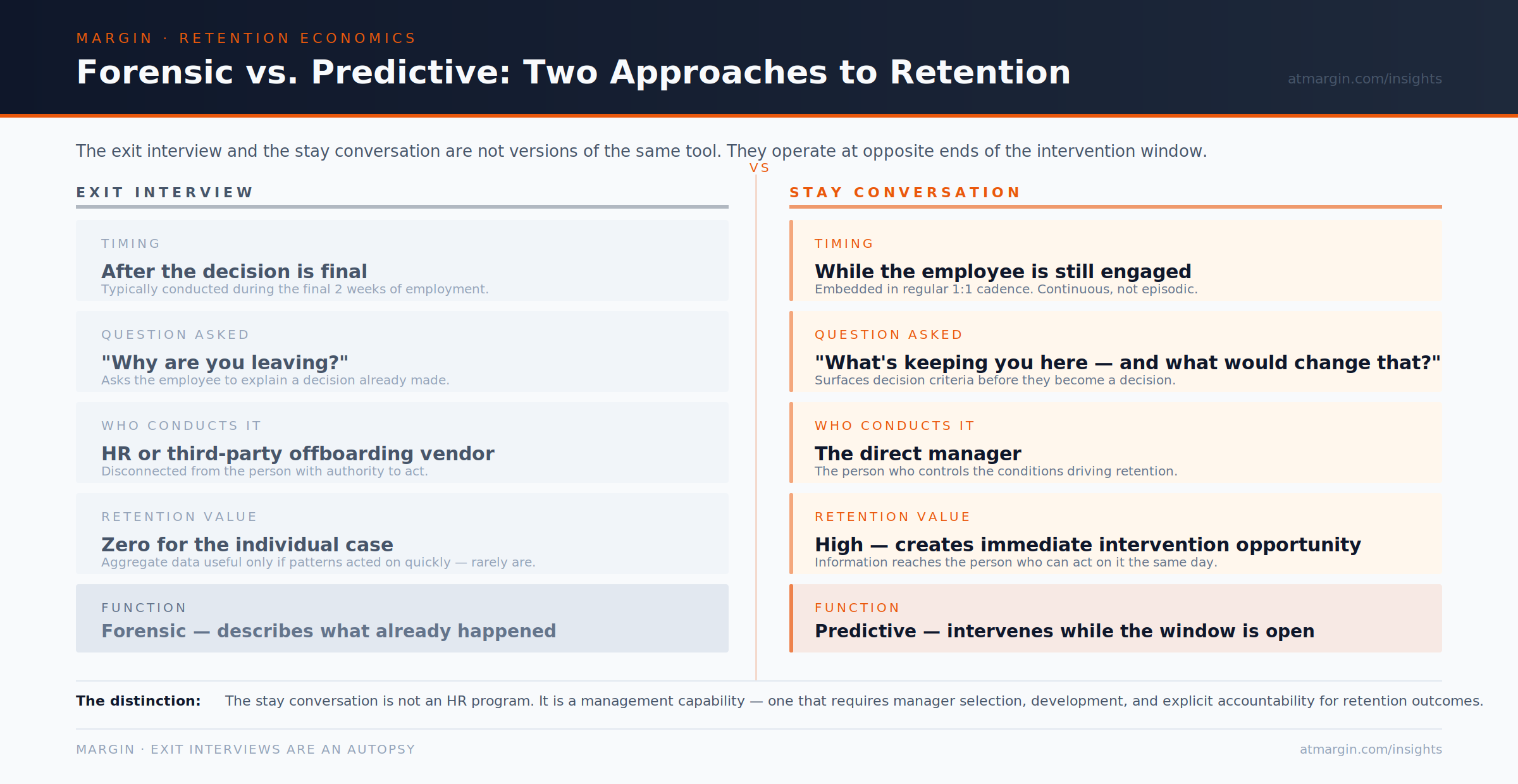
The most direct retention intervention available, and the most consistently underdeploped, is the stay interview. Unlike the exit interview, which asks a departing employee to explain a decision they have already made, the stay interview asks a current employee to describe what is keeping them engaged and what would change their calculus. It creates a retention conversation in the window when retention is still possible.
The stay interview is not a new concept. It appears in virtually every retention-strategy guide published in the last decade. It is also not widely practiced, because organizations treat it as an HR program rather than a management operating rhythm. When the stay interview lives inside HR (scheduled quarterly by an HR business partner, conducted in a formal setting, documented in a system of record) it functions as a periodic program with moderate impact. When it lives inside management teams (conducted naturally by direct managers as part of their regular one-on-one cadence) it functions as continuous intelligence.
The distinction matters because the retention leverage sits with managers, not with HR. An employee who tells an HR business partner that they are considering leaving is providing information that may or may not reach the person with authority to change their situation in time to matter. An employee who tells their manager, in a relationship built on enough trust to support that conversation, creates an immediate opportunity for intervention by the person who actually controls the conditions that drive retention.
This is why the stay interview as an HR program is categorically different from the stay conversation as a management practice. The former is a process. The latter is a capability, one that requires manager selection, development, and explicit accountability for retention outcomes.
Making Retention a Balance Sheet Problem
The organizational shift required to move from autopsy to early-warning is not primarily a methodological one. The methodology is well understood. The shift is about whether the organization treats retention as a lagging HR metric or as a leading financial indicator.
CFOs who track employee flight risk the same way they track customer churn (with predictive modeling, leading indicators, and explicit cost-of-loss accounting) consistently find that retention investments generate measurable returns. The cost of losing a high-performing senior individual contributor or manager is reliably between 100 and 150 percent of their annual compensation, when replacement cost, productivity loss during vacancy, and new hire ramp time are fully accounted for. An organization that loses twelve such employees in a year that could have been avoided with better early detection has absorbed a retention tax of $1.5 to $2.5 million, paid not in invoices but in the quiet erosion of organizational capacity.
The exit interview will always have some role, primarily as a cultural audit mechanism that captures information employees were not comfortable sharing while employed. But its role as a retention tool needs to be reconsidered clearly. It is not a prevention instrument. It is a forensic one.
The organizations that win on retention are not the ones with the best offboarding surveys. They are the ones with managers who know what is keeping their people, data systems that surface flight risk before it becomes resignation risk, and organizational cultures that create enough psychological safety for employees to name what they need before they decide to go find it elsewhere.
The information always exists. The question is whether the organization accesses it while the window is still open.