
When Your Pay Bands Are the Problem
A compensation architecture that was designed to create fairness and cost control is, in many organizations, the primary mechanism driving turnover in the roles most expensive to replace.
The pay band is one of the foundational instruments of compensation management. Organizations build band structures to create internal equity, establish market positioning, control payroll costs, and give managers a rational framework for making compensation decisions. These are legitimate objectives, and a well-designed band structure serves them reasonably well.
The problem is that most band structures are not well-designed. They were built at a point in time, calibrated to market data that is now outdated, and layered with modifications that addressed specific problems without considering systemic effects. Over time, they become something different from what they were designed to be: a constraint system that traps high performers, rewards tenure over contribution, and creates the precise conditions most likely to drive voluntary departure in the roles an organization can least afford to lose.
The relationship between compensation architecture and turnover is well-established but underappreciated in most organizations' retention analysis. When a high-performing employee leaves, the exit interview tends to surface the proximate cause: a better offer, a new challenge, a difficult manager. The compensation band structure rarely appears in the stated reason for departure. But the structure is often the underlying mechanism: it determined whether the organization could make the retention offer necessary to keep that employee, and in many cases the answer was no.
The Compression Problem
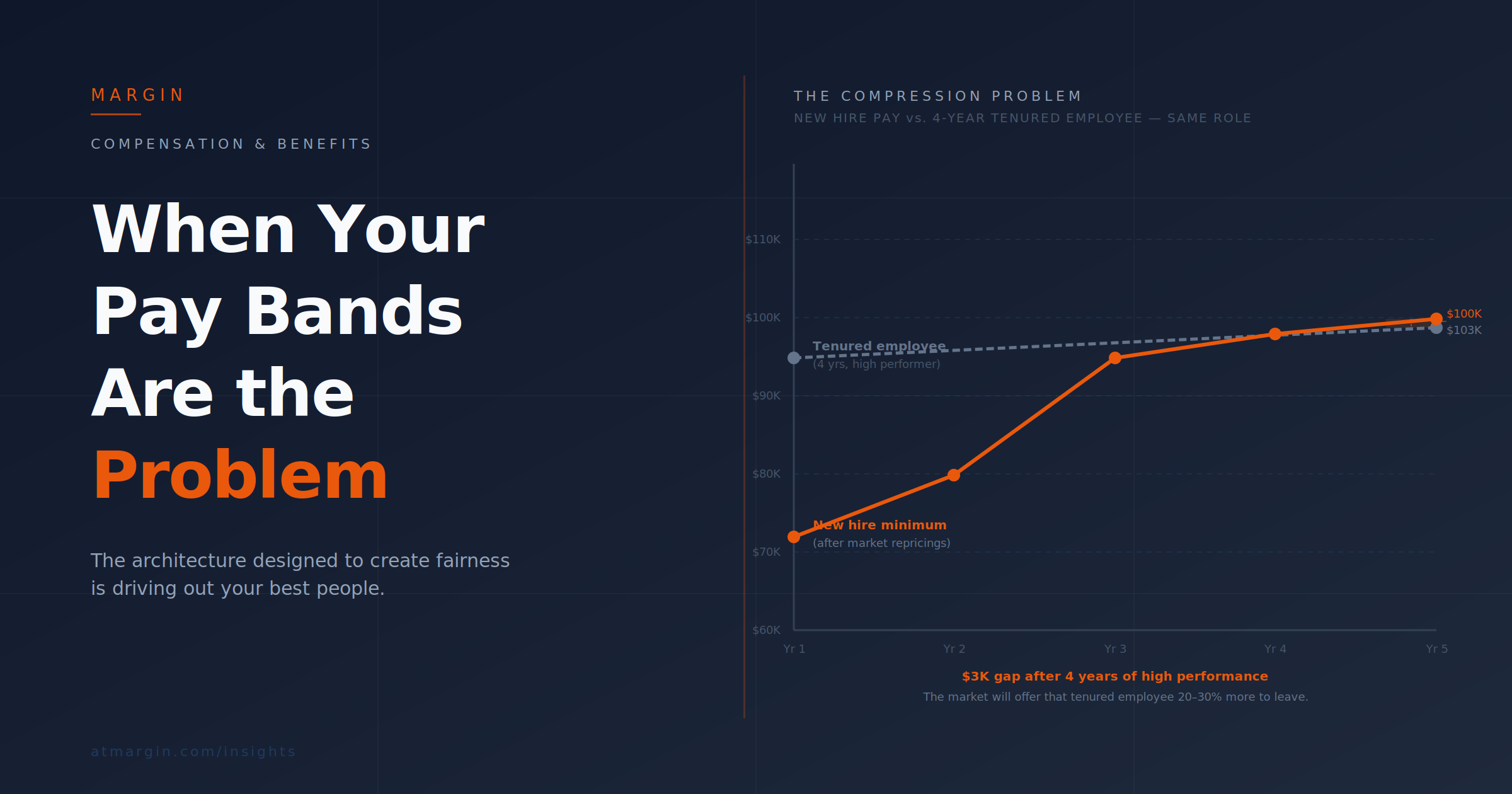
The most common structural failure in compensation architecture is band compression, the narrowing of the spread between what new hires are brought in at and what long-tenured employees at the top of their band can earn.
It works like this. A market repricing event occurs: a tightened labor market, an inflation spike, or a competitor talent war drives up the market rate for a given role. The organization responds by raising its minimum or midpoint for that band to remain competitive for new hires. Existing employees, however, remain where they are in the band. Their annual merit increases, typically 2 to 4 percent, are not calibrated to market movement. They are calibrated to performance ratings and budget availability.
The result, after two or three cycles of this pattern, is that a new hire coming into the bottom of the band is earning close to what a four-year employee in the same role is making at the top of it. The experienced employee is not performing at the same level as the new hire; they are almost certainly performing materially better. But the band structure has compressed their relative compensation advantage into near-invisibility.
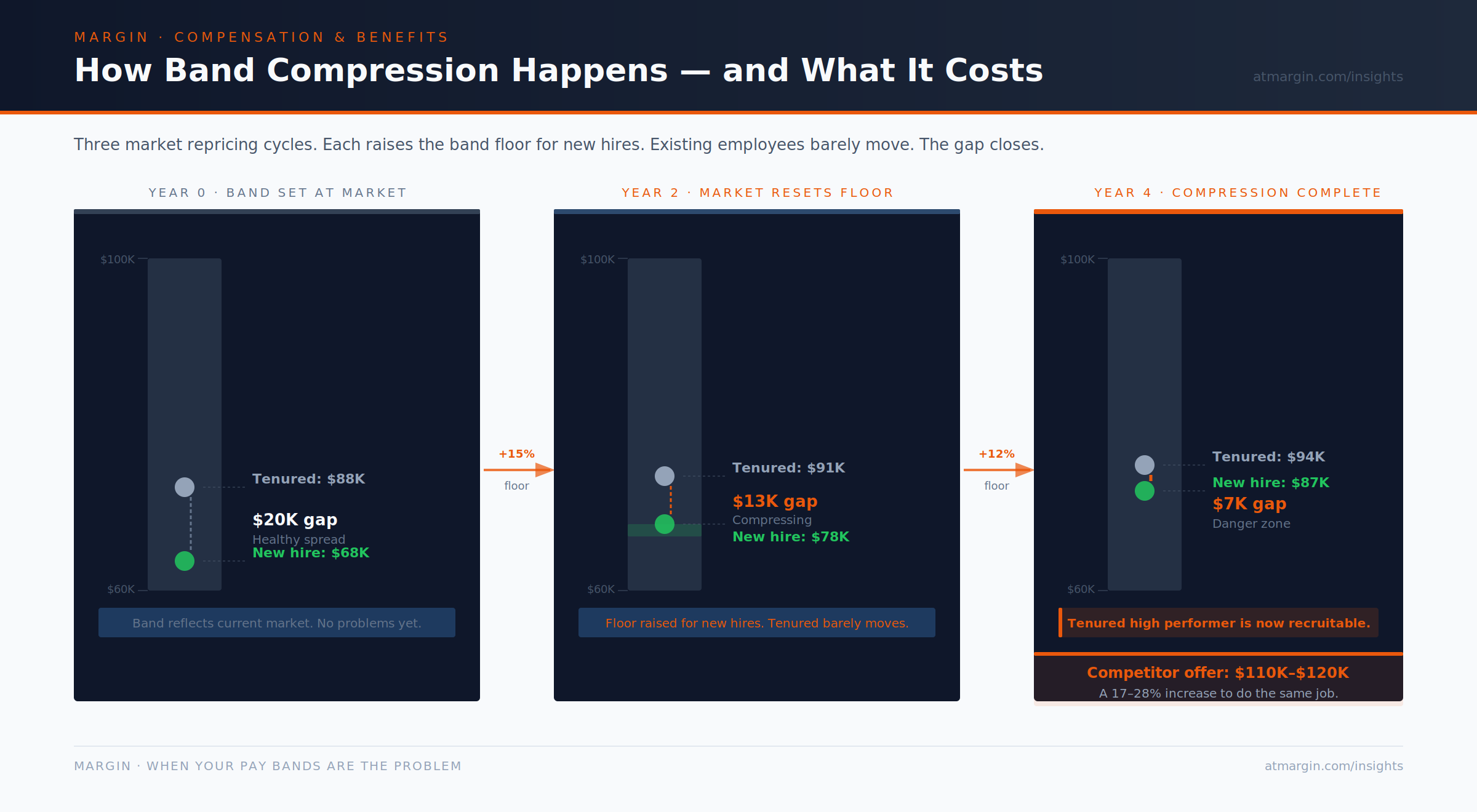
This creates an economically rational decision for the experienced employee. The market is pricing their skills at or above their current band maximum. A competitor can offer them a role at the bottom of the next band up, at market, and they will exit with a 20 to 30 percent compensation increase. The organization retains them only if it makes an exception: a band reclassification, an equity adjustment, or an off-cycle increase that acknowledges what the market already knows about their value.
Many organizations respond to this situation with counter-offers, which are an expensive and short-term solution. Counter-offer acceptance rates are high in the moment and low in the subsequent twelve months. Studies consistently show that 50 to 80 percent of counter-offer acceptors exit the organization within one year of accepting. They have revealed their hand; the organization has responded reactively; and the underlying conditions that made them recruitabie have not changed.
Related Article: The Half-Life of Salary Increases: Why Your Retention Bonuses Don’t Work
The Tenure Trap
A second structural failure operates through the opposite mechanism. In many organizations, particularly those with legacy compensation philosophies built around stability and longevity, band progression is heavily weighted toward tenure rather than contribution. Annual increases follow a formula tied more closely to years in role than to performance differentiation. The top of the band is reached not through exceptional performance but through persistence.
This structure fails high performers in two ways. First, it communicates that the organization does not price contribution at a premium. The high performer and the adequate performer receive roughly similar increases because the band structure is not designed to create meaningful differentiation. Over time, this signal is absorbed and produces exactly the outcome it implies: the high performer recalibrates their effort to the organization's evident indifference to its differential value.
“The employees most constrained by band structures are the ones most equipped to act on the constraint. They have options.”
Second, it creates a ceiling problem. When a high performer reaches the top of their band, which, in a tenure-weighted structure, happens faster for them than for their peers, their compensation is effectively frozen absent a promotion. If the next band up does not have an appropriate role available, the organization has created a structural dead end. The employee cannot advance their compensation without a title change that may not reflect their actual role or the organization's actual need.
The tenure-trap structure was rational in the labor market conditions that produced it: low voluntary attrition, stable employer-employee relationships, and compensation norms that valued time-in-seat. Those conditions no longer apply in most professional labor markets. The structure remains because compensation architecture has a high replacement cost and a strong internal constituency invested in the status quo.
Related Article: Pay Bands vs. Market Pricing: When Structure Helps (and When It Hurts)
The Highest-Cost Roles First
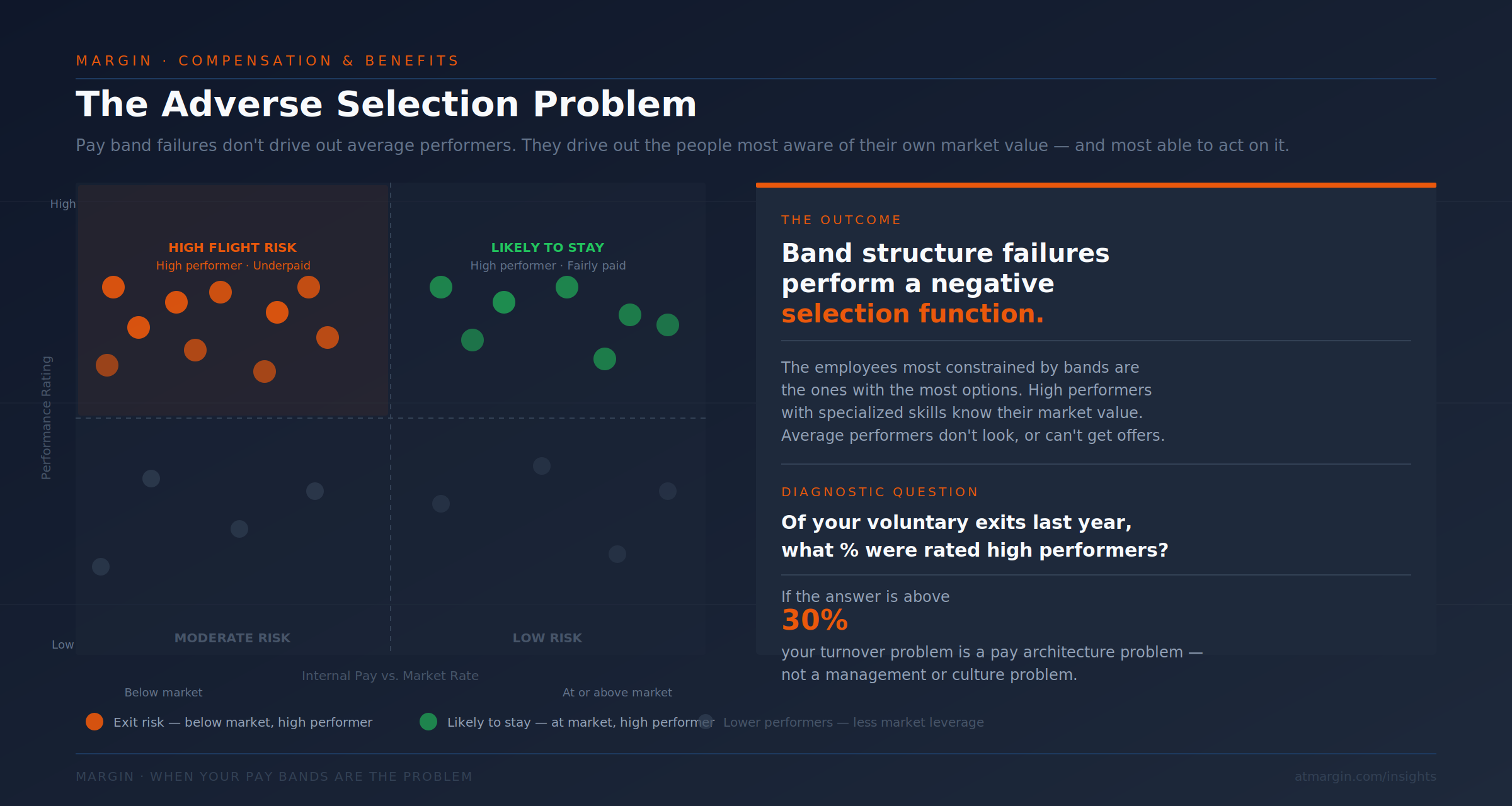
Not all turnover generated by band structure problems is equally costly. The employees most likely to exit in response to compensation architecture failures are also, reliably, the employees most expensive to replace: high performers with specialized skills, strong market demand, and enough self-awareness to understand their own value.
This creates an adverse selection problem at the portfolio level. The employees most constrained by band structures, those whose market value has grown faster than their internal compensation trajectory, are the ones most equipped to act on the constraint. They have options. The employees who are at market or above it have less reason to look. The result is a pattern where band structure failures disproportionately drive out the people the organization would most want to keep.
The CFO of a 1,000-person company experiencing 12 percent voluntary turnover should be asking a specific question: of the employees who exited voluntarily in the last twelve months, what percentage were rated as high performers in their most recent review? If the answer is above 30 percent, which is typical in organizations with structural compensation compression, the turnover problem is not primarily a management or culture problem. It is a pay architecture problem. The band structure is performing a negative selection function.
Designing for Retention Rather Than Administration
Fixing a compensation architecture is not a simple task. It requires market repricing, internal equity analysis, budget modeling, and often the political management of employees whose relative compensation position will change. But the alternative is a continuous and expensive turnover cycle that generates its costs in the form that accounting systems miss most reliably.
The design principles for a retention-oriented compensation architecture differ from the principles for an administrative compensation architecture. An administrative architecture optimizes for process efficiency, budget predictability, and legal compliance. A retention-oriented architecture optimizes for market alignment, high-performer differentiation, and transparency of the logic connecting pay to value.
Specifically, organizations that want their compensation architecture to support retention rather than undermine it need to price their bands to the current market, not the market at the time the bands were last updated, and revisit that calibration annually. They need to build meaningful spread into their bands (a minimum range of 50 percent from minimum to maximum) to allow genuine differentiation within a level.
They need to create explicit mechanisms for addressing compression when market movements create internal equity problems, rather than waiting for employees to surface the issue through a resignation. And they need to establish performance-based differentiation that is visible, meaningful, and consistently applied — not a 3 percent versus 4 percent distinction that communicates nothing about how the organization values contribution.
Pay bands were designed as management tools. In too many organizations, they have become the mechanism through which the market quietly recruits the best people away. The irony is that the organizations spending most heavily on recruiting to backfill voluntary attrition are often the same organizations whose compensation architecture is systematically generating that attrition. They are running water into a bucket they haven't noticed is leaking.