
The Transparency Reckoning
Pay transparency legislation is not primarily a compliance problem. It is an audit that will expose compensation structures most organizations are not prepared to defend.
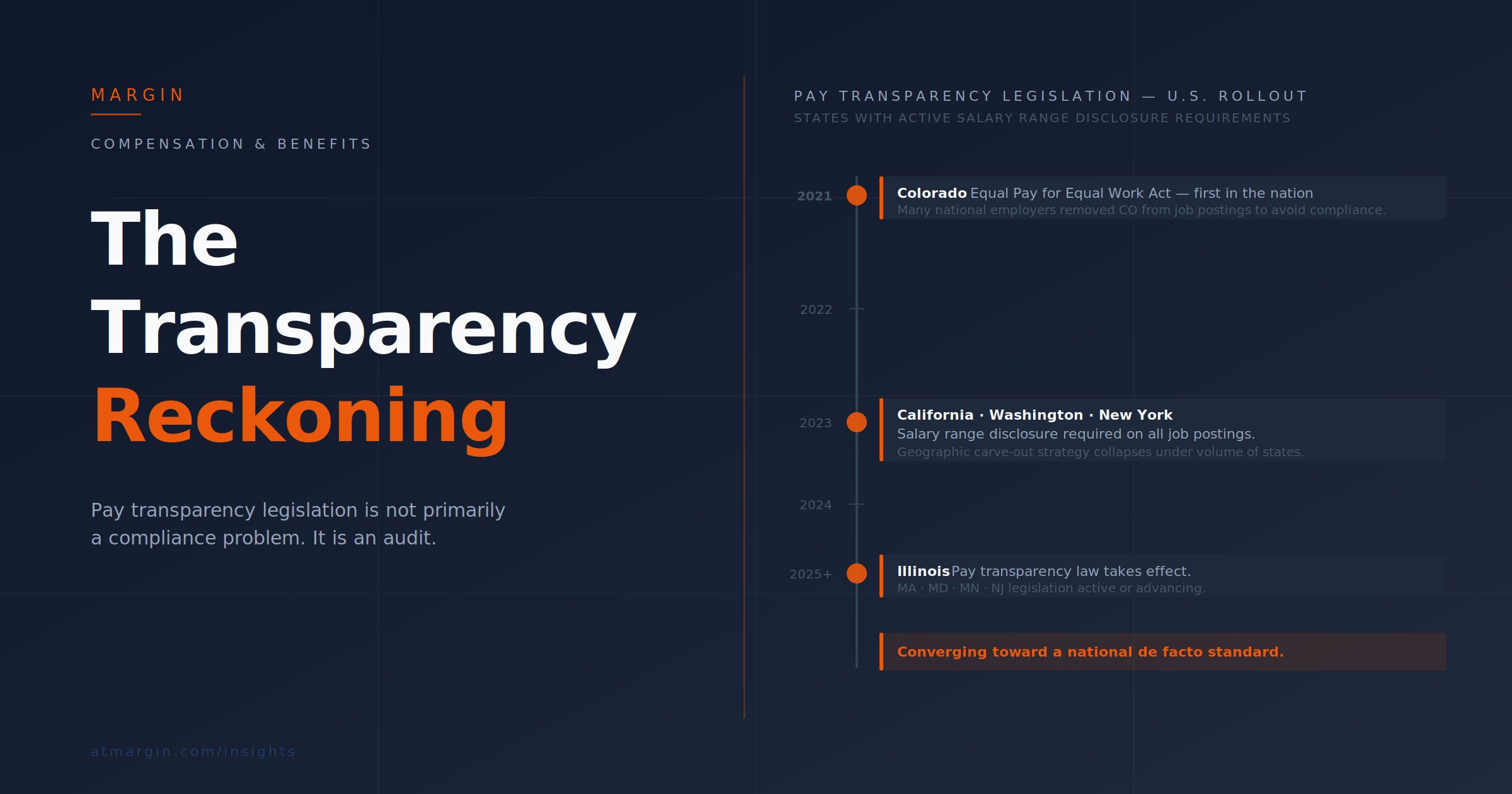
When Colorado passed its Equal Pay for Equal Work Act in 2021, many national employers responded by removing Colorado from their job postings entirely. The workaround was elegant in its simplicity: if you don't post roles in Colorado, you don't have to comply with Colorado's salary disclosure requirements. By 2022, job postings in Colorado from large national employers had declined measurably while the legislation was in its early enforcement period.
That strategy has a shelf life measured in months, not years. As of January 2023, California, Washington, and New York had all implemented salary range disclosure requirements. Illinois followed in 2025. Comparable legislation is active or advancing in Massachusetts, Maryland, Minnesota, and New Jersey. The patchwork of state requirements that some organizations have tried to navigate with geographic carve-outs is converging toward a national de facto standard. The employers who have delayed engagement with pay transparency have not avoided the problem. They have deferred it while it grew.
The CFO or CHRO who frames pay transparency as a legal compliance exercise is managing the wrong risk. The legislation is not the threat. The information the legislation will surface is the threat, specifically, the internal compensation inconsistencies, structural pay gaps, and band architecture problems that have accumulated over years of ad hoc compensation decisions made without systematic equity analysis.
What Transparency Actually Reveals
Salary range disclosure requirements, in their most common form, require employers to post the pay range for a given role when advertising an open position. At first glance, this appears to be a moderate disclosure, a band rather than an individual figure, a range rather than a commitment.
In practice, the implications are more significant. When salary ranges are posted at scale, across hundreds of job postings over time, several things become visible that compensation departments have historically kept opaque.
Internal Band Positions
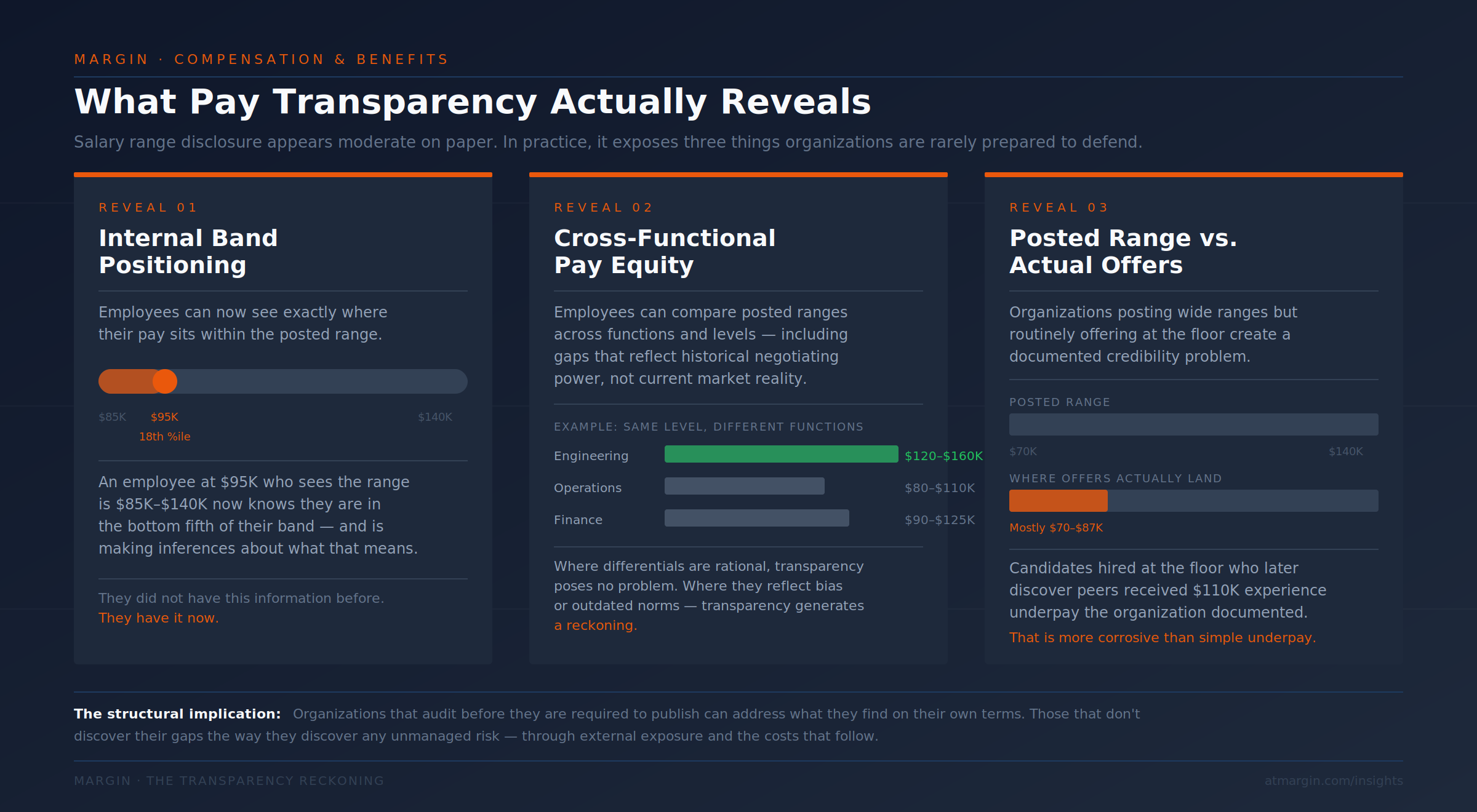
The first is internal band positioning. When employees see the posted range for their own role, or a role they were recently told they are performing at, they can immediately assess where their current compensation falls within the organization's stated range. An employee earning $95,000 who discovers that the posted range for their role is $85,000 to $140,000 now knows they are at the 18th percentile of their band. They did not have this information before. They have it now, and they are making inferences about what it says about how the organization values them.
Cross Functional Equity
The second is cross-functional equity. Employees can compare posted ranges for roles across functions and levels. In many organizations, historical pay differentials between functions (engineering versus operations, sales versus finance, field versus corporate) were maintained informally because the information required to compare them was unavailable. Transparency eliminates that information asymmetry. Where the differentials are rational and defensible, transparency poses no problem. Where they reflect historical negotiating power, talent market conditions from a decade ago, or straightforward pay inequity by gender or race, transparency generates a reckoning.
Mismatch Between Postings and Offers
The third, and most practically urgent for many organizations, is the mismatch between posted ranges and actual offers. Organizations that post wide, aspirational salary ranges and routinely offer candidates at the bottom of the range create a specific credibility problem. Candidates who accept offers at the floor of a broad range, only to discover later that peers hired at the same time or into similar roles received offers significantly higher, experience a form of disclosed unfairness that is more corrosive than simple underpay. It is underpay that the organization documented.
The Structural Audit Transparency Forces
For most organizations, the most consequential effect of pay transparency is not what it reveals to candidates or to regulators. It is what it reveals internally, and the organizational decision it forces: defend the current structure or fix it.
“The legislation is not the threat. The information the legislation will surface is the threat — specifically, the internal inconsistencies that have accumulated over years of ad hoc compensation decisions.”
A compensation audit conducted in preparation for transparency compliance typically uncovers a familiar set of problems. Individual pay outliers, employees whose compensation reflects their negotiating leverage at hire rather than their role or performance, are common. In organizations without systematic compensation management, the range of compensation for employees in the same role and at the same performance level can vary by 30 to 50 percent, driven almost entirely by hiring cohort, manager advocacy, and original offer negotiation.
Gender and racial pay gaps exist in most organizations that have not conducted systematic equity analysis. This is not a matter of explicit discrimination in most cases; it is a matter of cumulative effect. Merit increases compounding from different starting points. Promotional velocity differences that reflect sponsorship disparities. Off-cycle adjustment practices that are applied inconsistently. The individual decisions are often unintentional. The aggregate pattern is real, and it is visible in the data for organizations willing to look.
The structural implication is that pay transparency creates a pre-compliance audit opportunity that is far less expensive than the post-compliance exposure. An organization that conducts a rigorous compensation equity analysis before it is required to publish salary ranges can address the gaps it finds on its own terms: budget-paced remediation, prioritized by exposure, communicated on a timeline that allows the narrative to be managed. An organization that publishes salary ranges without conducting this analysis will discover its gaps the way it discovers any unmanaged risk: through external exposure, employee reaction, and the legal and reputational costs that follow.
The CFO's Transparency Calculus
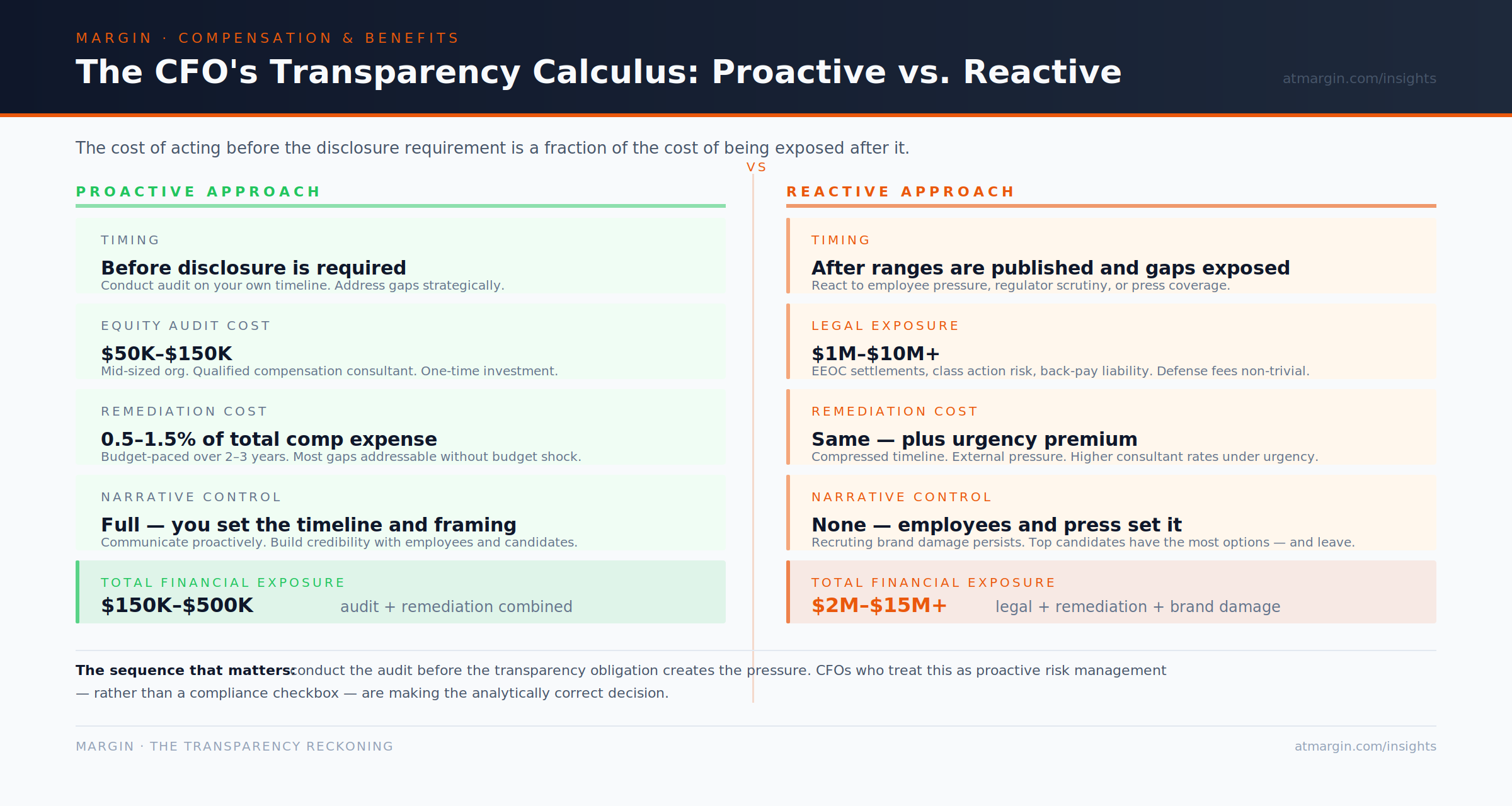
The financial stakes of getting this wrong are easier to quantify than most HR-adjacent risks. The legal exposure from a gender pay discrimination claim in California, where the private right of action is robust and plaintiff attorneys are active, begins at back-pay liability and scales to class action risk. EEOC settlements for systematic pay equity violations routinely run seven figures. Legal fees for defense in contested cases are not trivial even when the outcome is favorable.
The reputational exposure is harder to model but arguably more consequential. Organizations that are publicly associated with pay equity problems face recruiting disadvantages in the senior talent markets where employer brand matters most. A disclosed pay gap in a category that candidates care about, gender, in particular, degrades the organization's ability to attract the candidates who have the most options.
Against these exposures, the investment required for a systematic compensation equity analysis and remediation program is modest. A thorough audit, conducted with appropriate market data and internal analysis, can typically be completed by a qualified compensation consultant for $50,000 to $150,000 for a mid-sized organization, substantially less than the cost of defending a single pay equity claim. The remediation costs depend on what the audit finds, but organizations that budget 0.5 to 1.5 percent of total compensation expense for equity adjustment over a two-to-three year remediation cycle can address most identified gaps without budget shock.
The sequence that matters is conducting the audit before the transparency obligation creates the pressure. CFOs who approach pay transparency as a proactive financial and reputational risk management exercise, rather than a compliance checkbox, are making the analytically correct decision.
What Good Looks Like
Organizations that have navigated pay transparency well share a common characteristic: they treated it as an opportunity to build compensation infrastructure they should have built anyway, rather than as an external imposition.
Defensible Compensation Bands
That infrastructure has three components. The first is defensible compensation bands: ranges that are grounded in current market data, differentiated by meaningful performance and contribution criteria, and wide enough to accommodate genuine variation without creating the compression problems outlined elsewhere in this publication.
Equity Audit Cadence
The second is an equity audit cadence: a systematic review of internal pay equity conducted annually or biannually, before external disclosure requirements create the pressure to do so reactively. This review should use regression analysis to isolate compensation differentials by gender, race, and other protected characteristics after controlling for legitimate pay factors, and should generate a remediation plan for identified gaps.
Communication Discipline
The third is communication discipline. Employees who understand how their pay is set, what the range for their role is, and what the criteria are for moving within that range are less likely to develop the negative inferences that pay transparency can generate when the context for the numbers is absent. The organizations that fare worst under transparency requirements are not necessarily the ones with the worst compensation structures; they are the ones whose communication infrastructure left employees to draw their own conclusions. Those conclusions are rarely favorable.
Pay transparency is not the threat. It is the forcing function that makes visible what was always true.