
Succession Planning Economics: The Insurance Policy Nobody Wants to Pay For
Your CFO just gave notice. She's accepted a role at a competitor with higher compensation and more strategic scope. You have thirty days before she leaves.
You have no internal candidates ready to step into the role. Nobody on the finance team has CFO experience. The VP of FP&A is capable but needs two more years of development before being ready. Your succession plan for this critical role consists of a document created three years ago listing names that are now out of date, development activities that were never completed, and preparedness assessments nobody believed.
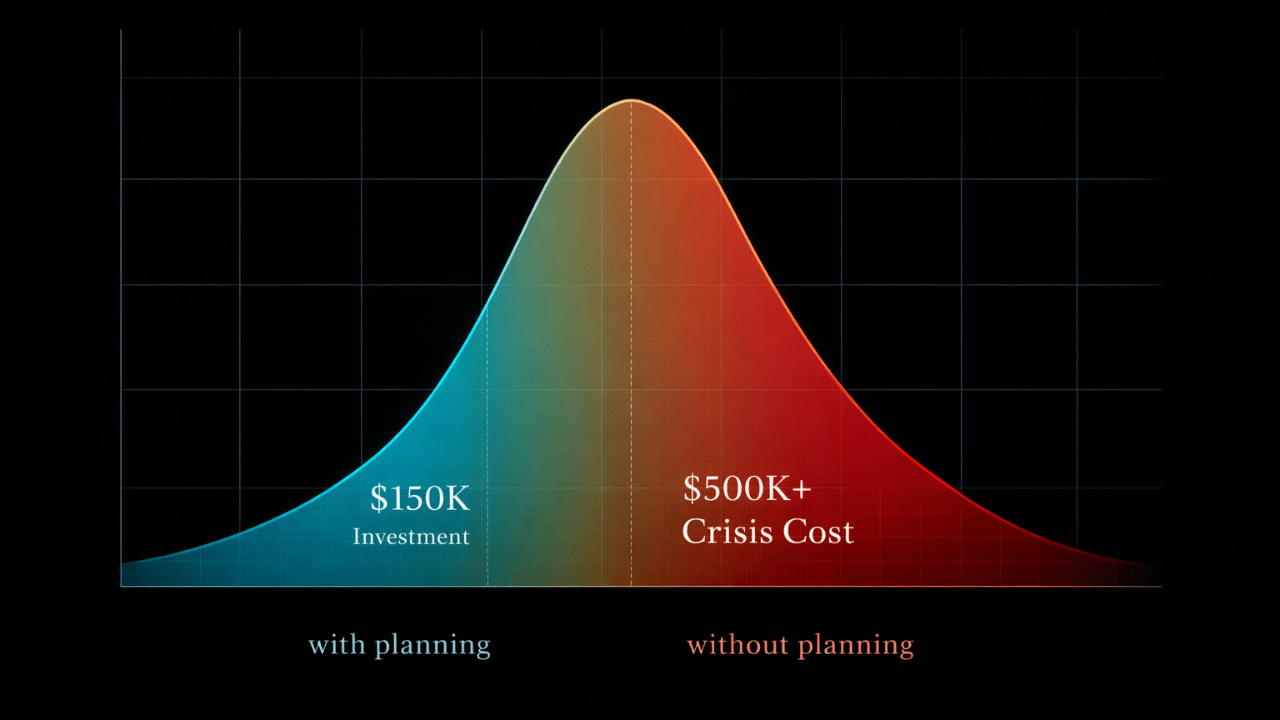
You're about to spend six to twelve months searching for an external CFO, paying a recruiting firm twenty-five percent of first-year compensation, experiencing strategic paralysis while the role sits vacant, managing with an interim CFO who knows she's temporary, and hoping the person you eventually hire doesn't fail due to culture fit problems. The total cost will exceed $500,000. The strategic cost of lost momentum while you're distracted by CFO search is harder to quantify but substantial.
Three years ago, you could have invested $150,000 in real succession planning: developing internal candidates, creating emergency backup plans, maintaining market awareness of external options. You didn't, because succession planning is like insurance: costly upfront with uncertain payoff, easy to deprioritize until disaster strikes, and requiring sustained investment even when nothing bad happens.
Let's examine the economics of succession planning, when investment pays off, how much planning is optimal, and how boards should govern this critical insurance policy nobody wants to fund.
Why Succession Planning Fails: The Investment Nobody Makes
Succession planning fails because it requires long-term investment with uncertain and delayed returns, threatens incumbents who see succession candidates as rivals, lacks board enforcement despite being governance responsibility, and competes with shorter-term priorities that have more immediate payoff.
The time horizon problem is fundamental. Succession planning requires investing today for benefits that may arrive in three to five years, or may never arrive if incumbents don't leave. Development programs, rotational assignments, and coaching for potential successors cost real money now. The payoff is having ready candidates if and when succession events occur. The probability of needing succession in any given year is perhaps fifteen to twenty percent for most executive roles. The expected value of succession investment depends on that probability multiplied by the cost of unplanned succession.
Incumbent resistance creates political barriers. Current leaders don't want to develop their replacements. They see succession candidates as threats, people waiting for them to fail or leave. Investing in succession planning makes incumbents uncomfortable by making their eventual replacement explicit and visible. They delay, minimize, or sabotage succession efforts to protect their positions.
Boards nominally own succession planning responsibility but rarely enforce it effectively. Directors know they should oversee succession, include it in governance discussions, and hold CEOs accountable for developing successors. In practice, succession planning gets cursory annual reviews where the CEO presents a document listing names, directors nod approval, and nothing changes until crisis forces action. Board oversight without teeth enables persistent neglect.
Competing priorities consume resources that should fund succession planning. Organizations always face immediate challenges: hiring for current openings, revenue targets this quarter, product launches next month. Succession planning requires investment for hypothetical future needs. When budgets are tight, hypothetical future needs lose to immediate present problems. Every year, succession planning gets deprioritized, and every year the organization remains vulnerable to sudden leadership departures.
The result is that most organizations have succession plans in name only: documents that exist to satisfy board requirements but don't represent actual candidate readiness or organizational preparedness. When succession events occur, the organization scrambles, searches externally, and pays crisis prices for emergency solutions.
The Expected Value Framework: When Succession Planning Pays Off
Succession planning should be evaluated like insurance using expected value: probability of succession event multiplied by cost of unplanned succession versus cost of succession program. The break-even calculation determines optimal investment level.
Start with probability. For any given executive role, what's the annual likelihood of needing succession? Planned retirements, unexpected resignations, terminations for performance or behavior, health issues, and role eliminations or restructuring all create succession needs. Empirically, executive turnover runs ten to twenty percent annually depending on industry, role, and company performance. Use fifteen percent as a reasonable estimate for planning purposes.
Calculate cost of unplanned succession. External search fees are twenty to thirty percent of first-year compensation. For a CFO at $300,000, that's $60,000 to $90,000. Add recruiter fees, signing bonuses or other premium compensation required to attract external talent, onboarding time where the new executive is learning rather than contributing, risk of wrong hire and having to repeat the search, and strategic momentum lost during six to twelve months of search and transition. All-in cost of unplanned succession for a senior executive often reaches $500,000 to $2,000,000 depending on role criticality and organizational disruption.
Expected annual cost of no succession plan is probability multiplied by cost. At fifteen percent annual turnover probability and $1,000,000 average unplanned succession cost, expected annual cost is $150,000. If your succession program costs less than $150,000 annually, it delivers positive expected value even before accounting for benefits like smoother transitions and better candidate quality.
This framework reveals that succession planning is economically rational for critical roles even when the payoff is probabilistic. The insurance policy is worth buying when expected cost of not having it exceeds premium cost. For CEO and C-suite roles, this calculus almost always favors investment. For director-level roles, it depends on replacement difficulty and role criticality.
Types of Succession Scenarios: Planning for Different Risks
Succession planning must address four types of scenarios, each requiring different preparedness levels: planned transitions like retirement, unplanned but smooth departures like resignations with notice, crisis departures like sudden health issues or termination, and growth scenarios where new roles are created.
Planned Succession
Planned succession is the easiest to manage. When a CEO announces retirement eighteen months in advance, the organization has time to assess internal candidates, develop the most promising ones, search externally if needed, and execute a managed transition. This requires succession planning to have identified potential candidates and assessed their readiness. If that work was already done, the planned transition executes smoothly. If not, eighteen months is enough time to figure it out, though longer runways are better.
Unplanned Succession
Unplanned but smooth succession occurs when an executive resigns with standard notice, typically thirty to sixty days. The departure isn't anticipated, but there's enough warning to begin search and transition processes. This requires having emergency interim plans: who steps up temporarily while you search? Interim leadership prevents organizational paralysis during search but requires pre-identifying capable temporary leaders and ensuring they're prepared to step in.
Crisis Succession
Crisis succession happens with no warning: sudden health issues requiring immediate departure, termination for performance or conduct, unexpected death, or executive walkout without notice. These scenarios require immediate interim coverage. Without pre-identified emergency successors, the organization thrashes while figuring out who can step in temporarily. Crisis succession planning means having names, ensuring those people are minimally prepared, and maintaining updated documentation they can access.
Growth Succession
Growth succession creates new executive roles rather than replacing departing incumbents. A company scaling from $50M to $200M in revenue needs new executive positions - perhaps adding a Chief Marketing Officer, splitting product and engineering leadership, or creating a Chief People Officer role. Growth succession planning means assessing whether internal candidates can step up to these new roles or whether external hiring is required. It's easier than replacement succession because timing is more controlled, but it still requires evaluation of internal bench strength.
Each scenario has different time pressure and different cost if succession readiness is low. Planned succession with poor readiness costs missed development opportunities and forces external hiring. Crisis succession with poor readiness costs organizational chaos and bad interim decisions. Succession planning should account for all four scenarios with appropriate investment in each.
Components of Effective Succession Planning
Effective succession planning includes identification of critical roles requiring succession plans, assessment of internal candidates and their readiness levels, development planning specifying how candidates will become ready, rotations and stretch assignments providing experience, external market awareness maintaining hiring options, and emergency interim plans enabling immediate response to crisis departures.
Identify Critical Roles
Identify critical roles where succession planning investment is justified. Not every role needs formal succession planning. The CEO role requires it always. C-suite roles typically require it. Some VP and director roles require it depending on technical specialization or organizational importance. Roles with deep external labor markets and easy replacement don't require extensive succession planning. Focus investment where replacement is difficult and cost of unplanned succession is high.
Assessment of Internal Candidates
Assess internal candidates using realistic evaluation. Who could potentially step into each critical role with appropriate development? Assess both capability and interest; someone might have capability but prefer not to take on executive responsibility. Avoid wishful thinking where you list high-potential people who aren't actually interested in or suited for the target role. Better to acknowledge weak internal bench strength and plan accordingly than to fool yourself with names on paper.
Evaluate Readiness
Evaluate readiness levels with specificity. Categorize candidates as ready now (could step into role tomorrow with high likelihood of success), ready in one to two years (with targeted development experiences), ready in three to five years (early high-potential requiring substantial development), or unlikely to become ready (capable people without interest or fit for the role). These categories determine succession timelines and whether external search is needed.
Development Planning
Development planning specifies what experiences, skills, and capabilities candidates need to become ready. A VP of Sales being developed for Chief Revenue Officer might need pricing strategy experience, board presentation skills, and exposure to investor relations. Create specific development plans rather than generic "leadership development" activities. Specify rotations, projects, coaching topics, and skill-building experiences that address capability gaps.
Rotations
Rotations and stretch assignments provide the most valuable development. Give succession candidates temporary assignments where they experience aspects of the target role. The CFO succession candidate takes on a special project involving board financial reporting. The COO candidate runs operations during the incumbent's extended leave. These experiences test readiness and build specific capabilities.
Market Awareness
External market awareness maintains backup options. Even with strong internal candidates, maintain relationships with executive recruiters and market awareness of potential external hires. If internal candidates don't work out or leave the company, you need external options. Regular market calibration also provides realistic assessment of what external candidates would cost and what capabilities they'd bring, informing build versus buy decisions.
Emergency Interim Plans
Emergency interim plans identify who steps in immediately if crisis succession occurs. For every critical role, designate an interim successor who can assume responsibilities temporarily with minimal handoff. Document what this person needs to know, where critical information lives, and who they should immediately contact. Update this quarterly so interim plans stay current.
Levels of Succession Readiness: The Depth of Your Bench
Succession readiness varies by role and organization. Strong succession planning creates depth: multiple candidates at different readiness stages, ensuring succession capability even if primary candidates leave or prove unready.
Ready Now
Ready now means one to two people who could step into the role tomorrow with reasonable confidence of success. For CEO succession, this might be the COO and CFO. For CFO succession, the VP of FP&A and VP of Accounting. These people know the organization, have demonstrated executive capability, and need minimal transition time. Having two ready-now candidates provides redundancy if one leaves or declines the role.
Ready in One to Two Years
Ready in one to two years means two to three people who could become ready with focused development. They have most required capabilities but need specific experiences to round out their readiness. Perhaps they need board exposure, strategic planning experience, or management of larger teams. Focused development over one to two years could make them ready. This category provides medium-term succession capability and creates competition among candidates, which can improve quality.
Ready in Three to Five Years
Ready in three to five years means five to ten early high-potentials who could potentially reach readiness with substantial development. These are talented managers or individual contributors who show leadership potential but lack extensive executive experience. They're long-term succession candidates, useful for planning but not reliable for near-term needs. Investment in this group is optional depending on organizational priorities and development program capacity.
External search applies when internal bench strength is weak. If you have no ready-now candidates and limited ready-in-one-to-two-years candidates, external search is likely required when succession events occur. Acknowledge this explicitly rather than pretending internal candidates are ready when they're not. External search isn't failure; it's realistic assessment that internal development hasn't produced ready successors.
The depth question is how many candidates to develop at each level. Having one ready-now candidate creates single point of failure; if that person leaves, you have nothing. Having two provides redundancy. Having five dilutes development resources and creates excess capacity. Two to three ready-now candidates for CEO and C-suite roles balances redundancy against resource efficiency.
When to Favor Internal Succession Versus External Search
Internal succession delivers continuity, culture preservation, faster onboarding, and lower integration risk. External search provides new capabilities, fresh perspectives, faster access to proven executive talent, and potentially better fit for strategic pivots. The choice depends on strategic needs and internal candidate quality.
Continuity
Favor internal succession when continuity is strategically valuable, culture is a competitive advantage and external hires risk diluting it, internal candidates are genuinely ready (not wishful thinking), organizational knowledge is critical for success, and you have long runway for planned transitions.
Continuity matters when the organization is performing well and strategic direction is sound. Disrupting that with external leadership creates unnecessary risk. Internal successors maintain momentum, relationships, and strategic direction. This is appropriate when the goal is sustained execution rather than transformation.
Culture Preservation
Culture preservation is critical when organizational culture drives performance and external executives from different cultures might struggle. Technology companies with strong engineering cultures often struggle with external executive hires from traditional corporate environments. Internal succession preserves cultural DNA while bringing in external executives risks culture clash.
Lower Risk
Strong internal candidates justify internal succession even when external options exist. If your ready-now candidate is genuinely capable, has demonstrated executive skill, and has organizational support, promoting them is lower risk than hiring an unknown external candidate. The question is honest assessment of capability, not wishful thinking.
Faster Onboarding
Organizational knowledge matters more in some roles than others. CFOs navigating complex regulatory environments, industry-specific accounting, and board relationships benefit from institutional knowledge. Chief Product Officers might benefit more from external perspective than from knowing organizational history. Match succession strategy to role requirements.
When to Favor External Search
Favor external search when you need new capabilities the organization lacks, face strategic pivot requiring different thinking, have weak internal bench strength, operate in turnaround situation, or need proven change agents. External hiring imports capabilities rather than developing them, accelerates access to executive talent, and brings perspectives unconstrained by organizational history.
New capabilities are the strongest argument for external hiring. If you're entering new markets, adopting new business models, or building capabilities you don't possess, hiring someone who has done it before is faster than developing those capabilities internally. A SaaS company moving into enterprise sales might hire an enterprise sales executive rather than developing that expertise from consumer sales background.
Strategic pivots often require external thinking. People who built the current business model may struggle to lead transformation to a different one. External executives bring mental models unconstrained by "how we've always done things" and challenge organizational assumptions. This is valuable when transformation is needed but can be destructive when continuity is better.
Weak internal bench strength forces external search. If succession planning has failed and you have no ready candidates, external search is the only option. Acknowledge this explicitly, execute the search well, and invest in succession planning afterward to avoid repeating the mistake.
The Promotion Trap: Avoiding the Next-In-Line Fallacy
Succession planning creates a dangerous trap: promoting the next-in-line candidate because they're there rather than because they're best for the role. Organizations fall into this trap when succession planning creates expectation that listed candidates will be promoted, when internal candidates feel entitled to the role, and when boards pressure for internal succession to avoid appearing to have failed at succession planning.
Just because someone is identified as a succession candidate doesn't mean they should be promoted when the succession event occurs. Succession planning identifies potentially ready candidates. Actual readiness is determined when the role opens. Between when someone is identified as a successor and when they're actually considered for the role, circumstances change: the candidate might have underperformed, organizational needs might have shifted, better internal candidates might have emerged, or external candidates might be superior.
Succession planning should create optionality, not commitment. The goal is having internal candidates ready if they're the best choice when succession occurs. It's not guaranteeing promotion to anyone. Boards and CEOs must retain flexibility to choose the best candidate when the time comes, even if that means hiring externally despite having internal succession candidates.
The opportunity cost of promoting mediocre internal candidates to satisfy succession planning expectations is substantial. An internal candidate who is adequate but not excellent becomes a mediocre executive for years. That's worse than taking time to find an excellent external candidate or developing the internal candidate further before promoting. Better to disappoint expectations than to promote someone who isn't ready.
This requires clear communication about what succession planning means. When someone is identified as a succession candidate, the message should be: "You're being developed as a potential successor. This creates opportunity for you but doesn't guarantee promotion. When succession occurs, we'll assess all options and choose the best candidate." This manages expectations while preserving organizational flexibility.
How Boards Should Govern Succession Planning
Board governance of succession planning typically fails because it's pro forma rather than rigorous. Directors review succession documents annually, the CEO presents candidates on slides, directors ask a few questions, and nothing substantive changes. Effective board governance requires annual review with substantive assessment, direct interaction with internal candidates, emergency CEO succession plan that's always current, CEO accountability for developing successors, and balance between continuity and fresh thinking.
Annual succession review should go beyond document review. Boards should meet internal candidates, not just see names on slides. Spend time with the ready-now candidates for CEO succession. Observe them presenting to the board, participating in strategic discussions, and interacting with board members. Assess their capability directly rather than relying solely on CEO assessment. This creates board confidence in internal candidates and surfaces concerns early.
Emergency CEO succession planning requires special attention because CEO departure can be sudden and organizationally destabilizing. Boards should maintain a current plan specifying who becomes interim CEO if the current CEO leaves unexpectedly, how long that person should serve, and what the search process would be. Update this at least annually and ensure the interim CEO knows of their designation and has sufficient context to step in effectively.
Hold CEOs accountable for developing successors through explicit goals and measurement. CEO performance evaluations should include assessment of succession planning: Are internal candidates being developed? Is the bench stronger this year than last year? Are development plans being executed? Have potential successors gained the experiences specified in succession plans? Making this an explicit CEO responsibility increases follow-through.
Balance continuity with fresh thinking by considering both internal and external candidates even when strong internal candidates exist. Boards should periodically calibrate internal candidate quality against external market: Would this internal candidate be competitive against external candidates? Are we settling for adequate internal candidates when excellent external candidates exist? This prevents defaulting to internal succession when external hiring would serve the organization better.
The board's role is governance, not management. Directors shouldn't manage succession planning directly. They should ensure succession planning happens, assess quality, hold management accountable, and retain authority to override management recommendations when appropriate. Effective governance means rigorous oversight without operational interference.
Optimal Succession Planning Investment: How Much Is Enough
The optimal level of succession planning investment varies by organization size, role criticality, turnover probability, and replacement difficulty. Calculate expected value using probability of succession need multiplied by cost of unplanned succession, then invest up to the expected value in succession planning.
For CEO and C-suite roles in most organizations, succession planning investment of $100,000 to $300,000 annually is economically justified. This might fund executive coaching for two to three succession candidates, rotational assignments, leadership development programs, and external search relationship maintenance. Given fifteen to twenty percent annual probability of C-suite succession needs and $500,000 to $2,000,000 cost of unplanned succession, expected annual cost of no planning is $75,000 to $400,000. Investment below the expected cost delivers positive ROI.
For VP and director roles, investment depends on replacement difficulty. Roles with deep external labor markets (say, VP of Marketing in a major metro area) might warrant minimal succession planning, perhaps $20,000 annually in development activities for one or two potential successors. Specialized roles with thin labor markets (VP of a niche technical function) might warrant more substantial investment because external hiring is difficult and expensive.
The investment ceiling is when marginal succession planning investment exceeds marginal expected value. If you've already developed two ready-now candidates and two ready-in-one-to-two-years candidates, developing three more provides limited additional value. The redundancy is unlikely to be needed. Stop investing at the point where additional succession readiness doesn't reduce expected costs of succession events.
Succession planning competes with other leadership investments: hiring for current needs, retention programs, broader leadership development. Allocate capital where it delivers best returns. For critical roles where succession risk is high, succession planning delivers excellent returns. For roles where succession risk is low, other investments may be superior.
The question isn't whether to do succession planning but how much succession planning is economically optimal given probabilities, costs, and alternatives. Organizations that treat succession planning as binary, either you do comprehensive succession planning for everyone or you do nothing, waste money or expose themselves to excessive risk. Those that calibrate investment to expected value maximize returns while managing succession risk appropriately.
Succession planning is insurance, and insurance is most valuable when the insured event is low-probability but high-cost. Executive succession fits that profile perfectly. Organizations that treat it as optional risk catastrophic costs when succession events inevitably occur. Those that invest systematically in succession planning (identifying candidates, developing them deliberately, maintaining readiness across multiple potential successors) reduce expected costs while improving leadership quality. That's worth paying for, even in years when nobody leaves.
Part of the Leadership Frameworks series examining strategic decisions about leadership selection, development, and organizational design.