
The First Recruiting Hire Is the Wrong Hire
Bringing recruiting in-house gets treated as a staffing decision when it is an architecture decision. The first hire is almost always wrong, and the rebuild eighteen months later is the cost most companies absorb without ever connecting it to the original error.
Picture the moment a company decides to bring recruiting in-house. The CFO has run the math on agency fees — typically 20 to 25 percent of first-year compensation per placement — and concluded that an internal team will pay for itself within the year. The CEO wants more control over the funnel. The CHRO assembles a job description, posts it on LinkedIn, and within ninety days a new recruiter is sitting at a desk with a stack of open requisitions and instructions to start filling them.
Eighteen months later, the company will rebuild the function from scratch.
This is not a story about a bad hire. The recruiter is competent. The recruiter does what recruiters do — runs searches, schedules interviews, manages requisitions, closes offers. The problem is that recruiting in-house is not a staffing problem disguised as a process problem. It is an architecture problem disguised as a staffing problem, and the first person hired into the function determines whether the company is building a system or accumulating overhead. Most companies hire the wrong person, at the wrong level, for the wrong job — and then absorb the cost of correction as if it were a separate decision rather than the consequence of the first one.
Recruiting Looks Like a Process Job
The conventional view treats recruiting as a process function. Process functions follow a familiar logic: define the workflow, hire someone to execute it, scale by adding more executors. By that logic, the first recruiting hire should be a recruiter — ideally one who is hungry, organized, and capable of running a process that the rest of the organization will define around them.
“A senior TA hire fills reqs and builds the function in the same ninety days; a junior one fills reqs while improvisation accumulates underneath.”
Two assumptions sit underneath this view, and both are wrong in the specific case of an in-house function being built from zero.
Is there a process?
The first assumption is that the process exists. In a mature TA function (one that has an applicant tracking system configured to the company's hiring patterns, a sourcing strategy with named channels and known costs, calibrated interview rubrics, hiring manager training programs, candidate experience standards, pipeline metrics dashboards, and adverse impact monitoring), a recruiter is exactly the right hire. They can plug into the system and produce hires. But none of that exists yet. The new hire is not being asked to operate a process. They are being asked to invent one.
Process invention is not a side project.
The second assumption is that inventing the process is a side project a junior recruiter can handle while filling reqs. This is where the error sits. The two functions — architecture and execution — can absolutely live in one role, and the right hire delivers both at once. But only a senior recruiting leader has the reps to do that. A junior recruiter has spent their career executing within process structures other people built. Asked to invent the structure while running it, they default to the work in front of them: the open req. The architecture work waits, indefinitely.
The misread compounds because the symptoms of getting it wrong don't appear immediately. In month one, the recruiter is busy. In month three, requisitions are getting filled, however slowly. In month six, the leadership team congratulates itself on the cost savings versus the agency model.
The structural problems (no scoring rubrics, ad hoc sourcing, no candidate pipeline data, no employer brand positioning, every hiring manager interviewing differently) accumulate quietly. By the time anyone notices the function isn't scaling, the recruiter has been there long enough to make replacement politically expensive, and the infrastructure debt has been deep enough that someone senior has to be brought in to retire it.
What a TA Function Actually Requires
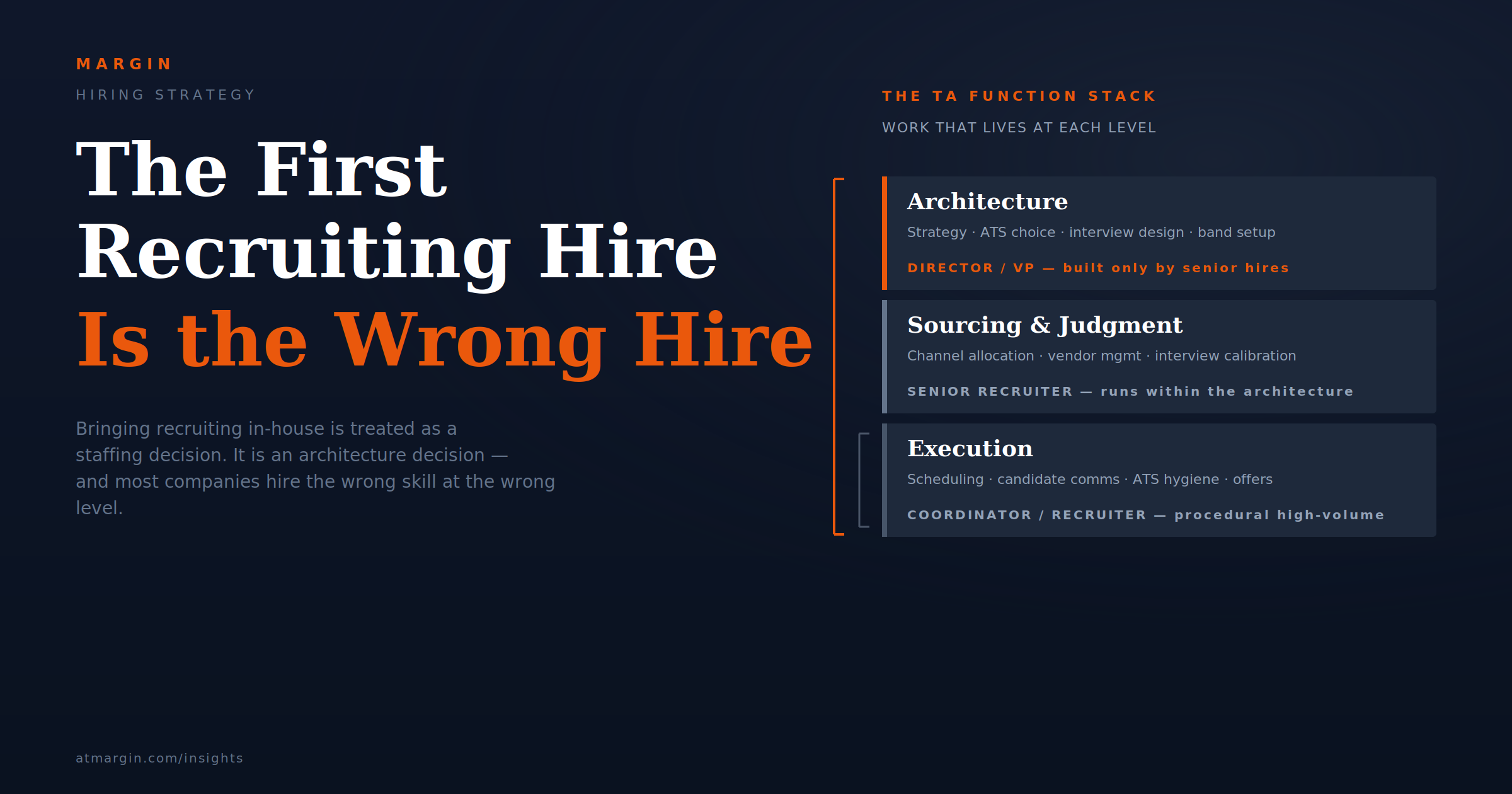
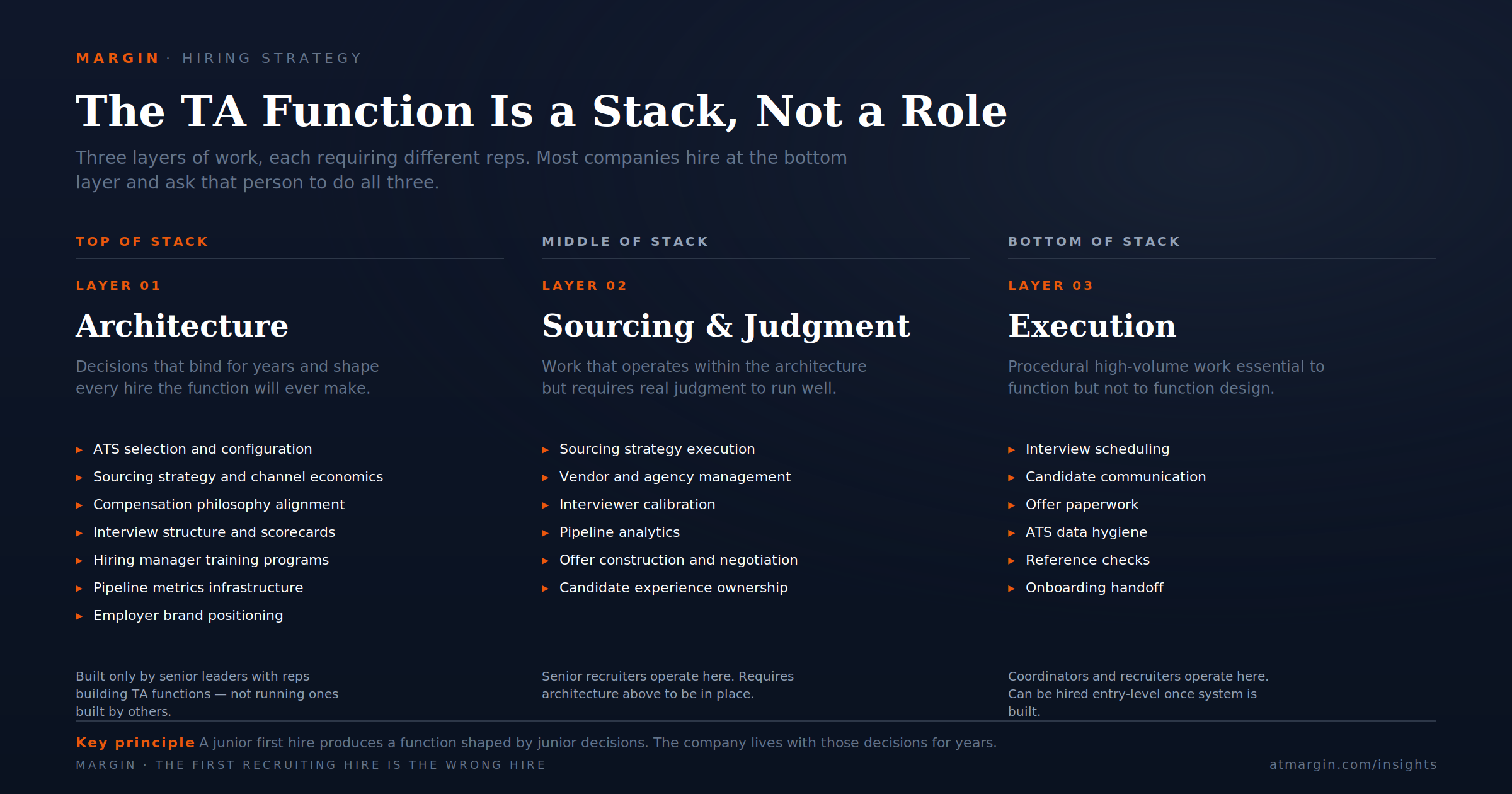
A recruiting function is not one job — it is a stack. At the top of the stack are decisions that bind for years: which ATS the company runs on, how requisitions get prioritized against budget, what compensation philosophy guides offers, which channels the company sources from, how interviews are structured, how candidates are evaluated, how the employer brand gets positioned, how forecasting feeds into headcount planning. These decisions sit upstream of every hire the function will ever make. Get them wrong, and every hire the function produces is suboptimal. Get them right, and a moderately talented recruiter can run the system at scale.
Below the architecture sit two layers of execution. The middle layer (sourcing strategy, vendor management, interviewer calibration, pipeline analytics) operates within the architecture but requires real judgment to run. The bottom layer (scheduling, candidate communication, offer paperwork, ATS data hygiene) is procedural and high-volume.
Most companies hiring their first TA person hire from the bottom of the stack to fill the top. They hire a coordinator and ask them to make architecture decisions. Or they hire a recruiter who has spent eight years executing within other companies' architectures and has never built one.
The mismatch is not about effort or intelligence. It is about reps. A recruiter with a strong track record at a company with a mature TA function has spent zero hours making architecture decisions. The company that made those decisions made them five or ten years before the recruiter was hired.
A CHRO at a 600-person biotech company described inheriting a recruiting function that had been built three years earlier around a recruiter who had been promoted to manager and then to senior manager as headcount grew.
"The function looked fine on paper. We had two recruiters and a coordinator. We were filling roles. But every time we tried to scale — open a new region, change our compensation philosophy, run a structured panel for a senior hire — the whole thing shook. There was no foundation. We were running searches on top of three years of accumulated improvisation."
Her first quarter in the role was spent rebuilding the foundation while the function continued to operate.
"I had to keep the team functional while telling them most of what they had built had to come down. That is not a fun conversation to have repeatedly."
The pattern is consistent enough to be diagnostic. The cost shows up in three places.
First, in the senior hire that eventually has to be made anyway — usually a Director or VP of Talent Acquisition who arrives, assesses, and concludes that the function needs to be rebuilt.
Second, in the political cost of either replacing or working around the original hire, who has typically built relationships with hiring managers and accumulated institutional credibility.
Third, in the search-by-search cost of running an immature function: longer time-to-fill, higher offer rejection rates, weaker candidate quality, internal hiring manager frustration, and the soft cost of leadership attention absorbed by recruiting issues that should have been engineered out at the architecture stage.
There is a useful name for this dynamic. Call it the operator-first error: hiring someone whose skill set is limited to operating an existing process, when the function needs someone capable of running the process and building it at the same time.
The error is not that operators come before architects in the org chart. The error is that the first hire has to be both — and most companies hire someone who can only be one. A senior recruiting leader can fill reqs and build the function in parallel. A junior recruiter can fill reqs on top of whatever infrastructure happens to exist.
When that infrastructure is mature, the junior hire is a fine choice. When it doesn't exist yet, the junior hire works through the open reqs while improvisation accumulates underneath them, and an architect has to come in later to dismantle what got built by default.
The error has a price tag, and most companies pay it without ever connecting the bill to the original decision — what amounts to a rebuild premium of one senior hire, eighteen months of suboptimal recruiting decisions, and the political cost of dismantling work that loyal employees built in good faith.
The Architecture-First Hire
The corrective is straightforward in concept and harder to execute organizationally. The first recruiting hire should be the most senior recruiting hire the company will need within its current planning horizon.
For most companies hiring 30 to 100 people a year, that is a Director of Talent Acquisition with seven to ten years of experience that includes building or substantially rebuilding a TA function — not running one that someone else built.
For companies hiring 100 or more, it is a VP. For companies hiring fewer than 30, it is a fractional TA leader running on a defined engagement until volume justifies the full-time hire.
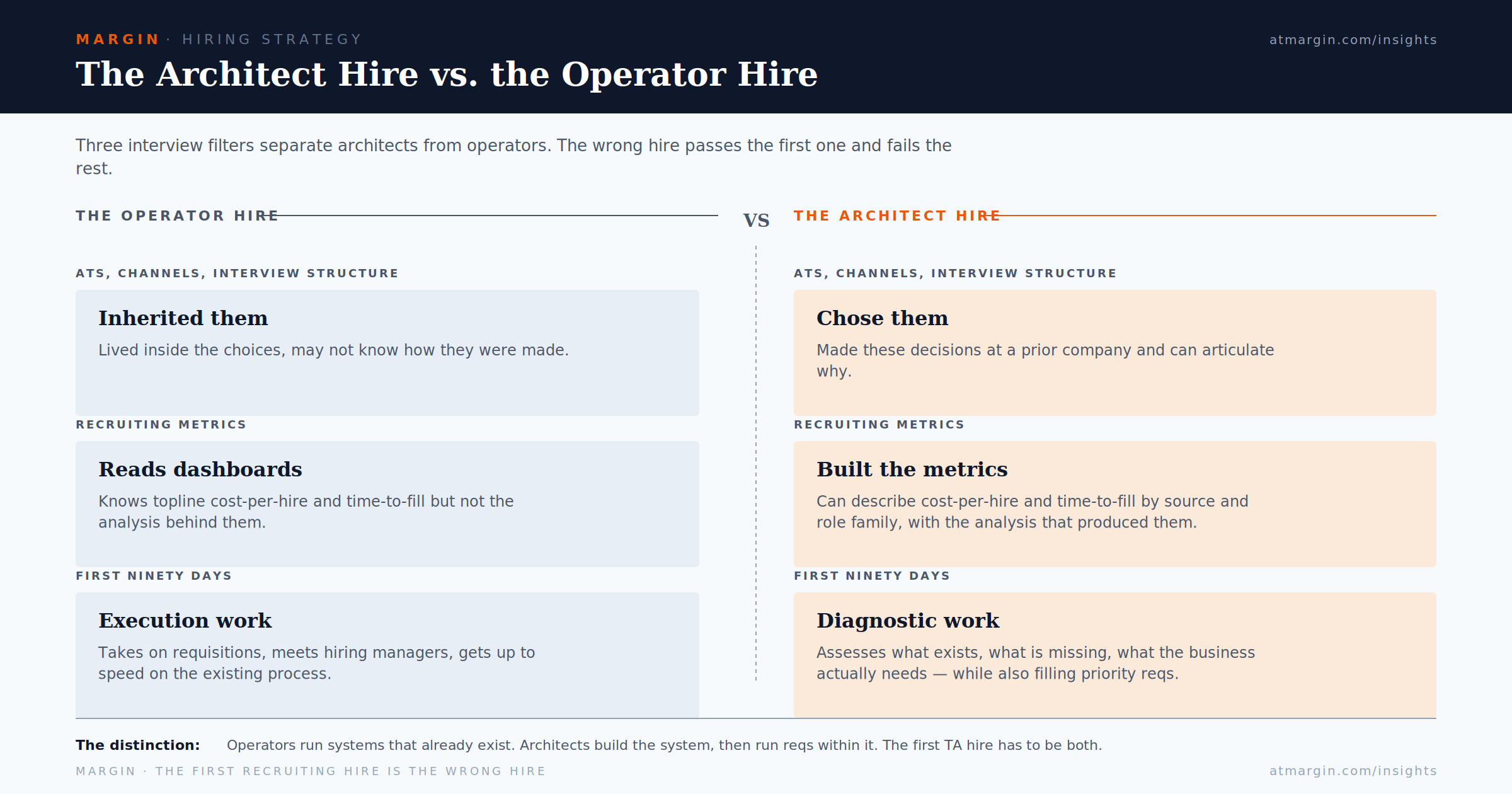
Three filters separate architects from operators in interviews.
The first is whether the candidate has chosen the ATS, sourcing channels, and interview structure at a previous company, or inherited them. Architects have made these choices and can articulate why. Operators have lived inside the choices and may not know how they were made.
The second filter is whether the candidate can describe cost-per-hire, time-to-fill, and offer acceptance rates at the function they ran, with breakdowns by source and role family — not the topline numbers, but the analysis that produced them. Architects build the metrics. Operators read the dashboards.
The third filter is the candidate's first ninety days as described in the interview. Architects describe diagnostic work — assessing what exists, what is missing, what the business actually needs. Operators describe execution work — taking on requisitions, meeting hiring managers, getting up to speed. Both answers are correct in different contexts. Only one is correct here.
The first 90 days.
Once the senior hire is in seat, the first ninety days do two jobs in parallel. The Director runs the priority requisitions (usually the critical or senior roles whose difficulty justified bringing recruiting in-house in the first place) and simultaneously builds the recruiting strategy, the ATS configuration, the sourcing channel allocation, the interview calibration framework, the hiring manager training program, and the metrics infrastructure.
The pace on requisitions is slower than it would be at steady state. That is the trade, and it is the correct one. A junior recruiter at half the cost would run reqs faster in those first ninety days and build none of the infrastructure underneath, which is exactly the choice most companies make and exactly the choice that produces the rebuild eighteen months later.
Beyond 90 days.
As volume grows past what one person can carry, the next hires fill in below. A senior recruiter to run searches against the architecture. A coordinator to handle the procedural layer. The Director gradually shifts from doing both jobs to managing the system the operators now run, and adds capacity below them as hiring demand expands. The build-out produces a function that scales linearly with headcount instead of one that has to be rebuilt every time the company crosses a growth threshold.
This is the architecture-first principle, and it contradicts the staffing logic that governs most other early hires. Companies usually start junior and add seniority as scale demands it, because in most functions the first hire's contribution is bounded by their personal output.
The first software engineer can be junior because there is little code to maintain and the first hire's contribution is limited to the code they personally write. The first TA hire is different. Their personal output, the reqs they close, is only half the role. The other half is the function they build underneath those reqs, and the second half is what a junior hire structurally cannot deliver. A junior first hire in TA produces a function shaped by improvisation, and the company lives with that improvisation for years.
What the Architecture-First Hire Demands
Adopting the architecture-first principle requires four things from the executive team, and each of them cuts against the institutional reflexes that produce the operator-first error.
Comfort with a Senior Hire With Slower Velocity
The first requirement is comfort with a senior hire whose velocity in the first six months looks lower than what a junior hire would deliver on reqs alone. The Director of TA fills priority requisitions from day one, but at a slower pace than a recruiter who does nothing else, because they are also building the system underneath those reqs.
The CFO and CEO have to internalize that the deliverable is two things — hires plus infrastructure — and that the second deliverable is what makes the first deliverable repeatable. This is uncomfortable for executive teams who measure progress in filled seats per week. It is also the only configuration that produces a function capable of filling seats reliably at scale.
Budget to Support Top-Loading
The second requirement is a budget structure that supports a top-loaded org chart. A Director of TA at $120,000 to $180,000 base costs more than a recruiter at $70,000 to $90,000, and at companies with heavy requisition volume during the build phase, contract sourcing support may be needed to handle peak load while the system gets built.
Most early-stage finance leaders, looking at the line items, will push back. The pushback is correct in math and wrong in economics. The senior hire's first-year cost is higher. The function the senior hire builds is dramatically cheaper to run at scale, and produces hires of materially better fit. The CFO who optimizes for the first six months underwrites the rebuild that follows year two.
Executive Backing
The third requirement is hiring manager willingness to be coached. An architect builds an interview structure, calibration system, and scorecard methodology that hiring managers will be required to use. Some hiring managers, particularly senior ones who have hired through their careers using their own judgment, will resist.
The architect's effectiveness depends on executive backing for the new system. Without it, the architecture exists on paper while hiring managers run their own processes underneath, and the function reverts to improvisation. The CEO and CHRO have to be willing to enforce the framework against the seniority of their own peer hiring managers.
Reporting Structure
The fourth requirement is a reporting line that reflects strategic importance. TA functions buried under HR Operations, reporting up through a benefits or compliance leader, signal to the organization that recruiting is a cost center. TA functions reporting to the COO or directly to the CHRO signal that talent acquisition is a capital allocation function.
The architect needs the latter signal to operate effectively. They are making decisions (sourcing channel allocations, comp positioning, interview standards) that have direct revenue implications. A reporting line that obscures this produces a function that is structurally constrained from operating at the level the company actually needs.
These four requirements produce a TA function that is meaningfully different from the one most companies build by default. It is more expensive in year one and dramatically less expensive thereafter. It produces hires that are higher quality, faster, and at lower long-term cost-per-hire. It scales.
The function the operator-first error produces does none of these things, and the rebuild premium — when the bill arrives — costs more than the architecture-first hire would have, with eighteen months of compounding suboptimal hires baked into the total.
The Sequencing Decides Everything
The companies that make the senior hire build TA functions that scale with the business. The companies that hire the junior one — the recruiter who can run reqs but cannot build the system underneath them — pay for the rebuild later, in cash, in political capital, and in the hires they should have made and didn't.