
Your TA Function Has Been Rewritten
The TA function CHROs and CFOs think they are funding has been silently replaced by a different function with the same name. The metrics, budgets, and KPI architecture still describe the old one — and the team running the new one is being measured against work that no longer exists.
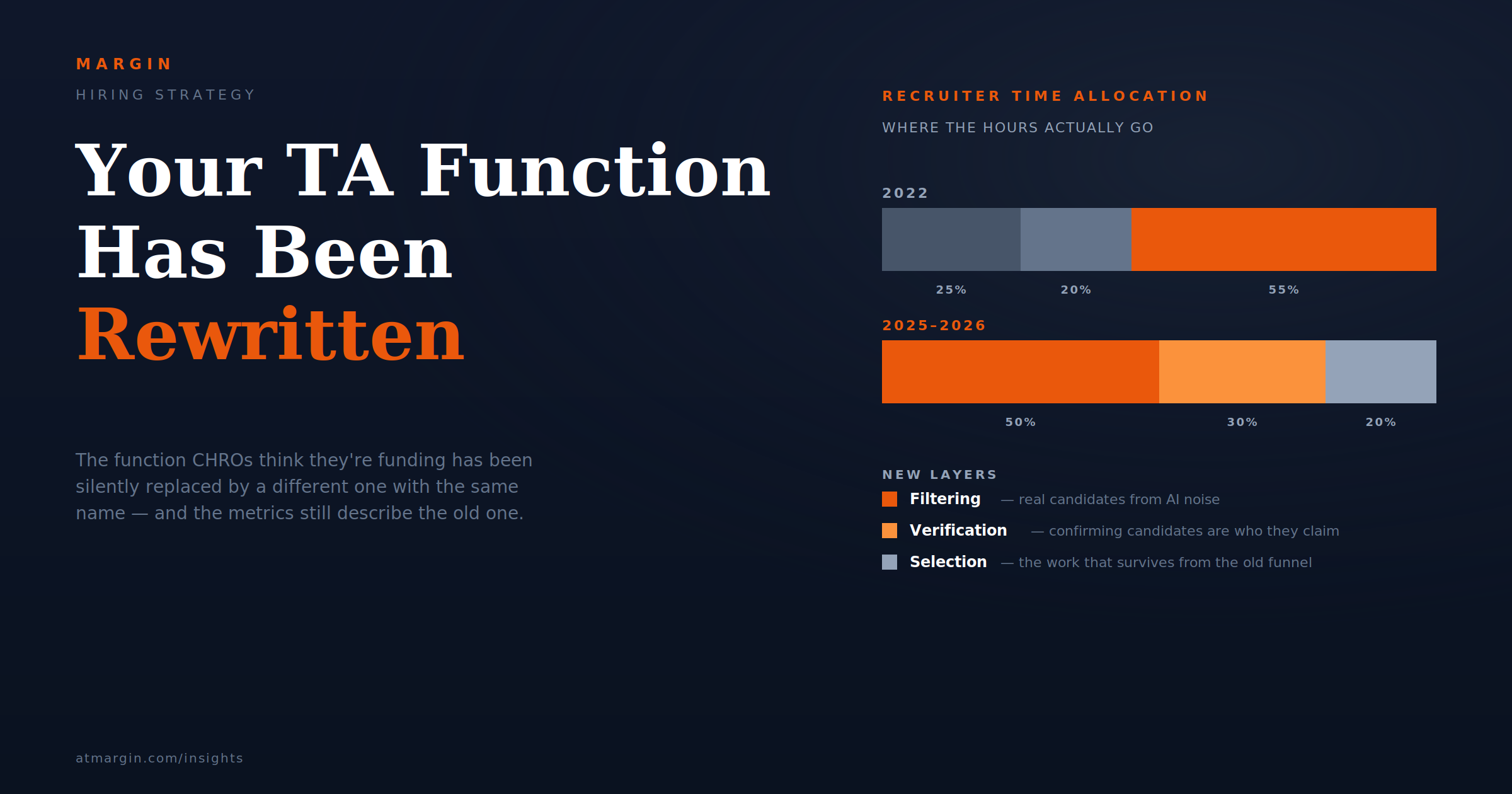
A recruiter at a mid-market industrial distributor opens her queue Monday morning. The Director of Operations requisition has been live for ten business days and currently sits at 96 applications. Two years ago, the same role at the same company would have drawn closer to 30 across the same window. Her time-to-fill targets, set in 2022, have not changed. Her headcount has not changed. The 96 applications include, by her best estimate after eighteen months of pattern recognition, roughly 22 candidates who genuinely meet the role specifications. The other 74 are AI-generated, application-bot-submitted, generically tailored, or fraudulent. Most look fine on first scan. That is the point.
This is the function the company is funding. It is not the function the company thinks it is funding.
The TA function that existed in 2021 — sourcing qualified candidates, screening for fit, presenting shortlists to hiring managers, optimizing time-to-fill — has been silently replaced by a different function with the same name. The new function spends most of its hours filtering AI-generated noise from genuine candidate signal.
It runs forensics on resumes that no longer correspond to real careers. It engineers interviews that AI assistants cannot complete in real time. It verifies identities that fraud rings now manufacture at scale. The metrics that govern the function — time-to-fill, cost-per-hire, applications-per-hire — were built for the old function and describe the new one inaccurately at every measurement point. The TA team is being assessed against work that no longer exists, while doing work that nobody is measuring.
The Funnel That Stopped Producing Signal
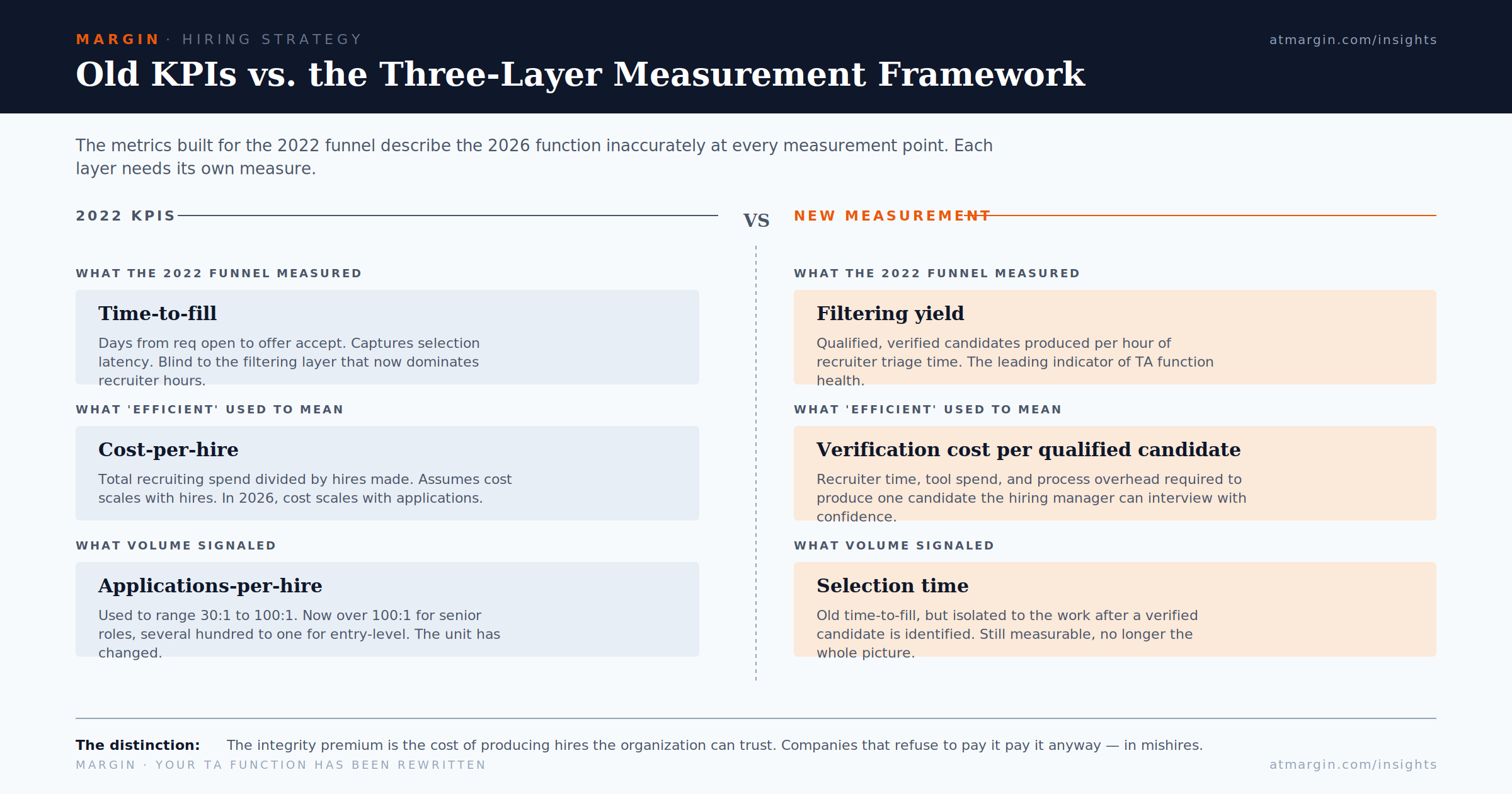
Three KPIs run TA in most organizations: time-to-fill, cost-per-hire, and applications-per-hire. Each was built on a structural assumption that no longer holds.
Time to Fill
Time-to-fill measures days from requisition open to offer accept. The metric assumes that the bottleneck in producing a hire is the speed of moving candidates through interview stages. In 2022, that was approximately true: the slow steps were scheduling, hiring manager calibration, and offer negotiation. The fast step was identifying which candidates merited interviewing.
In 2026, the bottleneck has reversed. The slow step is identifying which of the hundred applications on a given req represent real, qualified, non-fraudulent candidates — and doing it across every active req at once. The fast step, once you have a real candidate, is moving them through a process most companies have already optimized.
Time-to-fill captures the second half. It does not capture the first half. A team in 2025 filtering 100 applications per role down to 20 real ones to find 5 worth interviewing takes longer than a team in 2022 sorting 30 applications down to 8 worth interviewing — and the 2022 team's time-to-fill, on the same metric, looks better.
Cost per Hire
Cost-per-hire measures total recruiting spend divided by hires made. The metric assumes recruiting cost scales with hires. In 2022, that was approximately true: more hires required more recruiter time, more sourcing tool licenses, more agency fees.
In 2026, recruiting cost scales with applications, not hires. A function with the same headcount and the same hiring volume now spends materially more time per hire because of the filtering work — but the additional time produces no additional hires. Cost-per-hire goes up while function output stays flat or declines, and the metric reads as recruiter inefficiency.
Applications per Hire
Applications-per-hire was the historical efficiency metric: how many candidates does the funnel need to produce one hire? It used to range from 30:1 to 100:1 depending on role. Industry benchmarks now put the average corporate posting around 250:1, with senior and specialized roles running somewhat lower and high-visibility or entry-level roles often running several hundred to one.
The number is not measuring the same thing anymore. In 2022, an application was a signal of interest from a real person. In 2026, an application is a signal of one minute spent by a bot or one ChatGPT prompt entered by a candidate spraying applications across hundreds of postings. Counting applications across years as if they are comparable units produces ratios that look catastrophic and management responses that misdiagnose the cause.
The CHRO presenting these metrics to a CFO is reporting on a function that no longer exists. The CFO making capital allocation decisions based on these metrics is funding the wrong work. Both are operating on shared documentation of a function that was silently rewritten between them.
The Arms Race Underneath
If you have not sat with a recruiter for an afternoon in the last six months and watched the work, you have not seen the function you are funding. Here is what the work looks like.
“The function the team is running is not “source candidates and present them to hiring managers” — it is a forensics operation against an industrial-scale fraud and noise economy.”
A candidate's application arrives. The resume is well-written, formatted cleanly, and uses the exact phrasing from the job description. It claims six years at three companies. The recruiter pastes the candidate's name into LinkedIn — no profile, or a profile created last month. She searches the previous employers. The titles claimed do not match the company's career page. She moves on. Three minutes spent. Dozens more applications wait on this req alone, and she is covering six other open roles this week.
The next application looks legitimate. LinkedIn matches. Career history checks. The recruiter schedules a phone screen. The candidate dials in from a setting that looks like a home office. Their answers are slightly delayed, slightly over-formed, slightly too aligned with the job description's exact language.
The recruiter has learned the tells: real candidates pause and revise; AI-coached candidates produce paragraphs. She asks an unanswerable question — something the candidate's resume could not have prepared them for. The pause is too long. The answer arrives slightly more general than the others. She is fairly sure the candidate is reading from an AI assistant on a second screen. She is not certain. Certainty is harder to come by every quarter.
A take-home assessment goes out — a written analysis of a hypothetical operations problem. The candidate returns it in two hours, perfectly formatted, with structure and phrasing that read like polished consulting deliverables. The recruiter forwards it to the hiring manager.
The hiring manager reads it and says the analysis tracks every standard textbook framework, the recommendations are reasonable but generic, and the writing has the cadence ChatGPT favors. They suggest a live walk-through, where the candidate has to talk through the same problem in real time. The recruiter schedules it. The candidate declines to be on video. The recruiter asks why. The candidate withdraws.
This is one afternoon. Multiply it by every application in the queue, every recruiter on the team, every open requisition. The function the team is running is not "source candidates and present them to hiring managers." It is a forensics operation against an industrial-scale fraud and noise economy. The forensics operation requires expertise that did not exist in the role description three years ago — pattern recognition for AI writing, verification workflow design, identity fraud detection, interview format engineering, hiring manager training on AI-augmented candidate behavior.
A VP of Human Resources at a 1,500-employee multi-state distributor described the shift this way:
"I have one recruiter whose entire job, effectively, is verification. She is not sourcing. She is not screening for fit. She is confirming that the candidates the rest of the team is interviewing are real people with real backgrounds. We did not budget for that role. We did not write a job description for it. The work walked into the function and we absorbed it because the alternative was hiring people who were not who they claimed to be. My CFO sees a TA team that has not added headcount and has slower time-to-fill. He is partially right and entirely missing the point."
The arms race framing is not metaphorical. Every detection technique the recruiting team adopts gets countered within a quarter. Better resume screening produces better resume generators. Stricter interview formats produce more sophisticated real-time assist tools.
Verification steps produce identity-fraud-as-a-service offerings. The team is escalating against a counterparty that is also escalating, and the counterparty has lower marginal costs. A candidate-side AI tool costs the candidate twenty dollars a month. A recruiter-side detection tool costs the company an enterprise license, training time, false-positive risk, and the recruiter's hours spent learning it.
The asymmetry is structural, and it does not favor the function being funded. The TA team is absorbing it by working harder, working longer, and looking worse on every dashboard the executive team has been trained to read.
Measuring the Function That Actually Exists
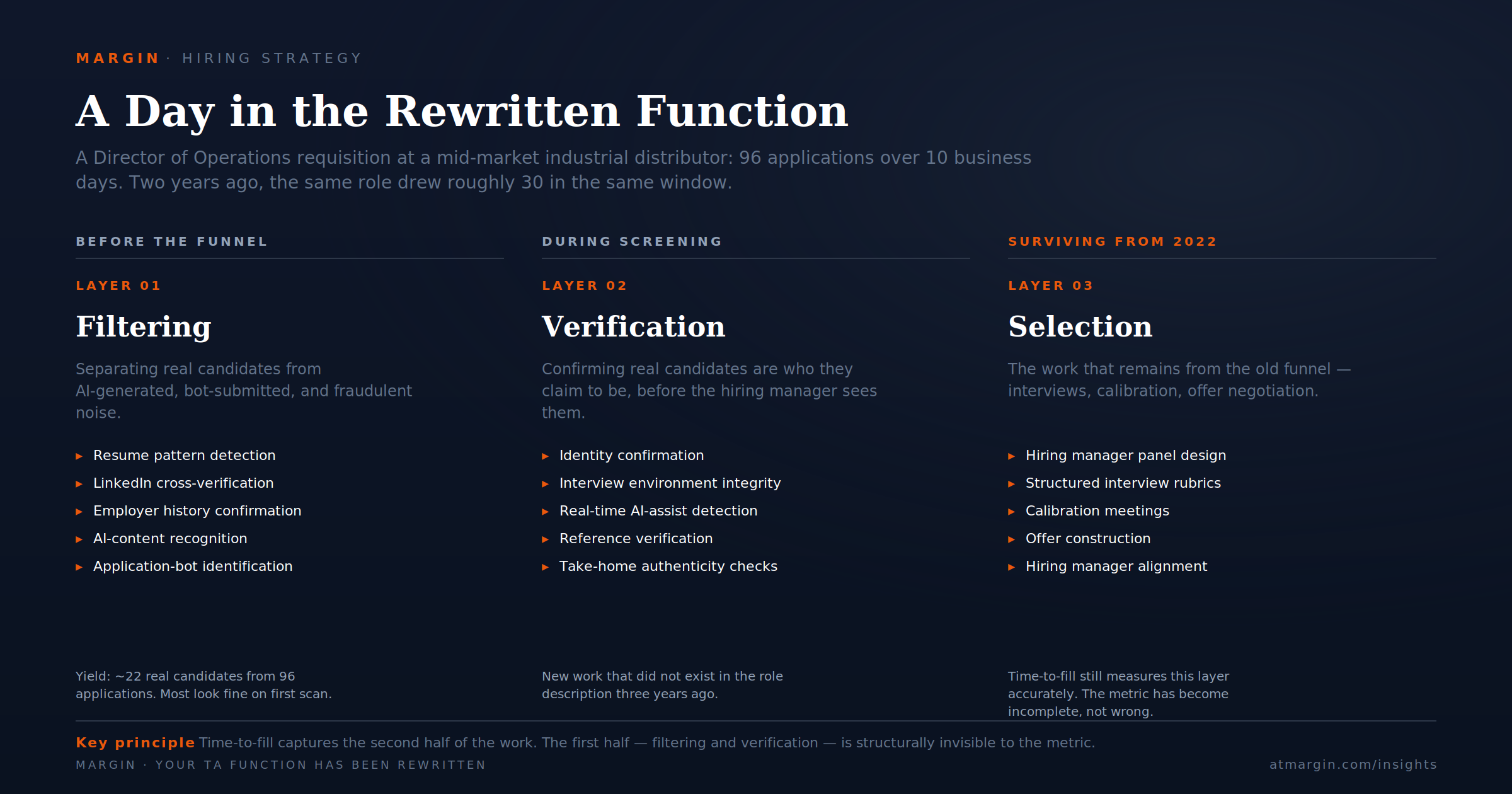
The corrective is to stop measuring TA against the funnel that no longer produces signal and to build a measurement architecture for the function the team is actually running. This requires distinguishing among three layers of work that the old metrics collapsed into one.
Filtering
The first layer is filtering: separating real candidates from AI-generated, fraudulent, or bot-submitted noise. This is the layer that has expanded most dramatically and is least visible in current metrics. The right measure is filtering yield — qualified, verified candidates produced per hour of recruiter time spent triaging applications.
In 2022, this number was implicit in time-to-fill because filtering was cheap. In 2026, filtering yield is the leading indicator of TA function health, and most companies do not measure it.
Verification
The second layer is verification: confirming that real candidates are who they claim to be — that the resume corresponds to actual experience, that the person on the Zoom call is the same person who completed the assessment, that the references provided are not fabricated.
The right measure here is verification cost per qualified candidate: how much recruiter time, tool spend, and process overhead is required to produce one candidate the hiring manager can interview with confidence. This is a new line item. Most companies have not budgeted for it because the work was not visible until recently.
Selection
The third layer is selection: the work that remains from the old funnel — interviewing, calibration, hiring manager alignment, offer negotiation. This layer still exists, and time-to-fill still measures it accurately. But it now represents a smaller share of total recruiter hours than it did three years ago. The metric has not become wrong; it has become incomplete.
Call this the three-layer measurement framework: filtering, verification, selection. Each layer has its own bottlenecks, its own tools, its own cost structure, and its own target metrics. A TA function being managed against a single composite KPI — time-to-fill, cost-per-hire — is being managed against a flattened picture of work that has structurally separated into three distinct functions.
The implication for executives is that the dashboards have to change. Reporting that tracks filtering yield, verification cost, and selection time as three separate streams produces a much clearer picture of where the function is actually constrained — and where additional headcount, tooling, or process investment will produce returns.
Reporting that maintains the composite metrics produces the diagnostic ambiguity the function has been operating under: slower time-to-fill, higher cost-per-hire, no clear answer to what is causing it, and a TA leader who cannot explain to the CFO why the numbers look the way they do without sounding like they are making excuses.
There is a financial dimension worth naming. The cost of running the rewritten function is structurally higher than the cost of running the 2022 function, and the higher cost is not waste — it is the integrity premium, the price of producing hires the organization can trust. Companies that refuse to pay it do not save money. They absorb the cost in a different form: bad hires that pass screening but fail in role, fraud incidents that emerge post-hire, hiring manager time wasted on candidates who were never real, and the slow erosion of confidence in the TA function's output. The premium is paid one way or the other. The question is whether it is paid visibly, on the budget line, or invisibly, in mishires and rework.
Funding the Function You Actually Have
Adopting the rewritten function requires four changes from the executive team that has been funding the old one.
Scaling Headcount Budget with Applications, Not Reqs
The first change is headcount budget that scales with application volume, not hire volume. The historical staffing model — one recruiter per X open requisitions — assumes recruiter capacity is consumed by reqs. It is now consumed by applications.
A team filtering 50,000 applications a year against 200 hires needs different staffing than a team filtering 8,000 against the same 200, and the difference is not made up by tooling. CFOs and CHROs accustomed to scaling TA headcount against hiring forecasts will find that the forecasts no longer predict the workload. A reframe is required: TA headcount scales against application volume, with hire volume as a secondary input.
Tooling Budgets for Verification
The second change is a tooling budget for verification, separate from the existing budget for sourcing. Sourcing tools — LinkedIn Recruiter, applicant tracking systems, job board licenses — were built for the function's outbound work.
Verification tools — identity confirmation services, AI-content detection, video interview integrity platforms, reference verification automation — were not standard line items three years ago. Most companies are funding verification work out of recruiter time because the tools are not on the budget. Moving the spend onto the budget is more expensive in line-item visibility and less expensive in total cost than absorbing it through headcount.
Interview Process Redesign
The third change is interview process redesign authority — the explicit authority to move from take-home assessments to live problem-solving, from unstructured Zoom calls to verified-environment interviews, from reference-letter reliance to active reference verification.
These changes will, in some cases, lengthen the interview process and reduce the volume of candidates the function can move through it. The decision is whether that trade-off is worth it.
The default answer in most organizations is no, because the cost of slower hiring is visible and the cost of bad hires from compromised interviews is invisible. Reversing that calculus is a senior executive decision, not a TA decision, and the TA team needs explicit authority to make the redesigns the calculus implies.
Training on AI-Augmented Candidate Behavior
The fourth change is hiring manager training on AI-augmented candidate behavior. Hiring managers who learned to interview before 2023 developed instincts calibrated to candidates who were not coached in real time by AI. Those instincts are now systematically wrong on a meaningful subset of candidates.
A polished, articulate interview answer used to be a positive signal. It is now an ambiguous signal that may indicate strong communication or may indicate real-time AI assist. Hiring managers who have not been trained to recognize the difference are making selection decisions on degraded signal.
The TA function cannot solve this without hiring manager partnership; the hiring managers cannot recognize they need partnership without training.
These four changes do not solve the arms race. The arms race is not solvable by the TA function in isolation, and pretending otherwise is what produces the burnout currently being absorbed quietly across the function.
What the four changes do is restructure the function so it can compete in the arms race with the budget, tooling, and authority appropriate to the work — instead of competing against AI-augmented adversaries with 2022 metrics, 2022 headcount, and 2022 tools, while the dashboards in the boardroom describe a problem the team has not been working on for years.
The Function and the Reality
The companies that recognize the rewriting will rebuild the metrics, the budgets, and the org structure around the function that exists. The companies that defend the old metrics will keep measuring an obsolete funnel — and watch their TA teams burn out.